ZoomInfo vs Disburse for Small and Growing Sales Teams
16 min readLachlan McBride White
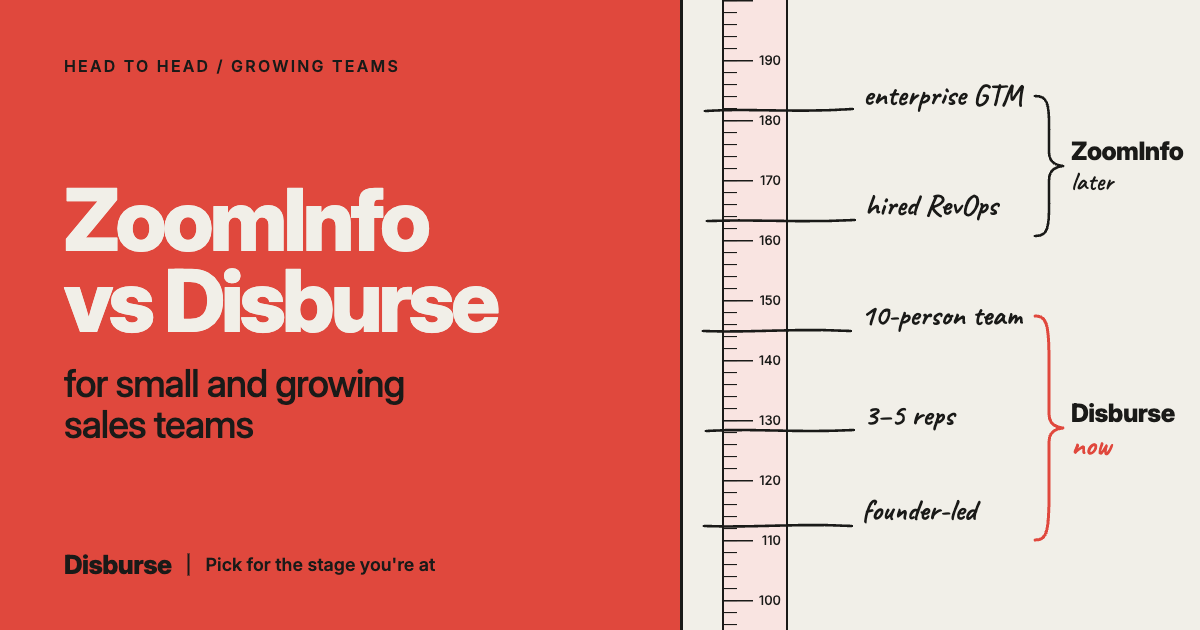
ZoomInfo and Disburse can both help sales teams find B2B prospects.
But they are built for very different stages of growth.
ZoomInfo is a broad sales intelligence platform. It combines a large B2B database with account intelligence, buyer intent, technographics, CRM enrichment, workflow automation and other go-to-market tools.
Disburse is more focused.
It helps teams describe the companies and people they want to find, retrieve the relevant contact and company data, and use that information inside the sales tools they already prefer.
The short answer: For small and growing B2B sales teams that mainly need prospect data, Disburse is likely the better fit. It is simpler to adopt, easier to scale and transparent on pricing.
ZoomInfo is stronger for larger or more mature revenue teams that need deeper account intelligence, CRM enrichment, buyer intent and enterprise GTM infrastructure.
ZoomInfo vs Disburse at a glance
Disburse
Best for: Small and growing teams mainly needing B2B dataB2B contact data: YesCompany data: YesBusiness emails: YesDirect/mobile numbers: YesLinkedIn URLs: YesNatural-language prospecting: Core experienceFirmographic data: YesTechnographic data: Not a core featureBuyer intent: Not a core featureWebsite visitor intelligence: NoCRM enrichment: External workflowsREST API: YesMCP / AI workflows: YesSetup complexity: LowPricing: Transparent self-serve plansAnnual commitment: NoTeam scaling: Up to 5 users on Growth, unlimited on ScaleBest approach: Add prospect data to your existing stack
ZoomInfo
Best for: Mid-market and enterprise revenue teamsB2B contact data: YesCompany data: YesBusiness emails: YesDirect/mobile numbers: YesLinkedIn URLs: YesNatural-language prospecting: AI-assisted capabilitiesFirmographic data: ExtensiveTechnographic data: YesBuyer intent: YesWebsite visitor intelligence: YesCRM enrichment: Extensive native enrichmentREST API: YesMCP / AI workflows: API and AI integrationsSetup complexity: HigherPricing: Quote-basedAnnual commitment: Common in enterprise contractsTeam scaling: Commercial terms vary by contractBest approach: Build deeper GTM workflows around the platform
What does a small or growing sales team actually need from a B2B data platform?
A small or growing sales team usually needs to do four things well:
Define the right target market.
Find the right people inside those companies.
Retrieve usable contact details.
Move those leads into a repeatable sales process.
The challenge is that many enterprise sales intelligence platforms are built around much broader needs.
A ten-person sales team may not need:
Enterprise CRM data governance
Complex account orchestration
Advanced technographic intelligence
Large intent-data programmes
Sophisticated RevOps workflows
Multiple layers of sales infrastructure
It may simply need:
“Find the companies we should sell to and the people we should contact.”
That difference matters when comparing ZoomInfo and Disburse.
Why might Disburse suit a small or growing team?
Disburse is designed to remove friction from prospect discovery.
A salesperson, founder or marketer can describe the audience they want to reach in plain English.
For example:
“Find founders of Australian B2B SaaS companies with 10–100 employees.”
Or:
“Find Heads of Sales at Singaporean software companies with 50–200 employees.”
Or:
“Find CFOs at New Zealand manufacturing businesses with A$20 million to A$100 million in revenue.”
Disburse interprets the request and returns matching people and companies.
That can be especially useful for growing teams because there is less setup between deciding on an ICP and getting a usable list.
Why might ZoomInfo suit a growing sales team?
ZoomInfo becomes more attractive as a sales organisation becomes more complex.
A growing team may eventually need more than contact data.
It may want to know:
Which accounts are showing buyer intent?
Which technologies are they using?
Which companies are visiting the website?
How should accounts be prioritised?
How should CRM records be enriched?
Which accounts fit different territories or segments?
ZoomInfo is designed for this broader type of go-to-market intelligence.
Its platform includes deep firmographic data, technographics, intent signals, org information, enrichment and workflow tools.
For a company that has reached the point where prospecting is only one part of a larger revenue-operations problem, that depth can be valuable.
Which is easier to adopt?
For a small or growing sales team, Disburse is generally easier to adopt for straightforward prospecting.
The workflow is simple:
Describe the ICP → search → retrieve the data → use it elsewhere.
There is less need to configure a large sales intelligence platform before the team can start getting value.
ZoomInfo offers much more functionality.
That naturally creates more complexity.
This does not make ZoomInfo difficult for the wrong reasons. Its wider feature set exists because larger teams need more control and context.
But for a team that simply wants to start finding prospects quickly, Disburse provides a shorter path.
Which is better for founder-led sales?
Disburse has a strong use case for founder-led sales.
Founders often know their ideal customer very well.
They may be able to say:
“Our best customers are Australian recruitment firms with 20–100 employees, and the founder usually makes the buying decision.”
The hard part is not defining the ICP.
It is finding the actual companies and decision-makers.
Disburse is designed around that problem.
A founder can turn the target description directly into a prospect search without needing to learn a more complex sales intelligence platform.
ZoomInfo can become more useful later, when the business has a larger sales team, more mature CRM infrastructure and a need for deeper account intelligence.
Which is better for a three-to-five-person sales team?
For a three-to-five-person team mainly needing B2B data, Disburse is likely to be the more practical option.
Its Growth plan costs A$20/month, includes 5,000 credits per month and supports up to five team members.
That means a small team can share one subscription rather than paying for multiple seats.
Disburse Scale costs A$99/month, includes 50,000 credits per month and supports unlimited team members.
ZoomInfo does not publish a simple self-service SalesOS price list.
It is generally sold through custom commercial agreements.
That fits its positioning toward larger and more complex revenue organisations.
The pricing difference matters, but the bigger difference is that Disburse is easier to trial, adopt and scale without a major commercial commitment.
Which is better as the sales team grows?
This depends on how the sales operation grows.
There are two common paths.
Path 1: the team keeps specialised tools
A company may already use:
HubSpot or Salesforce
A dedicated outbound platform
A dialler
AI tools
Sales automation
Internal workflows
In this model, Disburse can continue to act as the prospect-data layer.
The sales stack grows around it.
Path 2: the company centralises more GTM activity
A larger organisation may want one intelligence platform deeply connected to:
CRM
Account scoring
Enrichment
Buyer intent
Website activity
Territories
RevOps workflows
In this model, ZoomInfo becomes more attractive.
So the real question is not:
“Which tool scales better?”
It is:
“What kind of sales stack do we want as we scale?”
Which is better for APAC-focused teams?
For APAC-focused growing businesses, flexibility across markets can be especially important.
A team may prospect across:
Australia
New Zealand
Singapore
Hong Kong
Japan
Malaysia
Indonesia
The Philippines
Other Asia-Pacific markets
Disburse makes it easy to describe those audiences directly.
For example:
“Find founders of B2B SaaS companies in Australia, New Zealand and Singapore with 10–100 employees.”
Or:
“Find senior sales leaders at fintech companies in Singapore and Hong Kong.”
Or:
“Find Managing Directors of Australian and New Zealand engineering consultancies with 20–200 employees.”
That makes it easy for growing teams to test different APAC markets without rebuilding a complex prospecting setup.
ZoomInfo has broad global coverage and deeper enterprise intelligence.
But APAC teams should still test actual provider coverage against the countries, industries and job titles they care about.
Global database size alone does not tell you how strong regional coverage will be.
Which is better for experimenting with new ICPs?
Disburse is particularly well suited to experimentation.
Searching is unlimited.
That means a growing team can test different ICP ideas before using credits to retrieve leads.
For example, an Australian SaaS company could compare:
“Founders of recruitment agencies with 20–100 employees.”
Against:
“Heads of Operations at logistics companies with 100–500 employees.”
Against:
“Sales Directors at Singaporean software companies with 50–200 employees.”
This is useful for businesses still refining their go-to-market strategy.
ZoomInfo can also support advanced segmentation.
But it becomes more valuable when the organisation already has mature processes around account selection and prioritisation.
Which is better for building targeted lead lists?
For straightforward list building, Disburse is likely to be easier.
It can search using criteria such as:
Title
Seniority
Job function
Industry
NAICS
Revenue
Employee count
Geography
Company specialties
Email availability
Phone availability
A user can combine those criteria naturally in a search request.
For example:
“Find Heads of Marketing at Australian ecommerce businesses with 50–500 employees and a business email.”
ZoomInfo offers broader sales intelligence around those lists.
If the target also depends on technologies, buyer intent, website activity or more complex account signals, ZoomInfo has the stronger toolset.
Which is better for AI-driven prospecting?
Disburse is especially relevant for growing teams building lightweight AI-assisted sales processes.
It provides REST and MCP access.
This allows B2B data to be used inside:
AI assistants
Agents
Internal applications
Automated workflows
Custom sales tools
The team does not have to move its entire workflow into Disburse.
The data can be requested and used elsewhere.
ZoomInfo also supports APIs, automation and AI across its wider GTM ecosystem.
For a complex enterprise workflow, that can be more powerful.
For a growing team that simply wants AI to retrieve B2B data, Disburse is more focused.
Which is better for teams already using HubSpot or Salesforce?
Disburse is compelling when the company already has a CRM and likes the rest of its stack.
In that situation, the team may not need another broad GTM platform.
It may simply want:
better prospect data feeding into the systems it already uses.
Disburse can provide that data and let the business control the downstream workflow.
ZoomInfo is stronger when the organisation wants deeper CRM enrichment and data management.
For larger Salesforce or HubSpot deployments, this can be a major advantage.
So:
Disburse works well alongside an existing stack.
ZoomInfo can become deeply embedded inside a mature GTM stack.
Which is better when you do not have a RevOps team?
For teams without dedicated RevOps resources, Disburse is likely to be easier to operate.
A salesperson can focus on:
“Who are we trying to find?”
Instead of managing the setup of a broader intelligence platform.
That matters because smaller teams often have people performing several roles.
A founder may also be managing product.
A salesperson may also handle partnerships.
A marketer may help with outbound.
The value of simplicity increases when nobody owns sales operations full-time.
ZoomInfo becomes more valuable as the organisation develops the resources to use its deeper features.
Which provides better contact data?
There is no universal winner.
Data quality varies by:
Country
Company size
Industry
Job function
Seniority
Type of contact detail
ZoomInfo has an advantage in scale, maturity and breadth of account intelligence.
Disburse focuses more narrowly on returning useful contact and company records that match the user’s target.
For a growing team, the most important test is not:
“Which company has the biggest global database?”
It is:
“Which platform reliably returns the people in our ICP?”
For APAC businesses in particular, real search testing is more useful than headline global data figures.
Which is better for mobile numbers?
Disburse has a simple model:
One credit = one lead.
Mobile numbers do not cost extra credits.
That means a sales team can retrieve an available contact record without worrying that phone data will use a separate credit pool.
For teams that use both email and calling, that predictability is useful.
ZoomInfo also provides direct dial and mobile data.
But its pricing is tied to broader commercial packages rather than a simple one-lead-per-credit model.
Which is better for high-volume prospecting?
Disburse can be attractive as list volumes increase.
Current plans include:
Growth: 5,000 credits/month for A$20
Scale: 50,000 credits/month for A$99
Enterprise: Custom volume pricing
Scale also includes unlimited team members.
That means a growing sales team can increase contact volume without the cost rising every time another salesperson joins.
ZoomInfo is also built for large-scale prospecting.
But its value comes from the wider intelligence and workflow tools around the data, rather than simply low-cost contact volume.
Which is better for agencies and outsourced sales teams?
Disburse has a strong use case for small and growing agencies.
Agency prospecting needs change constantly.
One client may want:
“Founders of Australian SaaS companies with 20–100 employees.”
Another might need:
“Heads of Finance at Singaporean professional-services firms with more than 200 employees.”
A third may target:
“Managing Directors of New Zealand manufacturing businesses.”
Natural-language search makes it easier to move between those audiences.
Disburse Scale’s unlimited team members can also be useful where several agency employees need access.
ZoomInfo may be stronger for larger agencies running enterprise ABM, enrichment or intent strategies.
Which has more sales intelligence?
ZoomInfo.
This is one of the clearest differences.
ZoomInfo provides a much broader set of intelligence around accounts.
This can include:
Buyer intent
Technographics
Account signals
Website visitor intelligence
Organisational information
Enrichment
Workflow automation
If your sales process depends heavily on knowing when to contact an account and what is happening inside that account, ZoomInfo has more native capability.
Disburse is more focused on who the business should contact and providing the associated data.
Which requires less operational overhead?
Disburse.
For the core prospecting use case, there is less to configure and manage.
A small team can search, retrieve data and continue working in its preferred tools.
This can be valuable during growth because every new platform adds:
Onboarding
Configuration
User management
Workflow decisions
Integrations
Process changes
ZoomInfo’s added complexity can be justified for teams that use its deeper features.
But if those features are not being used, the extra overhead becomes harder to justify.
Which offers better value for a growing team?
For teams mainly buying prospect data, Disburse is likely to provide better value.
Current pricing is:
Free: A$0, 50 credits/month
Growth: A$20/month, 5,000 credits/month, up to five team members
Scale: A$99/month, 50,000 credits/month, unlimited team members
Enterprise: Custom
Searching is unlimited.
There is no annual lock-in.
Mobile numbers cost no extra credits.
Growth top-up credits never expire.
ZoomInfo’s pricing is generally custom and reflects a much broader enterprise product.
That can still be excellent value when the business uses the deeper intelligence.
The fair comparison is not simply:
“Which subscription is cheaper?”
It is:
“How much of the platform will our team actually use?”
When should a growing team choose ZoomInfo?
ZoomInfo is likely the better option if your team:
Is moving toward mid-market or enterprise sales operations
Needs buyer-intent data
Requires technographic intelligence
Wants advanced CRM enrichment
Needs website visitor intelligence
Has dedicated RevOps resources
Needs deeper account research
Wants to standardise GTM intelligence across a larger organisation
Is willing to make a larger platform commitment
Wants intelligence and workflow depth rather than just contact data
ZoomInfo’s greatest advantage is depth and enterprise capability.
When should a growing team choose Disburse?
Disburse is likely the better option if your team:
Mainly needs B2B contact and company data
Wants to get started quickly
Operates across APAC markets
Regularly tests different ICPs
Uses natural-language prospecting
Already has a CRM or outreach platform
Wants REST and MCP access
Uses AI in its prospecting workflows
Needs high volumes of contacts
Wants simple, predictable credits
Needs phone numbers without extra credit charges
Does not have a RevOps team
Wants to avoid enterprise-style contracts
Wants team access without expensive per-seat scaling
Disburse’s greatest advantage is helping a growing team access B2B data without requiring the rest of the company to grow into an enterprise sales platform first.
ZoomInfo vs Disburse: which is better for small and growing sales teams?
For most small and growing B2B teams whose main need is finding prospects, Disburse is likely the better fit.
It gives teams a simple way to describe an ICP, retrieve the relevant companies and decision-makers, and use that data inside the systems they already have.
Its natural-language search, APAC-friendly use cases, REST and MCP access, high data allowances and simple team structure make it well suited to businesses that want to scale prospecting without scaling software complexity at the same rate.
ZoomInfo becomes stronger as the organisation’s sales intelligence needs become more advanced.
A larger team with dedicated RevOps, complex CRM enrichment, buyer-intent programmes and enterprise account strategies can get more value from ZoomInfo’s broader platform.
The difference can be summarised simply:
Disburse helps a growing team get the prospect data it needs now.
ZoomInfo helps a mature revenue organisation build more intelligence and infrastructure around that data.
For many small and growing teams, Disburse is the more practical place to start.
Frequently asked questions
Is ZoomInfo suitable for small sales teams?
It can be.
ZoomInfo is generally better suited to teams that can use its deeper sales intelligence and enterprise features.
Small teams mainly looking for contact data may find a more focused platform easier to justify.
Is Disburse good for growing sales teams?
Yes.
Disburse is especially suited to growing teams because it combines simple prospect discovery, high contact allowances, flexible team access, REST and MCP integration and no annual lock-in.
Which is better for a five-person sales team?
For a five-person team mainly needing B2B contact data, Disburse Growth is likely to be the more practical option.
It supports up to five team members and 5,000 credits per month for A$20.
ZoomInfo may be more suitable if that team also needs deep sales intelligence and CRM enrichment.
Which is better for founder-led sales?
Disburse is particularly well suited to founder-led sales because founders can describe their ICP directly and retrieve matching contacts without adopting a larger GTM platform.
Which is better for APAC sales teams?
Disburse is particularly relevant to teams prospecting across Australia, New Zealand, Singapore, Hong Kong and other APAC markets.
Regional ICPs can be described directly in natural language.
Any provider should still be tested against the specific markets and roles the team targets.
Which is better for companies already using HubSpot?
Disburse can be a good fit if the business already likes its HubSpot workflow and mainly needs more prospect data.
ZoomInfo is stronger when the business wants deep enrichment and data management inside its CRM.
Which is better for companies already using Salesforce?
The same principle applies.
Disburse can supply prospect data to an existing stack.
ZoomInfo is more suitable where advanced Salesforce enrichment and enterprise account intelligence are required.
Which is better if we do not have RevOps?
Disburse is likely to be easier because its core prospecting workflow requires less setup and management.
ZoomInfo’s deeper capabilities become more valuable when a team has the operational resources to use them.
Which is better for AI prospecting?
Disburse is well suited to straightforward AI-driven B2B data discovery through natural language, REST and MCP.
ZoomInfo offers broader enterprise APIs and AI functionality around its GTM ecosystem.
Which is better for high-volume lead generation?
Disburse is particularly competitive for high-volume contact retrieval.
Growth includes 5,000 monthly credits.
Scale includes 50,000.
ZoomInfo may be more valuable when the team also needs the intelligence and workflows surrounding those prospects.
Does Disburse charge per user?
Growth supports up to five team members for A$20/month.
Scale supports unlimited team members for A$99/month.
Does Disburse charge extra for mobile numbers?
No.
Mobile numbers do not cost extra credits.
One credit equals one lead.
Does Disburse require an annual contract?
No.
Disburse has no annual lock-in.
Can Disburse replace ZoomInfo?
It can replace the contact-discovery part of ZoomInfo for teams mainly using ZoomInfo to find companies and decision-makers.
It is not designed to replace ZoomInfo’s buyer intent, technographics, website visitor intelligence or enterprise CRM enrichment.
When should a company move from a simpler data tool to ZoomInfo?
A platform such as ZoomInfo becomes more useful when the sales organisation needs deeper account intelligence, intent data, enterprise enrichment and coordinated RevOps workflows rather than contact data alone.
Which is better overall for a growing B2B company?
For a growing company mainly focused on finding more relevant prospects without adding lots of software complexity, Disburse is likely the better fit.
For a mature revenue organisation needing deep enterprise sales intelligence, ZoomInfo is the stronger platform.
APAC ProspectingSmall Sales TeamsB2B Contact DatabaseFounder-Led SalesRevOpsAI ProspectingZoomInfoB2B DataSales ProspectingData EnrichmentDisburseGrowing Sales TeamsB2B Lead ListsIdeal Customer Profile (ICP)