ZoomInfo vs Disburse: Enterprise Sales Intelligence vs Simple B2B Lead Search
15 min readLachlan McBride White
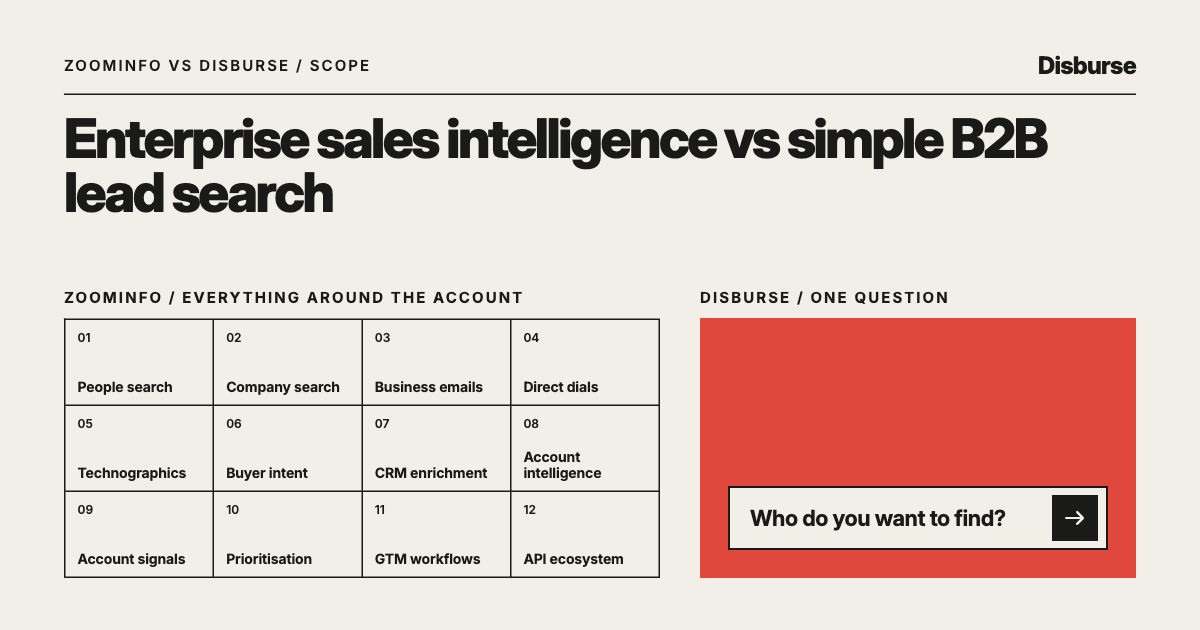
ZoomInfo and Disburse both help businesses find B2B companies and decision-makers.
But they solve the problem at very different levels.
ZoomInfo is a broad sales intelligence platform. It is built for organisations that want deep account data, enrichment, buyer intent, technographics and advanced go-to-market workflows.
Disburse is designed to make B2B lead search simpler.
Users describe the people and companies they want to find, retrieve structured contact and company data, and use those leads wherever their sales process already happens.
The short answer: ZoomInfo is likely the better fit for enterprise sales teams that need deep intelligence around accounts and buyers.
Disburse is likely the better fit for businesses that mainly want to find the right B2B companies and contacts without adopting a large sales intelligence platform.
ZoomInfo vs Disburse at a glance
Disburse
Primary focus: Simple B2B lead and contact discoveryPeople search: YesCompany search: YesBusiness emails: YesDirect/mobile numbers: YesLinkedIn URLs: YesNatural-language search: Core experienceCompany revenue: YesEmployee count: YesIndustry targeting: YesGeography targeting: YesTechnographics: Not a core featureBuyer intent: Not a core featureCRM enrichment: External workflowsAccount intelligence: Focused firmographic dataREST API: YesMCP / AI workflows: YesPricing: Transparent self-serve plansBest for: Teams that want the lead data itself
ZoomInfo
Primary focus: Enterprise sales intelligencePeople search: YesCompany search: YesBusiness emails: YesDirect/mobile numbers: YesLinkedIn URLs: YesNatural-language search: AI-assisted capabilitiesCompany revenue: YesEmployee count: YesIndustry targeting: YesGeography targeting: YesTechnographics: YesBuyer intent: YesCRM enrichment: Major strengthAccount intelligence: ExtensiveREST API: YesMCP / AI workflows: Broader API and AI ecosystemPricing: Enterprise / quote-basedBest for: Teams that want deeper intelligence around accounts
What is the main difference between ZoomInfo and Disburse?
The main difference is scope.
ZoomInfo is designed to answer a wide range of sales intelligence questions.
A revenue team may want to know:
Which companies fit our target market?
Who are the relevant decision-makers?
What technologies do they use?
Which accounts are showing intent?
Which companies should our team prioritise?
How should our CRM be enriched?
What is happening inside a target account?
Disburse is built around a simpler question:
“Who do you want to find?”
For example:
“Find founders of Australian B2B SaaS companies with 10–100 employees.”
Or:
“Find Heads of Sales at Singaporean software companies with 50–200 employees.”
Or:
“Find CFOs at New Zealand manufacturing businesses with more than A$20 million in revenue.”
Disburse turns the request into a structured B2B search and returns matching people and companies.
The distinction is simple:
ZoomInfo adds intelligence around the account.
Disburse focuses on helping you find the account and the person.
What is ZoomInfo best at?
ZoomInfo is strongest when the contact list is only one part of a wider sales intelligence process.
It is designed for teams that need deeper information around companies and buyers.
That can include:
Firmographic data
Account intelligence
Technographics
Buyer intent
CRM enrichment
Organisational information
Workflow automation
Account prioritisation
Sales research
This can be useful for larger sales organisations where hundreds of accounts need to be segmented, enriched and prioritised.
For an enterprise revenue team, the value may not simply be finding a contact.
It is understanding:
Which account matters
Why it matters
What should happen next
What is Disburse best at?
Disburse is strongest when the business already knows the kind of customer it wants to find.
The user can describe that audience naturally.
For example:
“Find Managing Directors at Australian engineering consultancies with 20–200 employees.”
Or:
“Find Heads of Marketing at Singaporean ecommerce companies with 50–500 employees.”
Or:
“Find founders of New Zealand SaaS companies with 10–100 employees.”
Disburse can then return structured B2B data such as:
Name
Title
Seniority
Job function
Business email
Direct phone
LinkedIn URL
Company name
Company domain
Industry
NAICS
Entity type
Revenue
Employee count
Locations
Specialties
City
Region
Country
Its purpose is not to create another large sales workspace.
It is to get the user from:
“This is our ICP.”
to:
“Here are the people.”
Which is easier to use?
For straightforward B2B lead search, Disburse is designed to be simpler.
A user does not need to understand an enterprise sales intelligence platform before finding prospects.
The target itself becomes the search.
For example:
“Find founders of Australian recruitment agencies with 20–100 employees.”
That is enough to begin.
ZoomInfo offers much more depth.
That is valuable when a business actually needs it.
But more depth also means more to:
Configure
Learn
Manage
For a large RevOps team, that can be worthwhile.
For a founder, small sales team or agency mainly trying to find prospects, the extra complexity may not be necessary.
Which is better for natural-language lead search?
Disburse is built around natural-language search as a core part of the experience.
The user describes the audience in the same way they would explain it to another person.
For example:
“Find senior finance leaders at Singaporean fintech companies with 100–500 employees.”
Instead of thinking about:
Which filters to select
Which ranges to apply
Which seniority values to choose
How to combine company and person criteria
The user focuses on the result they want.
ZoomInfo increasingly uses AI across its sales intelligence platform.
But its broader strength remains the depth of structured intelligence available around accounts.
The difference is not:
AI vs no AI.
It is:
Disburse uses natural language to simplify access to B2B data.
ZoomInfo uses AI inside a broader sales intelligence environment.
Which is better for targeted B2B lead lists?
For traditional ICP-based lead lists, Disburse is particularly strong.
A target can include:
Role
Seniority
Job function
Industry
Employee count
Revenue
Geography
Company specialties
Email availability
Phone availability
For example:
“Find founders of Australian cybersecurity companies with 20–100 employees.”
Or:
“Find Heads of Operations at Singaporean logistics businesses with more than 200 employees.”
Or:
“Find CFOs at New Zealand manufacturing companies with A$20 million to A$100 million in revenue.”
These searches are specific but easy to express.
ZoomInfo becomes stronger when the target list depends on extra layers of sales intelligence.
For example:
“Find companies matching our ICP that use a specific technology and are currently showing relevant buying signals.”
That is where enterprise intelligence starts to matter more than straightforward lead search.
Which gives you more account intelligence?
ZoomInfo.
This is one of the clearest areas where it has the stronger product.
ZoomInfo is designed to give revenue teams more context around companies and buyers.
That can include:
Technology usage
Buying signals
Account activity
Organisational insights
CRM context
Enrichment
Account prioritisation
Disburse is more focused.
Its job is to identify the relevant companies and people and return the data needed to use them elsewhere.
If your sales strategy depends heavily on understanding what is happening around an account, ZoomInfo has the deeper proposition.
Which is better for simple lead discovery?
Disburse.
If the requirement is:
“Find the people matching this ICP and give me their contact data.”
Then Disburse is closer to that exact job.
There is less surrounding infrastructure.
The process is:
Describe → search → retrieve → use.
That can be especially useful when a business already has its preferred CRM, outreach platform or sales automation.
Which is better for APAC prospecting?
For APAC teams, simplicity across multiple markets can be useful.
A sales team may prospect across:
Australia
New Zealand
Singapore
Hong Kong
Japan
Malaysia
Indonesia
The Philippines
Disburse lets the user describe those markets directly.
For example:
“Find founders of B2B SaaS companies in Australia, New Zealand and Singapore with 10–100 employees.”
Or:
“Find senior sales leaders at fintech companies in Singapore and Hong Kong.”
Or:
“Find Managing Directors at Australian and New Zealand engineering firms with 20–200 employees.”
This makes it easy to create different regional ICPs without changing the core workflow.
ZoomInfo can also be used internationally and offers broader enterprise intelligence.
For APAC teams, the best approach is still to test the actual countries, industries and roles they care about.
Global database-size claims alone do not tell you how useful the data will be for your market.
Which is better for founders?
For founder-led sales, Disburse is likely to be more practical.
Founders often know their ICP clearly.
They might say:
“We sell to Australian professional-services firms with 20–100 employees, and the Managing Director is usually the buyer.”
The challenge is not defining the market.
It is turning that knowledge into actual companies and contacts.
Disburse is designed around that step.
ZoomInfo becomes more attractive when the business has a larger sales organisation and needs more account intelligence around that data.
Which is better for small sales teams?
Disburse is likely to be the better fit for small teams mainly looking for B2B data.
Its Growth plan includes:
A$20/month
5,000 credits/month
Up to five team members
Unlimited searching
REST + MCP access
Scale provides:
A$99/month
50,000 credits/month
Unlimited team members
For small teams, this makes it possible to scale list volume without adopting enterprise software or adding expensive user seats.
ZoomInfo may still make sense for a smaller team if that team genuinely needs deeper account intelligence.
Which is better for enterprise teams?
ZoomInfo.
Large enterprise teams are more likely to benefit from:
Deep account data
Enrichment
Sales signals
Technographics
Buyer intent
Account prioritisation
CRM workflows
Larger RevOps processes
These tools become more valuable as a sales organisation grows.
Disburse is more likely to be used by an enterprise team as a flexible source of contact data rather than as its central sales intelligence platform.
Which is better if you already use HubSpot or Salesforce?
If your business already has a CRM and the sales process is working well, Disburse can be attractive.
The business may only need:
more prospect data feeding into the existing workflow.
Disburse can act as that data layer.
ZoomInfo is stronger when the business wants deep enrichment and broader intelligence connected to the CRM.
The distinction is:
Disburse complements an existing sales stack.
ZoomInfo can become a major intelligence layer inside that stack.
Which is better for CRM enrichment?
ZoomInfo.
CRM enrichment is part of the wider enterprise problem ZoomInfo is built to solve.
Larger businesses may have thousands or millions of records that need:
Updating
Standardising
Enriching
Segmenting
Prioritising
That is very different from simply building a list of new prospects.
Disburse can provide data that moves into external systems.
But it is not positioned as an enterprise CRM data management platform.
Which is better for AI workflows?
Disburse has a strong use case when the main requirement is giving an AI system access to B2B data.
It supports:
REST
MCP
AI assistants
Agents
Internal applications
Automated workflows
This means a workflow can request:
“Find 500 founders of Australian B2B SaaS companies with 20–100 employees.”
The resulting structured data can then be used somewhere else.
ZoomInfo also supports enterprise APIs, integrations and AI functionality.
Its advantage is the amount of intelligence that can be exposed around the account.
Disburse’s advantage is that the data-access use case is simpler.
Which is better for developers?
Disburse can be useful for developers building applications that require B2B data.
Its REST and MCP access allows developers to add prospect discovery to:
Internal sales software
AI applications
Automated workflows
SaaS products
Custom prospecting systems
The developer can use Disburse as the data layer.
Users do not need to work inside another large sales platform.
ZoomInfo is stronger where the application needs to interact with a broader enterprise intelligence ecosystem.
Which is better for agencies?
Disburse is well suited to agencies that often switch between client ICPs.
For example:
Client A:
“Find founders of Australian SaaS companies with 20–100 employees.”
Client B:
“Find Heads of Sales at Singaporean fintech companies with 50–500 employees.”
Client C:
“Find Managing Directors of New Zealand engineering consultancies.”
The agency can change the target audience simply by changing the search.
ZoomInfo may be more useful for agencies running advanced enterprise ABM or account-intelligence strategies.
Which is better for recruiters?
Disburse can be useful for recruiters who need targeted market maps or business-development lists.
For example:
“Find Engineering Managers at Australian mining companies with more than 500 employees.”
Or:
“Find CFOs at Singaporean technology companies with 100–500 employees.”
ZoomInfo may offer more value where the recruiter needs deeper company context and broader organisational intelligence.
Again, the difference comes back to whether the job is:
finding the people
or
understanding the account in greater depth.
Which is better for high-volume lead generation?
Disburse is particularly strong when a team needs large volumes of contact data.
Its pricing is based around:
One credit = one lead.
Current plans include:
Free: 50 credits/month
Growth: A$20/month for 5,000 credits
Scale: A$99/month for 50,000 credits
Enterprise: Custom pricing
Searching is unlimited.
Mobile numbers do not cost extra credits.
There is no annual lock-in.
Growth top-up credits do not expire.
ZoomInfo is also built for large-scale sales organisations.
But its value comes from the broader enterprise intelligence and workflows around the data rather than contact volume alone.
Which offers better value?
That depends on what the business actually uses.
If the main requirement is:
contact data
Then Disburse is likely to offer better value because the product and pricing are focused on that job.
If the requirement is:
contact data + buyer intent + technographics + enrichment + enterprise account intelligence
Then ZoomInfo may justify a much larger investment.
The mistake is comparing the products only by feature count.
A feature is only valuable if the team actually uses it.
What are ZoomInfo’s main advantages?
ZoomInfo’s strongest advantages include:
Enterprise sales intelligence
Deep account information
Technographics
Buyer intent
CRM enrichment
Organisational insights
Account prioritisation
Workflow automation
Large-scale sales operations
Strong fit for RevOps teams
Its biggest advantage is depth.
What are Disburse’s main advantages?
Disburse’s strongest advantages include:
Natural-language lead search
Straightforward ICP-to-data workflow
Detailed person and company fields
Business emails
Direct phone numbers
LinkedIn URLs
Revenue and employee targeting
APAC-focused use cases
REST access
MCP access
AI workflow compatibility
Unlimited searching
One credit per lead
No extra credit charge for mobile numbers
No annual lock-in
High-volume plans
Unlimited team members on Scale
Freedom to use the data in other systems
Its biggest advantage is focus.
What are the limitations of Disburse compared with ZoomInfo?
Disburse does not aim to reproduce the entire ZoomInfo platform.
It is not mainly built around:
Buyer intent
Technographics
Website visitor intelligence
Deep CRM enrichment
Account orchestration
Enterprise RevOps workflows
Large-scale account prioritisation
Businesses that need those features will likely find ZoomInfo more comprehensive.
What are the limitations of ZoomInfo compared with Disburse?
ZoomInfo’s biggest trade-off is that it can be more platform than a business needs.
If the company mainly wants:
“Find these businesses and give us the right people.”
Then adopting an enterprise sales intelligence platform may introduce:
More setup
More operational overhead
More functionality than necessary
A larger commercial commitment
More dependency on a central platform
For businesses that mainly need data, a simpler tool may be easier to justify.
When should you choose ZoomInfo?
ZoomInfo is likely the better option if you:
Run a large sales organisation
Have dedicated RevOps resources
Need buyer intent
Need technographic intelligence
Need advanced CRM enrichment
Want deep account context
Require account prioritisation
Need enterprise GTM workflows
Want a central sales intelligence platform
ZoomInfo’s strongest advantage is enterprise intelligence.
When should you choose Disburse?
Disburse is likely the better option if you:
Mainly need B2B companies and contacts
Want to search using natural language
Regularly build targeted lead lists
Prospect across APAC
Already use a CRM or outbound platform
Want REST access
Want MCP access
Use AI in your prospecting workflow
Need high-volume contact data
Want simple pricing
Want mobile numbers without extra credit costs
Do not need enterprise sales intelligence infrastructure
Want to use the data wherever you choose
Disburse’s strongest advantage is getting you from an ICP to usable data with less complexity.
ZoomInfo vs Disburse: enterprise sales intelligence or simple B2B lead search?
The right choice depends on how much intelligence you need around each prospect.
ZoomInfo is the better choice when B2B contact data is only one part of a much larger enterprise sales intelligence strategy.
It is designed to help teams:
Understand accounts
Enrich data
Prioritise accounts
Manage accounts in greater depth
Disburse is likely the better choice when the main job is finding the right businesses and people.
A user describes the ICP, retrieves the relevant company and contact data, and uses it wherever the sales process already happens.
The simplest distinction is:
ZoomInfo helps answer: “What do we know about this account, and should we prioritise it?”
Disburse helps answer: “Who exactly should we be talking to?”
For large enterprise revenue organisations, ZoomInfo’s depth can be a major advantage.
For founders, growing sales teams, agencies, developers and APAC-focused businesses that mainly need B2B contact data, Disburse can be the simpler and more practical option.
Frequently asked questions
Is Disburse a ZoomInfo alternative?
Yes.
Disburse is a ZoomInfo alternative for businesses mainly looking for B2B contact and company data.
It is not designed to replace every enterprise sales intelligence feature in ZoomInfo.
Is ZoomInfo better than Disburse?
ZoomInfo is better for enterprise teams that need deeper account intelligence, buyer intent, technographics and CRM enrichment.
Disburse can be better for teams that mainly need straightforward B2B contact discovery.
Is Disburse easier to use than ZoomInfo?
For simple lead discovery, Disburse is designed to be easier.
Users can describe the target audience naturally and retrieve the corresponding data.
Which is better for APAC prospecting?
Disburse is particularly relevant for teams building targeted lists across Australia, New Zealand, Singapore and other APAC markets.
Businesses should still test both providers against their actual industries, locations and decision-makers.
Which is better for small sales teams?
Disburse is likely to be the better fit for small teams mainly needing contact data.
ZoomInfo becomes more valuable where the team needs deeper account intelligence and enterprise workflows.
Which is better for enterprise sales teams?
ZoomInfo is generally the stronger choice for enterprise revenue organisations with advanced sales intelligence and RevOps requirements.
Which is better for CRM enrichment?
ZoomInfo.
Deep CRM enrichment is much closer to its core enterprise use case.
Which is better for natural-language B2B search?
Natural-language search is central to the Disburse experience.
The user can describe the companies and people they want rather than starting from a traditional database workflow.
Can Disburse provide emails and phone numbers?
Yes.
Disburse can return available business emails, direct phone numbers and LinkedIn URLs alongside person and company data.
Does Disburse charge extra for mobile numbers?
No.
Mobile numbers do not use extra credits.
Can Disburse work with AI agents?
Yes.
Disburse supports REST and MCP access.
This allows B2B data retrieval to be used inside AI agents, applications and automated workflows.
Can Disburse replace ZoomInfo for lead-list building?
Yes, for businesses mainly using ZoomInfo to identify companies and decision-makers.
It is not designed to replace ZoomInfo’s broader enterprise intelligence layer.
Which offers better value?
If the main requirement is B2B contact data, Disburse is likely to offer better value.
If the business actively uses deeper sales intelligence, CRM enrichment and account prioritisation, ZoomInfo may justify the additional investment.
Which is better overall?
For enterprise sales intelligence, ZoomInfo is stronger.
For simple, flexible B2B lead search and contact retrieval, Disburse is likely the better fit.
APAC ProspectingAccount IntelligenceEnterprise SalesSmall Sales TeamsB2B Contact DatabaseRevOpsAI ProspectingNatural-Language SearchZoomInfoB2B DataSales ProspectingData EnrichmentBuyer IntentDisburseB2B Lead ListsSales IntelligenceIdeal Customer Profile (ICP)