SalesIntel vs Disburse for Finding B2B Decision-Makers
18 min readLachlan McBride White
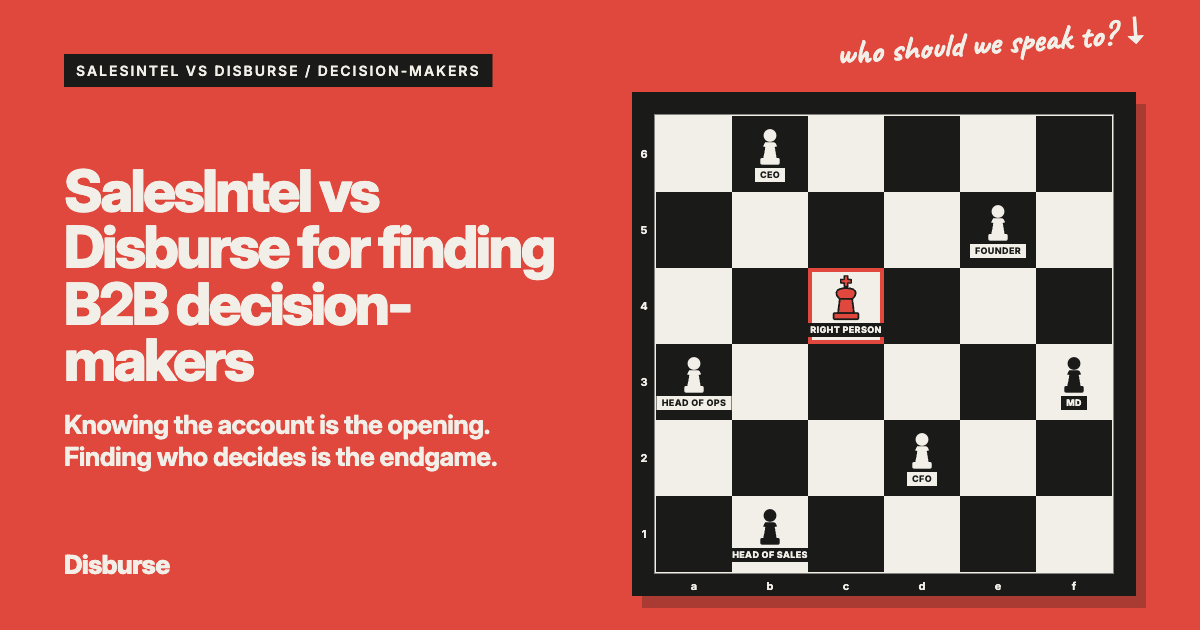
Finding the right company is only half the job.
The harder question is often:
Who should we actually speak to?
SalesIntel and Disburse can both help businesses identify B2B decision-makers, but they approach the problem differently.
SalesIntel combines B2B contact data with:
Human verification
Firmographics
Technographics
Buyer intent
Account intelligence
CRM enrichment
Research on Demand
Its platform is particularly suited to larger GTM teams that want to understand entire buying committees, not just individual contacts.
Disburse takes a more flexible approach.
You can:
Find one specific person
Describe the decision-maker you want in natural language
Find several personas at an account
Enrich a list you already have
Find companies similar to good customers
Identify relevant people inside those companies
Use the Chrome extension
Connect through REST
Connect through MCP
Use B2B data inside AI workflows
The short answer: SalesIntel is a strong choice if your team wants verified contact data combined with technographics, intent, account intelligence and human research.
Disburse is likely the better fit if you want a simpler and more flexible way to identify the right people, especially if natural-language search, enrichment, AI workflows, APAC prospecting and high data volumes matter.
SalesIntel vs Disburse at a glance
Feature
Find one specific person
Disburse:
Yes
SalesIntel:
Yes
Find decision-makers by role
Disburse:
Yes
SalesIntel:
Yes
Find multiple personas at an account
Disburse:
Yes
SalesIntel:
Yes
Find companies
Disburse:
Yes
SalesIntel:
Yes
Natural-language search
Disburse:
Yes
SalesIntel:
More filter-led
Business emails
Disburse:
Yes
SalesIntel:
Yes
Phone numbers
Disburse:
Yes
SalesIntel:
Yes
LinkedIn URLs
Disburse:
Yes
SalesIntel:
Yes
Enrich existing contacts
Disburse:
Yes
SalesIntel:
Yes
CSV enrichment
Disburse:
Yes
SalesIntel:
Yes
Similar-company discovery
Disburse:
Yes
SalesIntel:
Yes
Find personas at similar companies
Disburse:
Yes
SalesIntel:
Yes
Chrome extension
Disburse:
Yes
SalesIntel:
Yes
REST / API access
Disburse:
Yes
SalesIntel:
Yes
MCP
Disburse:
Yes
SalesIntel:
Not a core native offering
AI workflows
Disburse:
Yes
SalesIntel:
More API and platform-led
Human-verified contact data
Disburse:
Not positioned around manual verification
SalesIntel:
Yes
Technographics
Disburse:
Company data available
SalesIntel:
Major strength
Buyer intent
Disburse:
Not a core feature
SalesIntel:
Yes
Research on Demand
Disburse:
No
SalesIntel:
Yes
Best suited to
Disburse:
Flexible decision-maker discovery and enrichment
SalesIntel:
Verified decision-maker data inside a deeper sales intelligence platform
What does finding the right B2B decision-maker actually involve?
Sometimes the answer is obvious.
You need:
The CFO
The founder
The Head of Sales
But many B2B purchases involve several people.
A software deal might include:
An economic buyer
A department head
A technical evaluator
A user champion
Procurement
Finance
SalesIntel explicitly positions its data around buying committees and identifying multiple relevant people inside an account.
Disburse can also identify one or several personas depending on the request.
For example:
“Find the Head of Sales at this Australian SaaS company.”
Or:
“Find the founder, Head of Sales and Head of Operations at these companies.”
Or:
“Find companies similar to this customer, then identify the Managing Director at each.”
That matters because there is no universal definition of a decision-maker.
The right person changes depending on:
What you sell
Company size
Department
Deal complexity
Buying process
How does Disburse find decision-makers?
Disburse lets you describe the person you want directly.
For example:
“Find the Head of Marketing at this Australian ecommerce company.”
Or:
“Find CFOs at Australian professional-services firms with 100 to 500 employees.”
Or:
“Find founders of Singaporean cybersecurity companies with 20 to 100 employees.”
A request can include criteria such as:
Job title
Seniority
Job function
Industry
Employee count
Revenue
Location
Company specialty
Email availability
Phone availability
You can use the same approach whether you need:
One person
Ten people
Hundreds of decision-makers
Thousands of prospects
The interaction does not change much as the size of the request grows.
How does SalesIntel find decision-makers?
SalesIntel uses detailed people and company search combined with broader account intelligence.
Its database includes:
Job titles
Seniority
Business emails
Mobile direct dials
Firmographics
Technographics
Intent signals
Its wider platform is also designed to help users identify:
Buying committees
Relevant stakeholders
Account-level decision-makers
SalesIntel’s RevDriver Chrome extension can also support research across browser-based sales workflows.
For sales teams that already have target accounts and want detailed account-by-account research, this can be a strong approach.
Can Disburse find one specific decision-maker?
Yes.
You do not need to define a whole market or build a large prospect list.
You can ask:
“Find the CEO of this company.”
Or:
“Find the Head of Sales at this business.”
Or:
“Find the person responsible for operations at this Australian logistics company.”
This is important because not every prospecting task begins with an ICP.
Sometimes you simply need the right person at one account.
Can SalesIntel find one specific person?
Yes.
SalesIntel can also be used for individual contact research.
Its browser workflow is particularly useful when a rep is already looking at:
A company
A professional profile
A target account
and wants relevant contact information.
Single-contact research is therefore not a meaningful dividing line between the platforms.
Both can do it.
Which is better if you know the company but not the person?
Both are capable.
With Disburse, you can describe the role directly.
For example:
“Find the Head of Operations at this company.”
Or:
“Find the senior person responsible for sales at this business.”
SalesIntel can search contacts using:
Job function
Seniority
Title
Account data
and can help surface several members of a buying committee.
If the account is large and several stakeholders influence the purchase, SalesIntel’s deeper account intelligence can be useful.
If the job is simply identifying the right persona and retrieving usable contact data, Disburse is likely more direct.
Which is better if you know the ICP but not the companies?
Disburse is particularly strong here.
Suppose you know:
“We sell to Australian B2B SaaS companies with 20 to 100 employees and normally target the founder.”
That can become:
“Find founders of Australian B2B SaaS companies with 20 to 100 employees.”
You do not need to build the company list first and identify the people separately.
SalesIntel can also create target lists using detailed firmographic and contact criteria.
It can additionally layer in:
Technographics
Buyer intent
Account intelligence
So the difference is workflow.
Disburse is particularly natural when your team already knows how it would describe its ideal customer in plain language.
Which is better for identifying entire buying committees?
SalesIntel has the stronger native proposition.
Its product is explicitly designed to help users identify multiple relevant stakeholders across the buying centre.
That can be valuable in complex B2B deals involving:
Several departments
Technical evaluation
Procurement
Finance
Executive approval
Disburse can also identify multiple personas at the same account.
For example:
“Find the CFO, Head of Operations and Head of IT at each of these companies.”
But SalesIntel goes further in positioning its product around:
Buying committee coverage
Account intelligence
Wider sales intelligence
For enterprise account mapping, that additional context can matter.
For simpler sales motions where you already know which one or two personas matter, Disburse may be enough.
Which is better for natural-language decision-maker search?
Disburse has the clearer advantage in how central natural language is to the workflow.
You can ask:
“Find founders of Australian SaaS companies with 20 to 100 employees.”
Or:
“Find Heads of Sales at Singaporean fintech companies.”
Or:
“Find the most senior operations person at these businesses.”
The request is written the way a salesperson would naturally describe the audience.
SalesIntel is more structured around:
Advanced filters
Account intelligence
Technographics
Intent
That can provide more control.
It can also be more setup than necessary for straightforward persona discovery.
Which is better for finding decision-makers at similar companies?
Disburse has a particularly natural workflow here.
You may already know one company that represents an ideal customer.
You can ask:
“Find companies similar to this Australian SaaS business, then find the founders at those companies.”
Or:
“Find similar companies in Australia and Singapore, then identify the Heads of Sales.”
The workflow becomes:
Good company → similar companies → relevant people
without manually defining every characteristic that makes the original account attractive.
SalesIntel also supports ICP modelling and account targeting.
So it can support similar-account workflows too.
The distinction is that Disburse makes the process particularly easy to express conversationally.
Which has better decision-maker accuracy?
SalesIntel has a strong case here.
It says its human-verified contacts are:
Reverified every 90 days
Approximately 95% accurate
It also reports lower but still high accuracy for email-verified records.
Those are vendor-reported figures, but the human-verification model itself is a genuine product differentiator.
Disburse should not claim universal superiority on accuracy without testing the same target audience.
The better comparison is to test both platforms against the people you actually need.
For example, take 100 Australian SaaS decision-makers and compare:
Correct employer
Correct role
Correct seniority
Email availability
Phone availability
Company information
Overall match quality
That will tell you more than a general database-accuracy claim.
Which is better for phone-based decision-maker outreach?
Both can provide phone data.
SalesIntel has a particular strength in human-verified mobile direct dials.
That may be valuable for sales teams where cold calling is a major channel and phone accuracy has a high commercial value.
Disburse can also provide available direct and mobile phone information.
Available mobile numbers do not require another Disburse credit.
So the choice may depend on whether your team values:
Human verification
or:
Higher contact volume and simpler economics
more heavily.
Which is better for business emails?
Both can provide business email data.
SalesIntel’s verification model is a meaningful advantage when verified accuracy is the dominant buying criterion.
Disburse can return available business emails as part of the wider contact record.
If email sits inside a broader workflow involving:
Enrichment
Similar-company discovery
Persona finding
AI access
Higher contact volumes
then Disburse may offer the more practical overall workflow.
Can Disburse enrich existing decision-maker data?
Yes.
You do not need to rebuild an audience simply because some fields are missing.
For example, you can upload a CSV containing more than 2,000 existing contacts.
Existing identifiers such as email addresses can help match records and add available person and company information.
This can be useful for:
Existing prospect lists
Old CRM exports
Event attendee lists
Client-supplied records
Target-account files
Incomplete contact databases
Sometimes the right workflow is not:
Find new prospects
It is:
Make the prospects we already have more useful.
Can SalesIntel enrich existing data?
Yes.
This is one of SalesIntel’s stronger areas.
Its platform supports:
Contact enrichment
Account enrichment
Inbound enrichment
CRM enrichment
Scheduled data maintenance
It also integrates directly with major sales and marketing systems.
For larger organisations trying to maintain an entire CRM database over time, SalesIntel has deeper native infrastructure around data enrichment.
Disburse is particularly useful when enrichment is one of several data tasks rather than a dedicated enterprise data-hygiene program.
Which is better for technographic decision-maker targeting?
SalesIntel.
This is one of its clearest advantages.
SalesIntel allows teams to target businesses based on the technologies they use.
That matters when the person you need depends on the company’s technology environment.
For example:
“Find technology leaders at companies using Salesforce and AWS.”
For businesses whose ICP depends heavily on tech stack, SalesIntel has a stronger native proposition.
If your targeting mainly depends on:
Company size
Industry
Geography
Role
Seniority
Revenue
Disburse may already cover the core requirement.
Which is better for buyer intent?
SalesIntel.
Its platform combines contact data with intent and other account signals.
That helps answer two different questions:
“Who is the right person?”
and:
“Which of those people should we prioritise right now?”
Disburse is more focused on identifying and enriching B2B people and companies rather than supplying a native buyer-intent layer.
If timing signals are central to your prospect prioritisation, SalesIntel has the advantage.
Which is better for hard-to-find decision-makers?
SalesIntel has an interesting differentiator here:
Research on Demand.
If a contact is difficult to find, SalesIntel can use human researchers to help find or verify the information.
That can be valuable when your target market includes:
Highly specialised executives
Senior enterprise buyers
Niche industries
Difficult-to-source contacts
Disburse does not position itself around human research services.
Which is better for browser-based decision-maker research?
Both have Chrome extensions.
So browser access itself is not a clear differentiator.
The better comparison is what happens beyond the browser.
Can the platform:
Identify someone from a natural-language request?
Enrich an existing file?
Find similar companies?
Identify several personas?
Work through AI?
Connect through an API?
Those broader workflows are more useful when deciding between the two products.
Which is better for APAC decision-maker data?
Disburse is particularly relevant for APAC-focused workflows.
For example:
“Find founders of Australian B2B SaaS companies.”
“Find Heads of Sales at Singaporean fintech companies.”
“Find Managing Directors at New Zealand recruitment agencies.”
“Find the CFO at this Hong Kong professional-services company.”
SalesIntel also provides international data.
It should not be positioned as a US-only database.
For APAC buyers, the best approach is to test the actual markets and personas you need.
Compare:
Relevant decision-makers found
Title accuracy
Company accuracy
Email availability
Phone availability
Total usable records
Cost
Local performance is more valuable than headline global database size.
Which is better for small sales teams?
Disburse is likely easier for smaller teams.
Disburse pricing
Plan
Free
Monthly price:
A$0
Monthly credits:
50
Team members:
1
Growth
Monthly price:
A$20
Monthly credits:
5,000
Team members:
Up to 5
Scale
Monthly price:
A$99
Monthly credits:
50,000
Team members:
Unlimited
Enterprise
Monthly price:
Custom
Monthly credits:
Custom
Team members:
Custom
Searching is unlimited.
Available mobile numbers do not require additional credits.
SalesIntel takes a quote-based approach.
That model may work extremely well for larger organisations.
For a smaller team wanting to start immediately at a known price, Disburse is considerably easier to buy.
Which is better for larger GTM teams?
SalesIntel becomes much more compelling as the organisation becomes larger and more sophisticated.
Its strengths include:
Human-verified data
Technographics
Buyer intent
Buying committee coverage
Research on Demand
CRM enrichment
Enterprise workflows
RevOps functionality
These capabilities can be particularly valuable for:
Enterprise sales teams
RevOps
ABM programs
Disburse can still work at scale.
But it is especially attractive when the organisation wants its B2B data to fit into an existing stack rather than become the wider intelligence layer.
Which is better for agencies?
Disburse has a strong fit for agencies because each client can create a different decision-maker problem.
One client might ask:
“Find the Managing Director at these 50 Australian companies.”
Another:
“Find 1,000 Australian SaaS founders.”
Another may provide:
“A CSV containing 2,000 existing contacts that needs enrichment.”
Another may ask:
“These are our best clients. Find similar businesses and their Heads of Sales.”
The same platform can move between each request.
SalesIntel may make more sense for agencies serving enterprise clients that specifically need:
Technographic targeting
Human verification
Intent signals
Buying committee research
Which is better for recruiters?
Both can be useful.
SalesIntel’s:
Human verification
Research on Demand
may appeal to recruiters searching for difficult-to-find executives.
Disburse is particularly flexible for recruitment business development.
For example:
“Find Heads of People at Australian technology companies with 100 to 500 employees.”
Or:
“Find companies similar to our best recruitment clients and identify their Managing Directors.”
An existing database can also be enriched rather than rebuilt.
For recruitment firms moving between:
Market mapping
Business development
Enrichment
that flexibility can be useful.
Which is better for AI workflows?
Disburse has a particularly strong proposition here.
It provides REST and MCP.
An AI workflow can request:
“Find the CFO at this company.”
“Find 100 founders matching this ICP.”
“Enrich this uploaded dataset.”
“Find companies similar to these customers.”
“Identify the Head of Sales at each.”
SalesIntel also provides API access.
So its data can be incorporated into external software and workflows.
The distinction is that MCP and conversational B2B data access are more central to how Disburse is designed to work.
Which is easier to use?
For straightforward decision-maker discovery, Disburse is likely easier.
The user can simply describe the person they need.
SalesIntel provides significantly more intelligence that can be layered into the search.
That includes:
Firmographics
Technographics
Intent
Verification status
Account intelligence
Those dimensions are valuable when the sales process depends on them.
If they do not, they can also create more platform than the team needs.
Which is better for high-volume decision-maker data?
Disburse has a strong self-service proposition.
Plan
Free
Monthly price:
A$0
Monthly credits:
50
Growth
Monthly price:
A$20
Monthly credits:
5,000
Scale
Monthly price:
A$99
Monthly credits:
50,000
One credit represents one lead.
Available mobile numbers do not require extra credits.
SalesIntel uses a very different commercial model.
For a very large organisation, enterprise pricing and larger usage structures may be more attractive.
For a smaller or growing business that wants known pricing and significant volume without negotiating a contract, Disburse is easier to evaluate.
Where is SalesIntel stronger?
SalesIntel has several genuine advantages.
It is particularly strong for:
Human-verified contacts
Verified mobile numbers
Research on Demand
Technographic targeting
Technology spend intelligence
Buyer intent
Buying committee coverage
Ongoing CRM enrichment
Large GTM teams
Sophisticated ABM programs
If those capabilities are central to your sales process, SalesIntel has a strong case.
Where is Disburse stronger?
Disburse is particularly strong when the goal is to make decision-maker data easier to access and use.
You can start with:
One company
One person
A persona
An ICP
An existing CSV
A successful customer
A browser session
An AI prompt
An API request
From there you can find or enrich the relevant people and company data.
That flexibility is useful for teams that do not have one fixed prospecting process.
Disburse also offers:
Transparent self-service pricing
High contact volumes
REST
MCP
When should you choose SalesIntel?
SalesIntel is likely the better choice if:
Human-verified contact accuracy is a major priority
You need buying committee intelligence
Technographics matter
Buyer intent matters
You need Research on Demand
You run a larger sales or RevOps organisation
Ongoing CRM enrichment is important
You are comfortable with quote-based pricing
When should you choose Disburse?
Disburse is likely the better fit if:
You need to identify individual decision-makers
You also search for broader groups of people
You prefer natural-language search
You enrich existing contact and company data
You work with CSVs
You find similar companies
You identify personas within those companies
You prospect across APAC
You use a Chrome extension
You need REST
You want MCP
AI workflows matter
You already have a CRM and outbound stack
Transparent pricing matters
You need high self-service data volumes
SalesIntel vs Disburse: which is better for finding B2B decision-makers?
SalesIntel is a very strong option for organisations that want more than a name and contact details.
Its:
Human verification
Buying committee coverage
Technographics
Buyer intent
Research on Demand
give larger GTM teams a deeper intelligence layer around the people they are targeting.
That can be particularly valuable when sales cycles are complex and several stakeholders influence the deal.
But many B2B sales teams face a simpler problem.
They know the company they want.
Or they know the persona.
Or they know the ICP.
They simply need an easy way to move from that information to:
The right person + usable contact data.
Sometimes they already have the contacts and just need better information.
Sometimes they want to begin with a good customer, find similar businesses and identify the decision-makers inside them.
Disburse can handle all of those workflows without requiring the team to adopt a broader enterprise intelligence platform.
So:
Choose SalesIntel if you need deep buying committee intelligence, human verification, technographics and buyer intent.
Choose Disburse if you want a flexible and straightforward way to find and enrich the right B2B people across individual accounts, wider audiences and AI workflows.
For founders, agencies, lean sales teams and APAC-focused businesses, that simpler path from business question to usable decision-maker data can be a meaningful advantage.
Frequently asked questions
Can Disburse find B2B decision-makers?
Yes.
Disburse can identify decision-makers using criteria such as:
Role
Seniority
Company
Industry
Geography
Other ICP attributes
Can Disburse find one specific decision-maker?
Yes.
You can use Disburse to find one person, a small group or a much larger audience.
Can SalesIntel find buying committees?
Yes.
Buying committee coverage is one of SalesIntel’s stronger sales intelligence use cases.
Can Disburse find multiple personas at one company?
Yes.
Users can request several relevant roles at the same company or across a group of companies.
Which is better for finding decision-makers from an ICP?
Disburse is particularly strong when the ICP can be described naturally.
SalesIntel becomes stronger when the search also depends heavily on:
Technographics
Buyer intent
Wider account intelligence
Can Disburse enrich existing contacts?
Yes.
Existing contact and company lists can be enriched with additional available information.
Can SalesIntel enrich existing contacts?
Yes.
SalesIntel provides deeper CRM, contact and account enrichment workflows.
Can Disburse enrich CSV files?
Yes.
Uploaded CSVs containing thousands of contacts can be used as the starting point.
Can Disburse find similar companies?
Yes.
Disburse can identify companies similar to a target business and then find relevant decision-makers inside those companies.
Does SalesIntel support similar-company discovery?
Yes.
Its broader ICP and account-intelligence capabilities can support lookalike and high-fit account discovery.
Does Disburse have a Chrome extension?
Yes.
Does SalesIntel have a Chrome extension?
Yes.
Does Disburse provide business emails?
Yes.
Does Disburse provide phone numbers?
Yes.
Available direct and mobile data can be included.
Does SalesIntel provide mobile numbers?
Yes.
Mobile direct dials are part of its contact-data offering.
Which has better contact accuracy?
SalesIntel has a particularly strong verification proposition and reports around 95% accuracy for its human-verified contacts.
Actual performance should still be tested against the specific people and markets you target.
Which is better for technographic targeting?
SalesIntel.
Technographics are one of its clearest native strengths.
Which is better for buyer intent?
SalesIntel.
Buyer intent forms part of its wider sales intelligence proposition.
Which is better for APAC?
Disburse is particularly relevant for APAC-focused workflows.
SalesIntel also provides international coverage.
Buyers should test both against the specific APAC countries, industries and personas they target.
Which is better for small sales teams?
Disburse is likely easier to start with because it offers transparent self-service pricing and substantial monthly data allowances.
Which is better for larger GTM teams?
SalesIntel may be more compelling for larger teams that need:
Buying committee intelligence
Technographics
Human verification
Intent
CRM enrichment
Which is better for agencies?
Disburse is particularly useful for agencies moving between:
Individual decision-maker research
Wider audience creation
Enrichment
Similar-company workflows
Which is better for AI workflows?
Disburse has a strong AI-native proposition because it provides both REST and MCP.
Can Disburse replace SalesIntel for finding decision-makers?
For many decision-maker discovery and enrichment workflows, yes.
Disburse can cover:
Individual contact discovery
Persona search
Audience creation
Enrichment
Similar-company research
Browser workflows
REST
MCP
AI access
SalesIntel remains stronger when:
Human verification
Research on Demand
Technographics
Buyer intent
Enterprise buying committee intelligence
are central requirements.
Which should I choose?
Choose SalesIntel if you want a deeper enterprise sales intelligence layer around your decision-maker data.
Choose Disburse if you want a flexible way to identify, enrich and use B2B decision-maker data across natural-language, browser, API and AI workflows.
APAC Prospectinglead generationEnterprise SalesB2B Contact DatabaseRevOpsAI ProspectingNatural-Language SearchB2B DataSales ProspectingData EnrichmentBuyer IntentDisburseABMSales IntelligenceIdeal Customer Profile (ICP)