Disburse vs RocketReach: Which B2B Contact Database Is Better?
18 min readLachlan McBride White
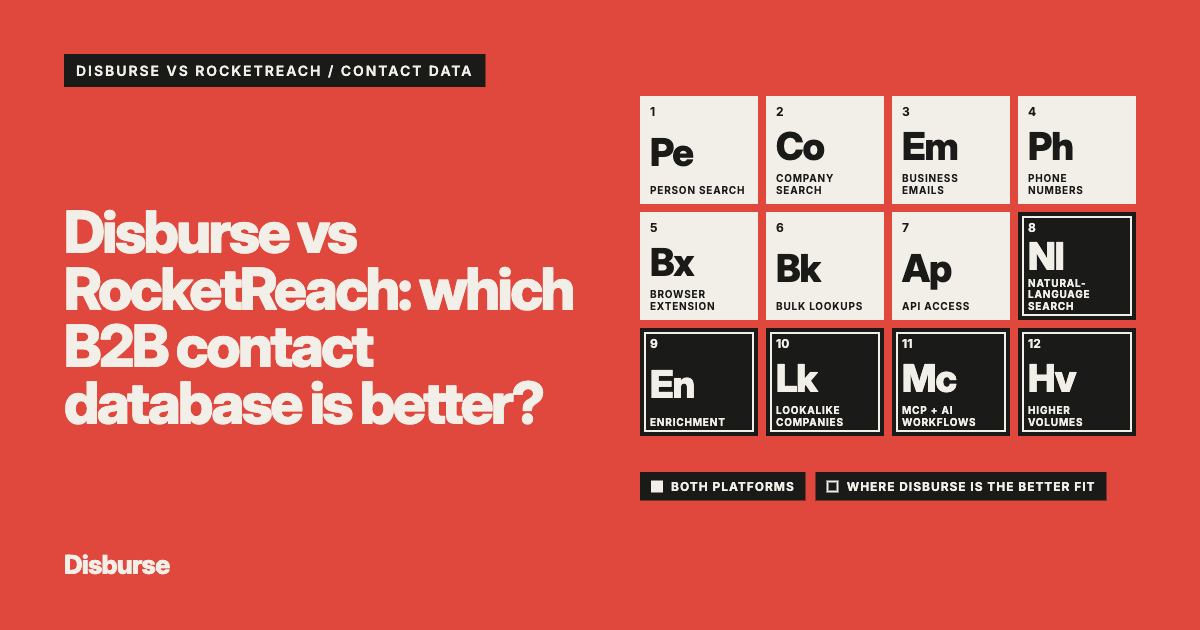
Disburse and RocketReach both help businesses find B2B people, companies and contact information.
You can use either platform to find one specific person or research a larger group of prospects.
The differences become clearer when you look at everything else you might want to do with that data.
RocketReach is an established professional contact database with:
Person and company search
Business emails
Phone numbers
Browser prospecting
Bulk lookups
Company intelligence
API access
Prospecting tools
Disburse is a B2B data platform that can be used just as easily to find one person as it can to find a larger audience.
It can also enrich data you already have, identify companies similar to a target business, find relevant people within those companies, and make structured B2B data available through its Chrome extension, REST, MCP and AI workflows.
The short answer: RocketReach is a strong, established choice for professional contact data.
Disburse is likely the better fit if you want more flexibility in how you find and use B2B data, particularly if natural-language search, enrichment, AI workflows, APAC prospecting or higher data volumes matter.
Disburse vs RocketReach at a glance
Feature
Find one specific person
Disburse:
Yes
RocketReach:
Yes
Find groups of people
Disburse:
Yes
RocketReach:
Yes
Find companies
Disburse:
Yes
RocketReach:
Yes
Business emails
Disburse:
Yes
RocketReach:
Yes
Phone numbers
Disburse:
Yes
RocketReach:
Yes
LinkedIn URLs
Disburse:
Yes
RocketReach:
Yes
Company data
Disburse:
Yes
RocketReach:
Yes
Natural-language B2B search
Disburse:
Yes
RocketReach:
Search and advanced filters
Enrich existing contacts
Disburse:
Yes
RocketReach:
Yes
Bulk data workflows
Disburse:
Yes
RocketReach:
Yes
CSV workflows
Disburse:
Yes
RocketReach:
Yes
Similar-company discovery
Disburse:
Yes
RocketReach:
Company discovery capabilities
Find personas within companies
Disburse:
Yes
RocketReach:
Yes
Chrome extension
Disburse:
Yes
RocketReach:
Yes
REST / API access
Disburse:
Yes
RocketReach:
Yes
MCP
Disburse:
Yes
RocketReach:
Not a core native offering
AI-native workflows
Disburse:
Yes
RocketReach:
More API and platform-led
High-volume self-service option
Disburse:
Up to 50,000 monthly credits on Scale
RocketReach:
Allowances vary by plan
Best suited to
Disburse:
Flexible B2B discovery, lookup, enrichment and AI workflows
RocketReach:
Established professional contact search and sales prospecting
What is Disburse?
Disburse is a B2B data platform for finding and enriching people and company data.
There is no single required starting point.
Find one specific person
If you know exactly who you want, you can search for one person.
For example:
“Find the Head of Sales at [company].”
Or:
“Find the founder of this Australian software company.”
Find a larger audience
You can also search more broadly:
“Find 100 Heads of Sales at Australian software companies with 50 to 200 employees.”
Enrich data you already have
You can start with an existing dataset.
For example, you could upload a CSV containing more than 2,000 contacts and enrich those records with available person and company information.
Find companies similar to a good customer
You could also start with a company:
“Find companies similar to this business, then find the founders at those companies.”
Disburse can therefore support several different B2B data jobs without requiring a separate product for each one.
What is RocketReach?
RocketReach is an established professional contact and company database used by:
Salespeople
Recruiters
Founders
Marketers
Business-development teams
It provides:
Professional emails
Phone data
Person search
Company search
Browser-based prospecting
Bulk workflows
RocketReach has also expanded beyond simple contact lookup.
Depending on the plan, its wider functionality can include:
Company trends
Org charts
Technographics
Integrations
API access
Prospecting features
So RocketReach should not be described as simply an email finder.
It is a broader professional contact and prospecting platform.
What is the biggest difference between RocketReach and Disburse?
There is significant overlap.
Both can:
Find one person
Find larger groups of prospects
Provide company data
Provide contact data
Work through browser extensions
Support bulk data workflows
The more useful difference is how flexible the workflow becomes.
With Disburse, you might start with:
“Find this person.”
Then ask:
“Find other sales leaders at similar companies.”
Then:
“Enrich these 2,000 existing contacts.”
Then:
“Find companies similar to our best customers and identify the founders.”
These are different B2B data jobs.
But they can all happen through the same platform.
Disburse is designed around asking for the data you need rather than requiring every user to follow the same prospecting process.
Can Disburse find one specific person?
Yes.
You do not need to build an entire prospect list to use Disburse.
If you are looking for one decision-maker, you can ask for that person directly.
For example:
“Find the CFO at [company].”
Or:
“Find the founder of [company] and return their available contact information.”
This is useful when you already know the account but need to identify the right person.
It also means you can move between individual research and larger prospecting projects without changing platforms.
Can RocketReach find one specific person?
Yes.
This is one of RocketReach’s established strengths.
Users can search for a professional and access available contact information, including business email and phone data on eligible plans.
Its Chrome extension also supports contact research directly from the browser.
RocketReach remains a strong option for teams that regularly research known professionals.
Which is better for finding business emails?
Both can provide business email data.
RocketReach has long been used for professional email discovery.
Its entry-level product is particularly focused on email data, while phone access is available on higher tiers.
Disburse can also return available business email information as part of a person’s contact record.
If all you need is one email address, both platforms can solve the basic problem.
The difference becomes more important when you also want to:
Find the person
Understand their company
Retrieve phone information
Enrich existing data
Expand into similar accounts
Use the data elsewhere
Which is better for finding phone numbers?
Both can provide phone data.
The difference is how phone access fits into the product.
RocketReach’s self-service structure separates its email-focused entry tier from higher tiers that include mobile and direct phone numbers.
Disburse includes available mobile data without charging additional credits for the mobile number.
That can be particularly useful for teams using both email and calling.
Which is better if you need both email and phone data?
Disburse has a strong proposition here.
Its pricing is based on the lead:
One credit = one lead.
Available mobile numbers do not cost additional credits.
That makes the economics straightforward for multi-channel sales teams.
RocketReach also offers email and phone data on eligible plans.
The useful comparison is therefore:
“How many complete, usable prospect records does each plan give us?”
rather than simply comparing subscription prices.
Which is better for finding a very specific ICP?
Disburse is particularly strong when you already know the type of company and person you want.
You can describe the audience in normal language.
For example:
“Find founders of Australian B2B SaaS companies with 20 to 100 employees.”
Or:
“Find Heads of Sales at Singaporean fintech companies with more than 50 employees.”
Or:
“Find Managing Directors of recruitment agencies in Australia and New Zealand.”
Criteria can include:
Job title
Seniority
Job function
Industry
Employee count
Revenue
Company location
Specialties
Email availability
Phone availability
The request can be for one person, 20 people or a much larger audience.
That flexibility matters because real prospecting rarely happens at one fixed scale.
Can RocketReach build targeted audiences?
Yes.
RocketReach supports person and company search, filters and broader prospecting workflows.
Its product can also include:
Company information
Org charts
Company trends
Technographic information
depending on the plan.
So RocketReach can absolutely be used to build a target audience.
The distinction is that natural-language B2B data requests are more central to the way Disburse is designed to work.
Can Disburse enrich existing contacts?
Yes.
Suppose you already have a CSV containing 2,000 contacts.
You may already have email addresses but be missing company information.
Or you might have company records that need additional people data.
Disburse can use existing identifiers such as email addresses to match those records and add available person and company information.
The data you already own can therefore become the starting point.
Can RocketReach enrich existing data?
Yes.
RocketReach supports:
Bulk lookups
API-based workflows
Existing datasets
Data enrichment
on eligible plans.
So bulk processing and enrichment are worth comparing on both sides.
The difference is how easily the user can move between enrichment and other B2B data tasks.
With Disburse, the workflow can move between:
Existing data → enrichment
ICP → people
Target company → similar companies → relevant personas
depending on what you need.
Can Disburse find similar companies?
Yes.
This is useful when you know what a great customer looks like but cannot easily define every attribute that makes the company a good fit.
You can start with the company itself.
For example:
“Find companies similar to this Australian SaaS business.”
Then:
“Find the Heads of Sales at those companies.”
That turns an existing customer or target account into a starting point for finding more relevant companies and contacts.
Can Disburse find the right persona at those companies?
Yes.
Finding the company is only half the job.
Once you have a target account, you still need the right person.
With Disburse, you can specify the persona directly.
For example:
“Find companies similar to these five customers, then find their founders.”
Or:
“Find similar businesses and identify the Head of Operations at each.”
That makes company discovery and contact discovery part of the same workflow.
Which is better for Chrome extension prospecting?
Both have Chrome extensions.
RocketReach’s browser extension is an established part of the product.
Disburse also has a Chrome extension.
So neither platform should be chosen purely because it offers browser-based B2B data.
The better questions are:
Do you sometimes search for one person?
Do you sometimes need 500 people?
Do you need to enrich an existing file?
Do you want AI to access the data?
Do you need an API?
Do you want to find similar companies?
Those requirements give you a more useful basis for comparison.
Which is better for natural-language B2B search?
Disburse has a strong advantage in how naturally this fits into the product.
You can describe what you need rather than thinking about the structure of the underlying database.
For example:
“Find the founder of this company.”
“Find 20 Heads of Sales at Australian SaaS companies.”
“Find software companies similar to these customers.”
“Find the founders at those companies.”
The size and type of request can change without fundamentally changing the way you interact with the platform.
That is useful for teams that understand their market but do not want prospecting to feel like database administration.
Which is better for AI workflows?
Disburse is particularly well suited to AI-driven B2B data workflows.
It provides both REST and MCP access.
That allows compatible AI assistants, agents and software to request data directly.
An AI workflow could ask Disburse to:
Find one specific person
Find a particular persona
Build a larger audience
Enrich existing contacts
Identify similar companies
Retrieve structured person and company information
RocketReach provides API access on eligible plans.
So its data can also be integrated into software workflows.
The difference is that MCP and conversational B2B data access are more central to the Disburse proposition.
Which is better for developers?
Both deserve consideration.
RocketReach provides API and bulk lookup functionality on eligible plans.
Disburse provides REST and MCP.
That can be useful for:
Internal sales applications
AI agents
Prospecting tools
Enrichment workflows
SaaS products
Custom company research
Automated B2B data tasks
For a traditional API integration, both may be viable.
For applications increasingly built around AI agents and conversational interfaces, Disburse’s MCP support becomes particularly relevant.
Which is better for APAC prospecting?
For teams selling across APAC, Disburse is particularly relevant.
You could search for:
“Founders of Australian B2B SaaS companies.”
“Heads of Sales at Singaporean fintech companies.”
“Managing Directors of New Zealand recruitment agencies.”
“CFOs at Hong Kong professional-services firms.”
Or you could search for one specific executive at one of those companies.
RocketReach has a large global professional database.
It should not be assumed to perform poorly in APAC.
The sensible approach is to test both against the markets that actually matter to your business.
Compare:
Correct people found
Email availability
Phone availability
Company information
Data accuracy
Total cost for the records you need
That tells you more than global database-size claims.
Which is better for recruiters?
Both can work well.
A recruiter might need one specific person:
“Find the CTO at this company.”
Or they might be mapping an entire market:
“Find Heads of Engineering at Australian software companies with 100 to 500 employees.”
They may also have an existing business-development database that needs enriching.
Disburse can move between all three workflows.
RocketReach is also widely used by recruiters and has a strong professional-search proposition.
The decision comes down to whether the recruitment team mainly wants established contact-search functionality or a more flexible data workflow that also includes:
Enrichment
Similar-company discovery
AI access
Which is better for agencies?
Disburse has a strong agency use case because each client can bring a completely different request.
One client might ask:
“Can you find the CEO of this company?”
Another:
“Find 500 Australian SaaS founders.”
Another:
“Here are 2,000 contacts. Can you enrich them?”
And another:
“These are our best customers. Find companies like them and the relevant decision-makers.”
The same B2B data platform can handle each request.
That reduces the need to piece together different tools for different client briefs.
Which is better for founder-led sales?
Disburse works particularly well when a founder understands the market but does not yet know every prospect.
For example:
“Find the Head of Sales at this company.”
Then:
“Find another 50 Australian companies like it and the Head of Sales at each.”
The workflow can expand as the founder learns.
That is useful in founder-led sales because prospecting is rarely perfectly defined from day one.
Which is better for high-volume B2B data?
This is one of the areas where Disburse has a strong proposition.
Disburse pricing
Plan
Free
Price:
A$0
Included:
50 credits/month
Growth
Price:
A$20/month
Included:
5,000 credits/month, up to 5 team members
Scale
Price:
A$99/month
Included:
50,000 credits/month, unlimited team members
Enterprise
Price:
Custom
Included:
Custom requirements
The Free plan includes:
Unlimited search
REST
MCP
Growth top-ups do not expire.
The core pricing model is:
One credit = one lead.
Available mobile numbers do not cost additional credits.
RocketReach uses lookup and export allowances that vary by plan and billing term.
For someone looking up a modest number of professionals, that may be enough.
For businesses regularly working with thousands or tens of thousands of B2B records, Disburse’s high-volume model becomes much more compelling.
Is RocketReach cheaper than Disburse?
For high-volume B2B data, Disburse has a particularly aggressive self-service proposition.
Growth provides:
5,000 monthly credits for A$20.
Scale provides:
50,000 monthly credits for A$99.
RocketReach pricing and export allowances vary by plan and billing term.
Price should not be the only reason to choose a database.
But when two platforms can both solve the underlying contact-data problem, the amount of usable data you receive for the money becomes relevant.
Which is better for small sales teams?
Disburse has a strong proposition here.
A team of up to five people can use Growth with 5,000 monthly credits for A$20.
That team can use the same platform to:
Find one person
Build larger audiences
Enrich existing records
Work through the Chrome extension
Connect B2B data to AI workflows
RocketReach may still make sense for teams that prefer its established search interface or value its wider company-research functionality.
But for a smaller team mainly paying for access to B2B data, the usable volume difference is significant.
Which is better if you already have a sales stack?
Disburse is especially attractive when your other systems are already in place.
You may already have:
A CRM
An outbound email platform
A dialler
LinkedIn
Automation tools
ChatGPT or Claude
Reporting software
In that situation, your B2B data provider does not necessarily need to replace those tools.
You need the data to work with them.
Disburse is designed around that flexibility.
RocketReach also provides integrations and API access.
The question is how much of the surrounding platform your team actually needs.
Where is RocketReach stronger?
RocketReach has several genuine strengths.
It is an established global professional database.
Its strengths include:
Mature professional search
Established Chrome extension
Large reported professional dataset
Company research
Org charts on applicable plans
Company trends
Technographics on applicable plans
API and integration options
Familiar workflows for recruiters and sales teams
For buyers accustomed to traditional professional contact databases, maturity and familiarity can matter.
Where is Disburse stronger?
Disburse’s strength is the number of ways you can get to the B2B data you need without making the process complicated.
You can start with:
One person’s role and company
A natural-language ICP
An existing spreadsheet
A good customer
A browser session
An API request
An AI assistant
From there, you can find or enrich the relevant person and company information.
The platform works whether you need:
1 person
10 people
or
5,000 people.
It combines that flexibility with high-volume pricing.
When should you choose RocketReach?
RocketReach is worth considering if:
You want an established global professional database
You like a traditional person and company search experience
You value its company research features
Your team already uses RocketReach workflows
You need contact data at more modest volumes
Its dataset performs particularly well for your ICP
RocketReach remains a capable and established B2B data product.
When should you choose Disburse?
Disburse is likely the better fit if:
You want to find individual contacts and larger audiences
You prefer natural-language search
You enrich existing contact and company data
You regularly work with CSVs
You want to find companies similar to good customers
You need to identify specific personas within those companies
You need email and phone data
You prospect across APAC
You want a Chrome extension
You need REST
You want MCP
You are building AI workflows
You already have your preferred sales stack
You need higher data volumes
You want simple per-lead economics
Disburse vs RocketReach: which is better overall?
RocketReach has earned its place as one of the better-known professional contact databases.
It provides:
A large global dataset
Business emails
Phone data
Company research
Bulk functionality
Chrome extension access
Integrations
API access
For many salespeople and recruiters, that may be exactly what they need.
Disburse approaches the same underlying problem with more flexibility around how you ask for and use the data.
You can:
Find one specific person
Find 500 people matching an ICP
Upload thousands of contacts and enrich them
Start with a successful customer and find similar businesses
Identify the right people within those companies
Access the data through browser workflows
Connect through REST
Connect through MCP
Use the data from AI workflows
Real prospecting rarely stays inside one neat use case.
A salesperson who needs one CFO today may need 500 CFOs next week.
An agency that builds a list for one client may receive an existing database to enrich from another.
A founder might know one company they desperately want to sell to and then want to find another 100 businesses like it.
Disburse can move between those jobs without changing the basic way you work with B2B data.
So:
Choose RocketReach if you prefer a mature, traditional professional contact database with established research features.
Choose Disburse if you want B2B data that can move more freely between individual lookup, audience discovery, enrichment, lookalike research and AI workflows.
For founders, agencies, lean sales teams and businesses prospecting across APAC, that flexibility can be more valuable than simply choosing the database with the biggest headline number.
Frequently asked questions
Is Disburse better than RocketReach?
Disburse is likely the better fit for businesses wanting flexible B2B data across contact lookup, audience discovery, enrichment, similar-company discovery and AI workflows.
RocketReach remains a strong option for teams that prefer an established professional contact database and wider company-research functionality.
Can Disburse find one specific person?
Yes.
Disburse can find a single person. You do not need to build a larger lead list.
Can Disburse find multiple contacts?
Yes.
The same platform can find one person, a small group or a larger targeted audience.
Can RocketReach find individual contacts?
Yes.
Professional contact search is a core RocketReach use case.
Can Disburse find business emails?
Yes.
Disburse can return available business email information.
Can Disburse find phone numbers?
Yes.
Disburse can provide available direct and mobile phone data.
Does Disburse charge extra for mobile numbers?
No.
Available mobile numbers do not consume additional credits.
Can RocketReach find emails and phone numbers?
Yes.
RocketReach provides professional emails, with mobile and direct phone access available on eligible plans.
Can Disburse enrich existing contacts?
Yes.
Disburse can enrich existing contact and company datasets with additional available information.
Can Disburse enrich a large CSV?
Yes.
Existing files containing thousands of contacts can be used as the starting point for enrichment.
Can RocketReach work with bulk data?
Yes.
RocketReach supports bulk lookup and API workflows on eligible plans.
Can Disburse find similar companies?
Yes.
Disburse can find companies similar to a target business and then identify relevant personas within those companies.
Does Disburse have a Chrome extension?
Yes.
Does RocketReach have a Chrome extension?
Yes.
RocketReach provides browser-extension access.
Does Disburse have an API?
Yes.
Disburse provides REST access.
Does RocketReach have an API?
Yes.
RocketReach offers API access on eligible paid plans.
Does Disburse support MCP?
Yes.
Disburse supports MCP for compatible AI workflows.
Which is better for natural-language B2B search?
Disburse is particularly strong here because users can directly describe the person, company or audience they want.
Which is better for APAC?
Disburse is particularly relevant for teams targeting Australia, New Zealand, Singapore and broader APAC.
Actual database performance should still be tested against your specific countries, industries and personas.
Which is better for recruiters?
Both can work well.
RocketReach has a mature professional-search proposition.
Disburse adds natural-language discovery, enrichment, similar-company research and AI workflows.
Which is better for agencies?
Disburse is particularly useful for agencies because it can move between:
One-person research
Larger audience discovery
Existing-list enrichment
Similar-company research
depending on the client brief.
Which is better for AI workflows?
Disburse has a particularly strong proposition because it provides REST and MCP and supports several discovery and enrichment workflows.
Which is better for high-volume B2B data?
Disburse is especially competitive at higher volumes.
Growth includes 5,000 monthly credits.
Scale includes 50,000 monthly credits.
Is RocketReach only useful for individual contact lookup?
No.
RocketReach also supports:
Person search
Company search
Bulk workflows
Company intelligence
Integrations
API access
Is Disburse only for building lead lists?
No.
Disburse can find one person, several people or a much larger audience.
It can also enrich existing data and support other B2B data workflows.
Can Disburse replace RocketReach?
For many B2B data workflows, yes.
Disburse can cover:
Individual contact discovery
Larger audience searches
Enrichment
Browser workflows
Similar-company discovery
Persona finding
REST
MCP
RocketReach may still be preferable if its dataset or established research functionality performs better for your specific use case.
Which should I choose, Disburse or RocketReach?
Choose RocketReach if you prefer its established professional contact database and company-research experience.
Choose Disburse if you want a more flexible B2B data platform that can handle everything from finding one person to enriching thousands of records, while also fitting into browser, API and AI workflows.
APAC Prospectinglead generationCold EmailSmall Sales TeamsB2B Contact DatabaseFounder-Led SalesAI ProspectingRocketReachNatural-Language SearchSales ProspectingData EnrichmentDisburseCold CallingB2B Lead ListsSales IntelligenceIdeal Customer Profile (ICP)B2B Prospect List