Disburse vs Apollo: Which B2B Data Platform Is Better?
15 min readLachlan McBride White
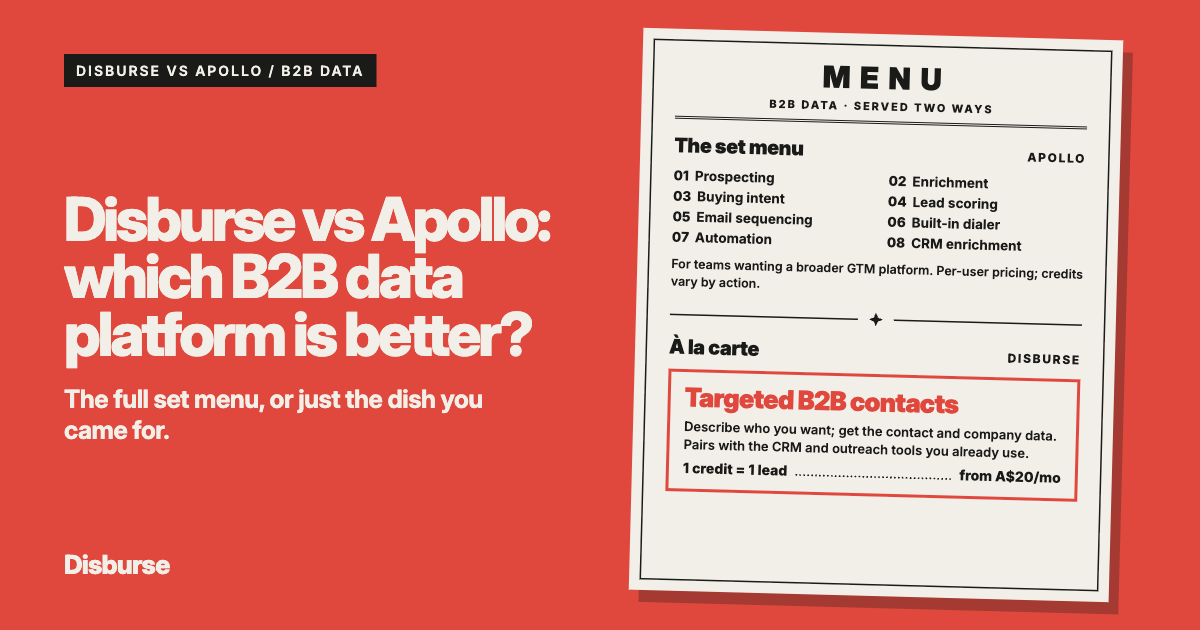
Disburse and Apollo both help businesses find B2B contacts and company data, but they are built for different kinds of users.
Apollo is a mature sales intelligence and engagement platform. It combines a large B2B contact database with prospecting, enrichment, buying signals, email sequencing, calling, automation and other sales tools.
Disburse is a more focused B2B data platform. It is designed to make finding the right companies and people as simple as describing who you want, then returning the relevant contact and company data.
The short answer: Disburse is likely the better choice if your main priority is finding highly targeted B2B contacts quickly, simply and at a low cost, particularly if you already use other tools for CRM, outreach or automation.
Apollo is likely the better choice if you want a larger all-in-one sales platform where your team can prospect, enrich, engage and manage outbound activity in one place.
Disburse vs Apollo at a glance
What is Disburse?
Disburse is a B2B data platform designed to make finding prospects easier.
Instead of beginning with a traditional database and manually constructing a long set of filters, a user can describe the people or companies they want to find in plain English.
For example:
“Find founders of Australian B2B SaaS companies with 10–100 employees.”
Or:
“Find Heads of Sales at UK software companies with 50–200 employees.”
Disburse converts the request into a structured search and returns matching people and companies.
Depending on the search and available data, results can include:
Name
Job title
Seniority
Job function
Business email
Direct phone number
LinkedIn URL
Company name
Company domain
Industry
NAICS
Entity type
Revenue
Employee count
Company locations
Specialties
City
Region
Country
The important distinction is that Disburse is not trying to become another complete sales operating system.
Its job is much simpler:
Help you find the right people and give you the data.
What is Apollo?
Apollo is one of the largest established sales intelligence platforms.
Apollo currently advertises more than 240 million verified contacts, more than 65 search filters, 98% email accuracy and 150 million contacts refreshed each month.
Its search capabilities include traditional criteria such as title, location, company size and industry as well as more advanced information such as intent signals and employee trends.
Apollo also goes well beyond data.
The platform includes:
Prospect and company search
Contact enrichment
CRM enrichment
Buying intent
Lead scoring
Sales sequences
Email outreach
Calling
Workflow automation
AI-assisted prospecting
Sales analytics
Apollo has also expanded its AI capabilities. Its AI Assistant can now interpret natural-language requests, and Apollo MCP allows users to work with Apollo data and sales functionality from AI tools including ChatGPT and Claude.
That breadth makes Apollo considerably more than a B2B contact database.
What is the main difference between Disburse and Apollo?
The biggest difference is scope.
Apollo is designed to become a central part of a sales team’s workflow.
Disburse is designed to give businesses access to B2B data without requiring them to move the rest of their sales process into the same platform.
An Apollo workflow might look like:
Search for prospects.
Enrich the contacts.
Score the leads.
Identify buying signals.
Add contacts to a sequence.
Send emails.
Make calls.
Analyse performance.
A Disburse workflow is intentionally much shorter:
Describe who you want to find.
Receive the contacts and company data.
Use the data wherever you want.
For businesses that already have a CRM, outreach platform or AI workflow, that can be a significant advantage.
Which is easier to use?
For straightforward B2B data discovery, Disburse is designed to be simpler.
A user doesn’t necessarily need to understand how a B2B database structures its filters before they can start searching.
They can simply ask:
“Find CFOs at Australian manufacturing companies with 100–500 employees.”
Or:
“Find founders of US cybersecurity companies with 20–100 employees.”
The user’s desired result becomes the starting point.
Apollo can also interpret natural-language prospecting requests through its AI Assistant, so natural-language searching is no longer unique to Disburse.
However, Apollo still sits within a much larger platform containing data, engagement, enrichment, analytics and other sales functionality.
That breadth is useful for teams that need those tools.
For someone who simply wants a list of the right people, a more focused product can be easier to work with.
Which is better for finding highly specific prospects?
Both platforms are capable of sophisticated targeting, but they approach it differently.
Apollo provides more than 65 filters across people and companies, including criteria such as title, seniority, location, company size, industry, buying intent and other firmographic and behavioural signals. Apollo also supports natural-language search through its AI Assistant.
Disburse is built around expressing that targeting as a request.
For example:
“Find founders of Australian recruitment agencies with 10–50 employees.”
“Find sales directors at UK SaaS companies with 50–200 employees.”
“Find CEOs of US logistics companies with $20m–$100m in revenue.”
For experienced SDR or RevOps teams that want granular control over every part of a database query, Apollo’s depth of filtering can be an advantage.
For users who know what a good prospect looks like and simply want the resulting list, Disburse offers a more direct approach.
Which has better B2B data?
There is no credible universal answer because data quality depends heavily on geography, industry, role and the specific people being searched.
Apollo has a clear advantage in publicly documented scale.
It advertises more than 240 million verified contacts and says it uses a combination of its contributor network, engagement products, public data crawling and third-party providers to collect and verify information.
Apollo also reports 98% email accuracy.
Disburse’s proposition is different.
It is not built around convincing users that access to the largest possible database is the most important measure of a B2B data product.
For most sales campaigns, the practical requirement is not:
“Give me access to 240 million people.”
It is:
“Give me the right 100 people for this campaign.”
Disburse focuses on getting from that request to usable contact data with as little friction as possible.
If maximum database scale is your priority, Apollo has the advantage.
If the priority is efficiently retrieving the particular prospects you need, the comparison becomes much closer.
Which is better for AI prospecting?
Both Apollo and Disburse can now work within AI-driven prospecting workflows.
Apollo has invested heavily in this area.
Apollo MCP connects Apollo with tools such as ChatGPT and Claude, allowing users to search for leads, enrich contacts and perform other Apollo actions from an AI conversation.
Disburse is also built around REST and MCP access, but the philosophy is slightly different.
With Apollo, the AI assistant can become an interface to a broader sales platform.
With Disburse, the AI assistant can become an interface to the B2B data itself.
That distinction matters for businesses that already have the rest of their sales infrastructure.
They may not need another platform to become their system of record. They may simply want to ask for a target market and receive the relevant data inside the tools where they already work.
Which is better for ChatGPT and Claude?
Both can be used with AI assistants.
Apollo MCP allows Apollo customers to work with Apollo data and sales functionality from ChatGPT, Claude and other supported AI environments.
Disburse also provides MCP access and is designed specifically so B2B data can sit inside AI-driven workflows.
The choice depends on what you want your AI assistant to do.
If you want it interacting with a broader sales platform, including sales engagement actions, Apollo is more comprehensive.
If you mainly want to ask an AI:
“Find these companies and the right people at them.”
Disburse provides a more focused solution.
Which is better for developers?
Both platforms provide programmatic access.
Apollo offers an established API covering data and other parts of its platform.
Disburse provides REST and MCP access, including on its free plan.
This makes Disburse particularly interesting for:
AI applications
Internal sales tools
Automated prospecting workflows
Data enrichment processes
Custom software products
Businesses that don’t want salespeople to work inside another dashboard
Developers can use Disburse as the B2B data layer while determining themselves what happens with the information afterwards.
Apollo is stronger if the application needs to interact with a wider sales ecosystem as well as the underlying data.
Which is better for founders and small teams?
Disburse is particularly well suited to founders and small teams that need prospect data but do not need another complete sales platform.
A founder might know exactly what their ideal customer looks like:
“Australian B2B SaaS founders with 10–100 employees.”
They don’t necessarily want to configure software, create workflows or learn a new prospecting system.
They want the list.
That simplicity is central to Disburse.
Apollo can also be a strong choice for small businesses, particularly if the company wants to build its outbound infrastructure from scratch.
Because Apollo combines data and sales engagement functionality, a small team may be able to consolidate several tools into one subscription.
So for small businesses the question is less:
“Which product has more features?”
And more:
“Do we actually need those features?”
Which is better for established sales teams?
For traditional SDR organisations, Apollo has a significant advantage.
A sales representative can find a contact, enrich their details, add them to a sequence, make calls and manage additional sales activity without leaving Apollo.
That integrated workflow can be valuable at scale.
Disburse becomes more attractive where the organisation already has an established stack.
If the business already uses:
A CRM
An outbound email platform
Sales automation tools
Internal AI workflows
Other enrichment tools
Then adding another large GTM platform may create unnecessary duplication.
Disburse can instead sit underneath those systems as a source of B2B data.
Which gives you more flexibility?
This depends on what you mean by flexibility.
Apollo provides flexibility inside its platform. There are extensive filters, workflows, engagement features and integrations.
Disburse provides flexibility in where the data goes next.
It is deliberately less opinionated about how you sell.
You can find the contacts, retrieve the data and use it in:
Your CRM
Your outbound platform
An AI agent
An internal system
A custom workflow
Another sales tool
For businesses with an existing technology stack, that can be more valuable than having additional functionality inside the data provider itself.
How does pricing compare?
Price is another area where Disburse is deliberately different.
Disburse uses a simple model:
One credit, one lead.
Searching is unlimited and free, and mobile numbers do not cost additional credits.
Current plans include:
Free: 50 credits per month
Growth: A$20/month for 5,000 credits and up to five team members
Scale: A$99/month for 50,000 credits and unlimited team members
Enterprise: Custom pricing
There is no annual lock-in, users are not charged twice for the same person, and Growth credit top-ups do not expire.
Apollo’s pricing is based around users, plans and credits. Its credit system can also vary depending on the data or functionality being accessed.
That does not necessarily make Apollo poor value. Apollo includes considerably more software.
But for a company that primarily wants contact data, Disburse’s model is considerably easier to understand:
Pay for the leads rather than the surrounding sales platform.
Which is better for mobile phone data?
This is an area where Disburse has a practical advantage.
With Disburse, mobile numbers do not cost additional credits.
A person still costs one credit.
Apollo uses credits for certain data types and actions, and its own documentation notes that credits can be consumed when revealing or enriching data such as email addresses and phone numbers.
For sales teams that rely heavily on calling, the cost of obtaining mobile data is worth including in the comparison rather than looking only at subscription prices.
Which has more features?
Apollo.
By a considerable margin.
Apollo combines its contact database with prospecting, sales engagement, enrichment, intent signals, workflows, calling and analytics.
If the requirement is:
“Give our sales team one platform where they can find leads and then run outbound.”
Apollo has the stronger proposition.
But feature count isn’t necessarily the best way to evaluate a B2B data provider.
If the requirement is:
“Find the right people and give us their data.”
Then the additional platform functionality matters much less.
This is where Disburse’s narrower scope becomes a strength rather than a limitation.
What are the main advantages of Apollo?
Apollo’s strongest advantages are:
A very large established B2B database
More than 65 prospecting filters
Mature sales intelligence functionality
Buying signals and intent data
Built-in sales engagement
Email sequencing
Calling functionality
CRM enrichment
Extensive integrations
AI Assistant and MCP functionality
A broader ecosystem for SDR and RevOps teams
Apollo is particularly strong when a business wants its B2B data provider to play a central role across the sales process.
What are the main advantages of Disburse?
Disburse’s strongest advantages are:
Natural-language B2B discovery
A simple search-to-result workflow
Highly targeted contact and company searches
Business emails, phone numbers and LinkedIn URLs
Detailed company and person attributes
REST API access
MCP access
Easy integration into AI workflows
No requirement to adopt another sales platform
Unlimited searching
One credit per lead
Mobile numbers at no additional credit cost
Low-cost high-volume plans
No annual lock-in
Unlimited users on the Scale plan
Flexibility to use the data in any downstream sales workflow
Disburse is particularly strong when the data is the product you actually need.
What are the limitations of Disburse compared with Apollo?
Disburse is not an all-in-one sales engagement platform.
If you need built-in:
Email sequencing
Calling
Buying intent
Lead scoring
Sales engagement analytics
Extensive CRM workflows
Apollo is the more complete product.
Businesses choosing Disburse would generally use their preferred tools for those functions.
That is an intentional part of the product’s positioning rather than something Disburse is trying to replicate.
What are the limitations of Apollo compared with Disburse?
Apollo’s breadth can also create trade-offs.
If you only want B2B data, you may be adopting and paying for a substantially broader platform than necessary.
Its pricing and credit structure are also more complex than Disburse’s simple one-lead-per-credit model.
And while experienced sales teams may value Apollo’s extensive interface, businesses that primarily want to ask for a target market and retrieve the contacts may prefer a more focused workflow.
When should you choose Apollo?
Apollo is likely the better option if you:
Want prospecting and outbound sales in one platform
Need a very large established contact database
Want extensive prospecting filters
Need buying intent or sales signals
Want built-in email sequences
Need calling functionality
Want deep CRM enrichment
Have a dedicated SDR or RevOps team
Want to consolidate several sales tools into one platform
Apollo’s greatest strength is breadth.
When should you choose Disburse?
Disburse is likely the better option if you:
Primarily need B2B contact and company data
Want to describe prospects in plain English
Need highly targeted prospect lists
Want a simpler prospecting workflow
Already have a CRM or outbound platform
Want data inside ChatGPT, Claude or other AI workflows
Need REST or MCP access
Want to use the data inside your own software
Need high volumes of contact data at a low cost
Want simple, predictable credits
Need phone numbers without additional credit costs
Don’t want an annual contract
Don’t want to pay per user as your team grows
Disburse’s greatest strengths are focus, simplicity and flexibility.
Disburse vs Apollo: which is better?
There is no single winner for every business.
Apollo is the better product if you’re looking for a comprehensive sales intelligence and engagement platform.
Its database scale, advanced filters, intent data, enrichment and outbound functionality make it particularly well suited to established sales teams that want to work within one ecosystem.
Disburse is the better fit if your priority is the B2B data itself.
It gives businesses a simple way to describe who they want, retrieve relevant contact and company information, and use that data in whatever tools or workflows they prefer.
It is also significantly more accessible for businesses that want high-volume contact data without enterprise-style pricing or an annual commitment.
The simplest way to think about the difference is:
Apollo helps you build and run a sales workflow around its data.
Disburse gives you the data and lets you decide what happens next.
For businesses that already have their preferred sales stack, or simply want an easier way to find the right B2B contacts, that makes Disburse a compelling Apollo alternative.
Frequently asked questions
Is Disburse an alternative to Apollo?
Yes. Disburse is an Apollo alternative for businesses primarily looking for B2B contact and company data. It is not intended to replicate every part of Apollo’s broader sales engagement platform.
Is Disburse better than Apollo?
Disburse can be better if your priority is finding targeted B2B contact data simply, flexibly and at a low cost. Apollo is better suited to businesses that want prospecting data combined with sales engagement, enrichment, intent data and other sales functionality.
Is Apollo better for large sales teams?
Apollo is generally better for large SDR teams that want sales intelligence and outbound execution within the same platform. Disburse can be more attractive for larger organisations that already have an established sales stack and primarily need B2B data.
Which is better for founders?
Disburse is particularly well suited to founders who know the type of customer they want to reach and primarily need the contacts. Apollo may be better for founders who also want built-in tools for executing their outbound sales campaigns.
Which is easier to use?
For straightforward contact discovery, Disburse is designed to be simpler. Apollo offers considerably more functionality and therefore a broader product experience.
Can Disburse find emails and phone numbers?
Yes. Disburse can return available business emails, direct phone numbers and LinkedIn URLs alongside person and company information.
Does Apollo have a bigger database?
Yes. Apollo publicly advertises more than 240 million verified contacts, giving it a clear advantage in documented database scale.
Can both Disburse and Apollo search using natural language?
Yes. Disburse is built around natural-language prospect discovery, while Apollo’s AI Assistant can also interpret natural-language requests when searching for people and companies.
Can Disburse work with AI tools?
Yes. Disburse provides REST and MCP access and is designed to work within AI-driven prospecting and data workflows.
Can Apollo work with ChatGPT and Claude?
Yes. Apollo MCP allows Apollo data and actions to be accessed from supported AI environments including ChatGPT and Claude.
Is Disburse cheaper than Apollo?
For businesses primarily purchasing B2B contact data, Disburse offers very low-cost plans. Growth costs A$20/month for 5,000 credits and Scale costs A$99/month for 50,000 credits. Apollo provides substantially more sales functionality, so pricing should be compared in the context of what each product includes.
Does Disburse charge extra for mobile numbers?
No. Mobile numbers do not cost additional Disburse credits. One credit retrieves one lead.
What is the biggest difference between Apollo and Disburse?
Apollo is a broad sales intelligence and engagement platform built around B2B data. Disburse is a focused B2B data product designed to make finding and using business contacts simple.
Who should choose Disburse over Apollo?
Businesses should consider Disburse over Apollo when their main requirement is finding targeted B2B contacts and company data rather than adopting another complete sales platform.
Who should choose Apollo over Disburse?
Businesses should consider Apollo when they want prospect data, enrichment, intent, sales engagement and outbound execution inside a single platform.
Apollo Alternativelead generationB2B Contact DatabaseApolloAI ProspectingB2B DataSales ProspectingDisburseB2B Sales ToolsSales Intelligence