Clay vs Disburse for Building Targeted B2B Lead Lists
17 min readLachlan McBride White
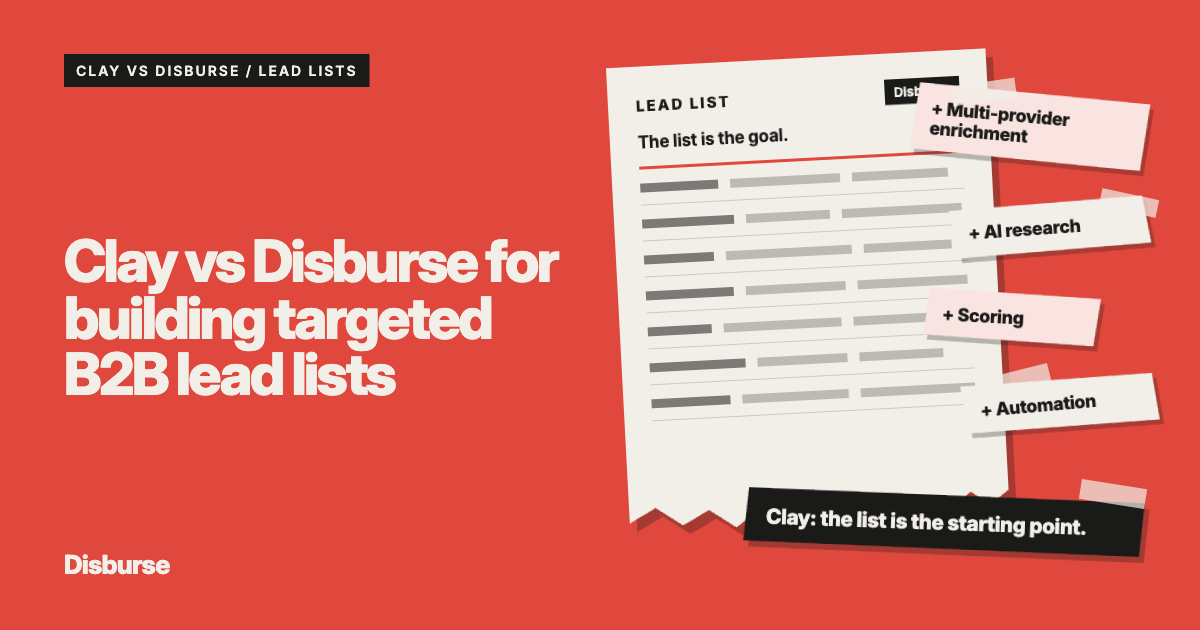
Clay and Disburse can both help businesses build targeted B2B lead lists.
But they are designed around very different ways of getting there.
Clay is a GTM workflow and enrichment platform. It lets teams combine multiple data providers, enrich records, run AI research, track signals, score prospects and automate what happens next.
Disburse is a focused B2B data platform.
It is designed to help users describe the companies and people they want, retrieve structured contact and company data, and use those leads in whatever sales or AI workflow they already prefer.
The short answer: For businesses that mainly want to turn a clear ICP into a usable B2B lead list, Disburse is likely the simpler and more direct option.
Clay is stronger when the list is only the starting point and the team also wants multi-provider enrichment, custom research, scoring and workflow automation.
Clay vs Disburse at a glance
Feature
Primary use case
Disburse:
Targeted B2B lead discovery
Clay:
GTM enrichment and workflow automation
Natural-language prospecting
Disburse:
Core experience
Clay:
Yes
Company search
Disburse:
Yes
Clay:
Yes
People search
Disburse:
Yes
Clay:
Yes
Business emails
Disburse:
Yes
Clay:
Yes
Direct/mobile numbers
Disburse:
Yes
Clay:
Yes
LinkedIn URLs
Disburse:
Yes
Clay:
Yes
Revenue targeting
Disburse:
Yes
Clay:
Yes
Employee targeting
Disburse:
Yes
Clay:
Yes
Industry targeting
Disburse:
Yes
Clay:
Yes
Geography targeting
Disburse:
Yes
Clay:
Yes
Multi-provider enrichment
Disburse:
Abstracted from the user
Clay:
Major strength
Waterfall enrichment
Disburse:
Not user-configured
Clay:
Yes
AI web research
Disburse:
Not the core product
Clay:
Yes, via Claygent
CRM enrichment
Disburse:
External workflows
Clay:
Major strength
Signal tracking
Disburse:
Not a core feature
Clay:
Yes
Workflow automation
Disburse:
External
Clay:
Extensive
REST / API access
Disburse:
Yes
Clay:
Yes
MCP / AI workflows
Disburse:
Yes
Clay:
Yes
Setup complexity
Disburse:
Low
Clay:
Higher
Best for
Disburse:
Teams that want the lead list itself
Clay:
Teams that want to build the system around the lead list
Which is better for building targeted B2B lead lists?
For the specific job of building a targeted B2B lead list, Disburse has a strong advantage in simplicity.
A user can describe the audience they want in plain language.
For example:
“Find founders of Australian B2B SaaS companies with 10–100 employees.”
Or:
“Find Heads of Sales at Singaporean fintech companies with 50–200 employees.”
Or:
“Find CFOs at New Zealand manufacturing companies with more than A$20 million in revenue.”
Disburse interprets the request and returns matching people and companies.
Clay can also build highly targeted lists.
But it is designed to let users go much further.
A Clay workflow might:
Find companies.
Identify the right contacts.
Run multiple enrichment providers.
Find emails.
Find phone numbers.
Research the account with AI.
Score the lead.
Push the result into a CRM or sequencer.
That is powerful when the team wants to manage the full workflow.
If the team mainly wants the list, Disburse is more direct.
How does Disburse build lead lists?
Disburse starts with the ICP.
Instead of manually building a complex sequence of filters or enrichment steps, the user describes the result they want.
For example:
“Find Managing Directors at Australian engineering consultancies with 20–200 employees.”
Or:
“Find senior HR leaders at professional-services firms in Australia and New Zealand with more than 200 employees.”
Disburse can search across person, company, contact and geographic criteria including:
Job title
Seniority
Job function
Company industry
NAICS
Entity type
Revenue
Employee count
Company locations
Specialties
City
Region
Country
Email availability
Phone availability
The resulting lead record can include available:
Business email
Direct phone number
LinkedIn URL
Company domain
Company revenue
Employee count
Industry
Location
The final output is already usable as a prospect dataset.
How does Clay build lead lists?
Clay can source people and companies.
But its main strength is what happens around that data.
A team can combine:
Clay’s own prospecting sources
Third-party enrichment providers
Waterfall enrichment
AI research through Claygent
Custom scoring
Signals
CRM data
Workflow logic
Clay gives teams more control over how prospect data is found, enriched and used.
That is especially useful when a business does not simply want to know:
“Who fits our ICP?”
but also:
“Which data source should we use, what else should we know about them, and what should happen after we find them?”
Which is better for a clearly defined ICP?
If the ICP is already clear, Disburse is likely the easier option.
For example:
ICP: Founders of Australian SaaS companies with 20–100 employees.
In Disburse, that can become:
“Find founders of Australian SaaS companies with 20–100 employees.”
The ICP and the search are almost identical.
Clay can also create the same audience.
But its additional value becomes more relevant when the team wants to enrich or transform the list further.
If the ICP is already well defined and the goal is simply to get the contacts, Disburse removes extra steps.
Which is better for highly specific lead lists?
Both can be strong.
Disburse is especially well suited to highly specific criteria based on person, company and geography.
For example:
“Find Finance Directors at New Zealand logistics companies with 100–500 employees.”
“Find Heads of Marketing at Singaporean SaaS businesses with 50–200 employees.”
“Find founders of Australian cybersecurity companies with 10–100 employees.”
Clay becomes more useful when specificity depends on custom enrichment or research.
For example:
“Find Australian SaaS companies with 50–200 employees, then determine which ones sell to enterprise customers and are hiring salespeople.”
That second part may require custom research or enrichment logic.
The distinction is:
Disburse is strong for precise structured targeting.
Clay is stronger when precise targeting depends on custom research and enrichment.
Which is faster for building a list?
For straightforward B2B list building, Disburse is designed to minimise the number of steps.
The workflow is:
Describe the audience → search → retrieve the leads
This is especially useful when users regularly switch between markets or ICPs.
An APAC sales team could search:
“Founders of Australian SaaS companies with 20–100 employees.”
Then:
“Heads of Sales at Singaporean fintech companies with 50–200 employees.”
Then:
“Managing Directors of New Zealand recruitment firms with 20–100 employees.”
The user does not need to rebuild a complex data workflow every time.
Clay can become faster once a sophisticated workflow has already been built and automated.
So:
For ad hoc or changing lists → Disburse
For repeatable automated workflows at scale → Clay
Which is easier to use?
For simple lead-list creation, Disburse is likely easier.
The user mainly needs to know who they want to find.
Clay requires more understanding if the team wants to use its full power.
That can include:
Tables
Providers
Waterfalls
Enrichment logic
Claygent
Actions
Data Credits
Signals
Integrations
CRM sync
Workflow automation
For RevOps and technical growth teams, this level of control can be useful.
For a founder or salesperson who mainly wants a clean list of relevant prospects, it may be more setup than necessary.
Which is better for APAC lead generation?
Disburse is especially relevant for APAC-focused sales teams because regional ICPs can be expressed directly.
For example:
“Find founders of B2B SaaS companies in Australia, New Zealand and Singapore with 20–100 employees.”
Or:
“Find senior sales leaders at fintech companies in Singapore and Hong Kong.”
Or:
“Find Managing Directors at Australian and New Zealand engineering consultancies with more than 50 employees.”
This makes it straightforward to switch between APAC markets without changing the core workflow.
Clay can also be powerful across APAC.
Teams can combine different enrichment sources and test which providers perform best across different countries.
That is especially useful for sophisticated data teams.
The choice comes down to:
Do you want to manage the regional enrichment strategy yourself?
or
Do you want the resulting lead list?
Which is better for founders and small sales teams?
For founders and smaller teams mainly needing prospect data, Disburse is likely the more practical fit.
A founder may already know:
“We sell to Australian recruitment agencies with 20–100 employees, and the founder is usually the buyer.”
They do not necessarily need to build:
An enrichment table
A provider waterfall
Scoring logic
Automated routing
AI research workflows
They need the actual companies and people.
Disburse is designed around that job.
Clay may be a better fit for a technically sophisticated small team that wants to automate a broader outbound process from the start.
Which is better for RevOps teams?
Clay.
This is one of the clearest distinctions.
Clay is designed for teams that want to orchestrate what happens around prospect data.
A RevOps workflow may look like:
New account → enrichment → find contacts → email waterfall → phone waterfall → AI research → scoring → CRM sync → outbound sequence
That is exactly the type of workflow Clay is designed to support.
Disburse is more likely to act as a straightforward data source inside an existing RevOps stack.
Which is better for agencies?
Disburse can be especially useful for agencies that need to create different prospect lists for different clients.
For example:
Client A
“Find founders of Australian SaaS companies with 20–100 employees.”
Client B
“Find Heads of Sales at Singaporean fintech companies with 50–500 employees.”
Client C
“Find Managing Directors at New Zealand engineering consultancies.”
The agency can change the target audience simply by changing the request.
Clay may be stronger for agencies that sell sophisticated outbound operations or data enrichment as part of their service.
If the agency is building reusable enrichment, scoring and research workflows for clients, Clay’s configurability can become a major advantage.
Which is better for recruiters?
Disburse can be useful for recruiters that need to build structured market maps or business-development lists.
For example:
“Find Heads of Talent at Australian technology companies with 100–500 employees.”
Or:
“Find engineering leaders at Singaporean software companies with more than 200 employees.”
Clay may be more useful where the recruiter already has a large dataset and wants to enrich, categorise or research those records.
For straightforward market mapping, Disburse is simpler.
For more complex data operations, Clay is stronger.
Which is better for emails and phone numbers?
Both can provide email and phone data, but the workflow is different.
Clay lets users create multi-provider waterfalls.
If the first provider does not find an email or phone number, Clay can try another provider, then another.
This can improve coverage and gives the team control over how enrichment works.
Disburse abstracts that process away from the user.
A retrieved lead can include available business email and direct phone data without the user needing to configure a provider chain.
Disburse also uses a simple model:
One credit = one lead.
Mobile numbers do not cost extra credits.
The distinction is:
Want to control the enrichment process → Clay
Want the contact details without managing the process → Disburse
Which is better for custom data fields?
Clay.
This is one of its major advantages.
Through Claygent and other enrichment tools, a team can create custom research fields that do not normally exist in standard contact databases.
For example:
Does this company sell to enterprise customers?
Does its website mention a particular product?
Is it hiring salespeople?
Has it recently expanded into a new market?
Does it match an internal qualitative ICP rule?
That makes Clay especially strong for teams whose definition of a good lead goes beyond standard firmographic data.
Disburse is more focused on structured B2B person and company information.
Which is better for AI-generated lead lists?
Both can be used in AI-driven workflows.
Disburse provides REST and MCP access.
This lets an AI assistant or agent request structured B2B data directly.
For example:
“Find 500 founders of Australian B2B software companies with 20–100 employees.”
The data can then be sent into another workflow.
Clay can go further by allowing AI-driven workflows to perform:
Enrichment
Research
Additional actions
Workflow execution
The distinction is:
Disburse is strong when AI needs the lead data.
Clay is strong when AI needs to operate a broader GTM workflow around the leads.
Which is better if you already have a sales stack?
Disburse is especially attractive if the rest of your sales process already works.
For example:
Disburse → CRM → outbound platform → dialler → reporting
If that setup already exists, you may not need an extra orchestration layer.
You simply need the prospects feeding into it.
Clay becomes more useful when the goal is to connect and automate the systems themselves.
For example:
CRM → Clay → enrichment → research → scoring → outbound → CRM update
The distinction is:
Disburse feeds the stack.
Clay helps orchestrate the stack.
Which is better for building large prospect lists?
For straightforward contact volume, Disburse is particularly competitive.
Disburse lead-list pricing
Plan
Free
Price:
A$0
Included:
50 credits/month
Growth
Price:
A$20/month
Included:
5,000 credits/month
Scale
Price:
A$99/month
Included:
50,000 credits/month
Enterprise
Price:
Custom
Included:
Custom requirements
Searching is unlimited.
One credit equals one lead.
Mobile numbers do not cost extra credits.
Growth top-ups never expire.
Clay uses a broader usage model because its users may perform several actions and enrichments for each prospect.
That makes sense when every lead is being researched, enriched and processed through a more advanced workflow.
If the goal is simply to build a large structured list, Disburse’s pricing and usage model is easier to predict.
Which is better for testing new ICPs?
Disburse has a strong advantage for teams still experimenting with their target market.
Searching is unlimited.
A business could test:
“Australian SaaS founders with 10–50 employees.”
Then:
“Singaporean fintech Heads of Sales with 50–200 employees.”
Then:
“New Zealand recruitment agency owners with 20–100 employees.”
before deciding which contacts to retrieve.
Clay can also be excellent for ICP experimentation.
It becomes especially useful when the team wants to enrich sample accounts with extra data before deciding what defines a good lead.
The difference is:
Disburse makes ICP exploration simple.
Clay makes ICP experimentation more configurable and data-rich.
Which is better for repeatable lead-generation workflows?
Clay can be stronger when the workflow is stable and repeatable.
Once a Clay workflow has been configured, new records can move through the same enrichment, research and routing process automatically.
For example:
New company → find buyer → enrich contact → research → score → route
That can save significant operational time at scale.
Disburse is more useful when the main requirement is repeatedly retrieving different targeted audiences without maintaining the surrounding enrichment workflow.
Which gives you more control?
Clay.
It gives teams more control over:
Data providers
Enrichment order
Workflow logic
AI research
Scoring
Routing
Signals
CRM updates
Disburse gives the user less control over the underlying data-retrieval machinery.
That is deliberate.
Its goal is to make the machinery something the user does not need to think about.
So:
Clay offers control through configuration.
Disburse offers simplicity through abstraction.
Is Clay overkill for building lead lists?
Sometimes.
If a team actively uses Clay’s:
Enrichment
AI research
Signals
CRM sync
Workflow automation
then it is not overkill.
Those features can create real value.
But if the workflow is simply:
Find people → get emails and phones → export
then the team may be paying for and maintaining capabilities it does not need.
That is where a more focused platform such as Disburse can make more sense.
How does pricing compare?
Price should not be the only factor because Clay and Disburse provide very different levels of functionality.
Disburse pricing
Plan
Free
Price:
A$0
Included:
50 credits/month
Growth
Price:
A$20/month
Included:
5,000 credits/month
Scale
Price:
A$99/month
Included:
50,000 credits/month
Enterprise
Price:
Custom
Included:
Custom requirements
Disburse uses a simple model:
One credit = one lead.
Searching is unlimited.
Mobile numbers do not cost extra credits.
There is no annual lock-in.
Clay separates platform usage from underlying data consumption through Actions and Data Credits.
That reflects the fact that a Clay workflow may perform many operations on a single lead.
For businesses using those workflows, that complexity may be justified.
For a business simply buying contact data, Disburse’s model is easier to understand.
Which offers better value for list building?
For straightforward list creation, Disburse is likely to offer better value.
The product and pricing are closely tied to the end result:
a lead.
Clay can offer better value when each record requires more work.
That might include:
Multi-provider enrichment
Custom research
Scoring
Signal monitoring
CRM maintenance
Routing
Automation
The better question is:
“What work do you need the platform to perform per lead?”
If the answer is mainly:
“Find the person and give me the data.”
Disburse is likely the better fit.
If the answer is:
“Find, enrich, research, score and activate the person.”
Clay becomes much more compelling.
What are Clay’s main advantages for lead-list building?
Clay’s strongest advantages include:
Multi-provider waterfall enrichment
Custom AI research
Flexible enrichment logic
CRM enrichment
Signal tracking
Custom scoring
Workflow automation
Provider choice
Complex data orchestration
Repeatable GTM workflows
Its biggest advantage is what you can build around the list.
What are Disburse’s main advantages for lead-list building?
Disburse’s strongest advantages include:
Natural-language prospect discovery
Straightforward ICP-to-list workflow
Structured company and contact data
Business emails
Direct phone numbers
LinkedIn URLs
Revenue and employee targeting
APAC-focused use cases
REST access
MCP access
AI workflow compatibility
Unlimited searching
Simple one-credit-per-lead model
No extra credit cost for mobile numbers
High-volume plans
No annual lock-in
Low setup overhead
Its biggest advantage is getting from a defined ICP to a usable list with fewer steps.
When should you choose Clay for lead lists?
Choose Clay when:
Your list needs several enrichment sources
You want custom AI research
You have RevOps or technical growth resources
You need custom scoring
You want CRM auto-enrichment
Signals influence targeting
You want automated downstream workflows
You need control over provider selection
Your lead-generation process is highly repeatable
The workflow around each lead creates significant value
Clay is strongest when the list is the beginning of the workflow.
When should you choose Disburse for lead lists?
Choose Disburse when:
The lead list itself is the main outcome
You already know your ICP
You want natural-language search
You prospect across APAC
You switch between target markets regularly
You already have a CRM or outbound platform
You want REST or MCP access
You use AI for prospecting
You need business emails and phone numbers
You do not want to configure enrichment providers
You need large data volumes
You want simple credit usage
You want minimal setup
Disburse is strongest when the list is the result you actually need.
Clay vs Disburse: which is better for building targeted B2B lead lists?
For building targeted B2B lead lists specifically, Disburse is likely the better fit for businesses that value speed, simplicity and a direct route from ICP to contact data.
You describe the target, retrieve the matching companies and decision-makers, and use those records wherever your sales process already happens.
That makes Disburse particularly relevant to:
Founders
Small sales teams
Agencies
Recruiters
APAC-focused businesses
AI-driven sales workflows
Clay is the stronger choice when lead-list creation is part of a broader data-engineering process.
Its enrichment waterfalls, AI research, custom fields, signals and workflow automation allow sophisticated RevOps and growth teams to build much more around each lead.
The simplest distinction is:
Disburse helps you build the list.
Clay helps you build the system around the list.
If the list itself is the job you need done, Disburse is likely the more practical option.
If the workflow around the list is strategically important, Clay offers significantly more depth.
Frequently asked questions
Is Clay or Disburse better for building B2B lead lists?
Disburse is likely better for straightforward ICP-based lead-list creation.
Clay is stronger when the list also requires:
Multi-provider enrichment
Custom research
Scoring
Automation
Can Disburse build highly targeted lead lists?
Yes.
Disburse can target using person, company and geographic criteria including:
Job title
Seniority
Industry
Revenue
Employee count
Location
Can Clay build highly targeted lead lists?
Yes.
Clay can source prospects and add extra targeting through:
Enrichment
AI research
Provider data
Custom logic
Which is easier for building lead lists?
Disburse is designed to be simpler for straightforward list creation because users can describe the target audience and retrieve the corresponding data.
Which is better for APAC lead generation?
Disburse is especially relevant for straightforward list creation across Australia, New Zealand, Singapore and other APAC markets.
Clay may be stronger where the business needs custom multi-provider enrichment across those markets.
Which is better for small sales teams?
For teams mainly needing prospect data, Disburse is likely more practical.
Clay may be more useful for technically sophisticated teams that want to automate the wider prospecting process.
Which is better for agencies?
Disburse is especially useful for agencies that frequently switch between client ICPs.
Clay is stronger when the agency builds customised enrichment and automation workflows for clients.
Which is better for RevOps teams?
Clay.
Its multi-provider enrichment, workflow automation, CRM integrations and custom logic are much closer to a sophisticated RevOps use case.
Which is better for founders?
Disburse is likely easier for founders who already know their ICP and mainly need the matching companies and people.
Which is better for business emails?
Both can provide business email data.
Clay gives teams more control over which providers are used to find the email.
Disburse abstracts that process and returns the available contact data directly.
Which is better for phone numbers?
Both can provide phone data.
Disburse does not charge extra credits for mobile numbers.
Clay lets teams configure phone-enrichment workflows across several providers.
Which is better for AI-generated lists?
Disburse is strong for AI workflows that simply need to request and receive B2B data through REST or MCP.
Clay is stronger where AI also needs to:
Enrich
Research
Score
Automate workflows
around those leads.
Which is better for custom research?
Clay.
Claygent and Clay’s wider enrichment system allow teams to generate custom research fields that go beyond standard B2B contact data.
Is Clay overkill if I only need contact lists?
It can be.
If you do not use Clay’s enrichment, AI research, signals or automation, a more focused B2B data platform may be simpler.
Can Disburse replace Clay for list building?
Yes, if the main use of Clay is sourcing people and companies and retrieving standard contact data.
Disburse does not replace Clay’s broader enrichment and workflow capabilities.
Which offers better value for high-volume lead lists?
For straightforward contact retrieval, Disburse is particularly competitive.
Growth includes 5,000 monthly credits for A$20.
Scale includes 50,000 monthly credits for A$99.
What’s the biggest difference between Clay and Disburse for lead lists?
Disburse focuses on getting from an ICP to a usable contact list.
Clay focuses on giving teams control over how the list is:
Sourced
Enriched
Researched
Scored
Activated
Which is better overall?
For straightforward targeted B2B lead-list creation, Disburse is likely the simpler and more focused option.
For sophisticated enrichment and automated GTM workflows, Clay is stronger.
GTM WorkflowsAPAC ProspectingGTM AutomationSmall Sales TeamsB2B Contact DatabaseRevOpsAI ProspectingNatural-Language SearchB2B DataSales ProspectingData EnrichmentDisburseClay AlternativeClayB2B Lead ListsWaterfall EnrichmentIdeal Customer Profile (ICP)B2B Prospect List