Clay vs Disburse: Do You Need a GTM Workflow Builder or Just the Data?
17 min readLachlan McBride White
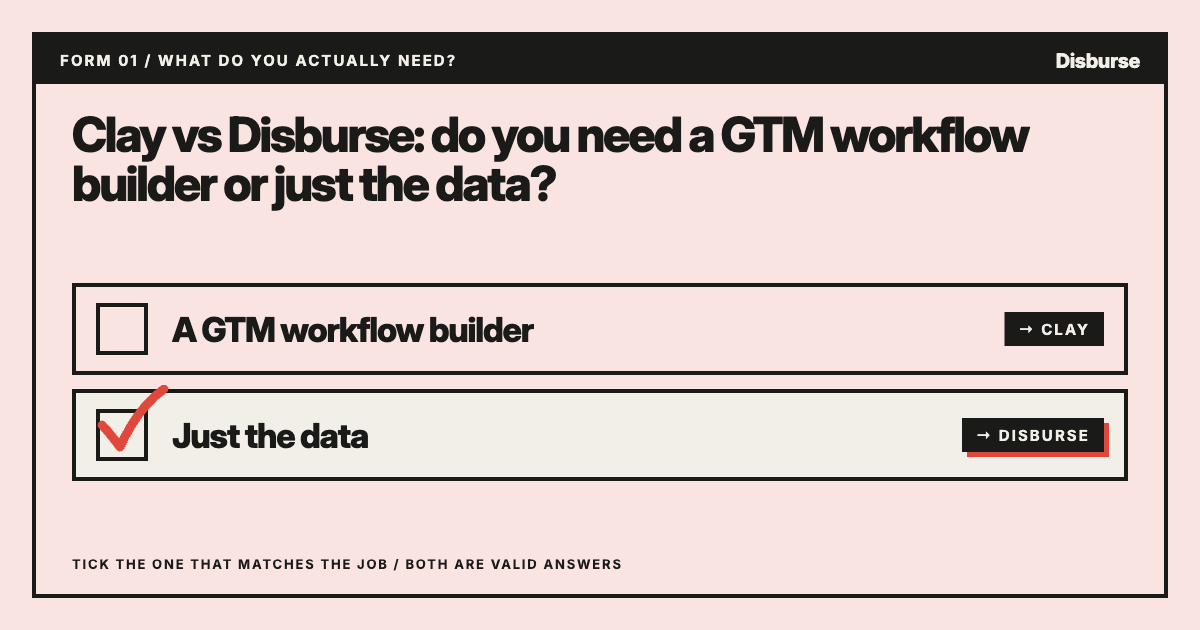
Clay and Disburse can both help businesses find B2B companies and contacts.
But they are built for very different levels of complexity.
Clay is a GTM workflow and enrichment platform. It lets teams combine data from many providers, build waterfall enrichments, run AI research, track signals, sync CRMs and automate what happens after a lead is found.
Disburse is a focused B2B data platform.
It is designed to help users describe the companies and decision-makers they want, retrieve structured contact and company data, and use those leads in whatever system they already prefer.
The short answer: If you want to build and control a sophisticated GTM data workflow, Clay is the stronger platform.
If your main requirement is simply to find targeted B2B companies and contacts without building the machinery around that process, Disburse is likely the better fit.
The real question is not which platform has more features.
It is:
Do you need to build the workflow, or do you just need the data?
Clay vs Disburse at a glance
Feature
Primary focus
Disburse:
B2B contact and company discovery
Clay:
GTM workflow and data enrichment
Natural-language prospecting
Disburse:
Core experience
Clay:
Yes
Company search
Disburse:
Yes
Clay:
Yes
People search
Disburse:
Yes
Clay:
Yes
Business emails
Disburse:
Yes
Clay:
Yes
Direct/mobile numbers
Disburse:
Yes
Clay:
Yes
LinkedIn URLs
Disburse:
Yes
Clay:
Yes
Revenue targeting
Disburse:
Yes
Clay:
Yes
Employee targeting
Disburse:
Yes
Clay:
Yes
Geography targeting
Disburse:
Yes
Clay:
Yes
Multi-provider enrichment
Disburse:
Abstracted from the user
Clay:
Major strength
Waterfall enrichment builder
Disburse:
No
Clay:
Yes
AI web research
Disburse:
Not the core product
Clay:
Claygent
Signal tracking
Disburse:
Not a core feature
Clay:
Yes
CRM auto-enrichment
Disburse:
External workflow
Clay:
Yes
Workflow automation
Disburse:
External
Clay:
Major strength
REST
Disburse:
Yes
Clay:
Yes, depending on plan/use case
MCP
Disburse:
Yes
Clay:
Yes
Setup complexity
Disburse:
Low
Clay:
Higher
Best for
Disburse:
Teams that want usable B2B data
Clay:
Teams that want to engineer GTM workflows
What is Clay?
Clay is a GTM data, enrichment and automation platform.
Rather than acting as a single traditional contact database, Clay lets teams combine data and actions across a wide ecosystem of providers.
Clay can:
Run multi-provider waterfalls
Use Claygent for AI web research
Track signals
Enrich CRM records
Sync data into CRMs
Trigger downstream workflows
A typical Clay workflow might look like this:
Find target companies.
Find the right people.
Run multiple providers to locate email addresses.
Run additional providers for phone numbers.
Research each company with AI.
Score the accounts.
Track relevant signals.
Push qualified leads into a CRM or outbound sequence.
For teams that want to build this kind of system, Clay is extremely powerful.
What is Disburse?
Disburse approaches B2B prospecting from the opposite direction.
Instead of asking the user to build the data workflow, it focuses on the desired result.
A user can ask:
“Find founders of Australian B2B SaaS companies with 10–100 employees.”
Or:
“Find Heads of Sales at Singaporean fintech companies with 50–200 employees.”
Or:
“Find CFOs at New Zealand manufacturing businesses with more than A$20 million in revenue.”
Disburse interprets the request and returns structured people and company records.
Available data can include:
Name
Title
Seniority
Job function
Business email
Direct phone
LinkedIn URL
Company name
Company domain
Industry
NAICS
Entity type
Revenue
Employee count
Locations
Specialties
City
Region
Country
The user does not need to decide which enrichment providers should run or how a waterfall should be configured.
The product is built around:
Describe who you need → get the data.
What is the biggest difference between Clay and Disburse?
The biggest difference is how much responsibility the user wants for building the prospecting workflow.
Clay gives users a high level of control.
A team can decide:
Where prospects come from
Which providers enrich them
In what order those providers run
Which custom research should happen
How leads should be scored
Which signals should be tracked
Where the final records should go
Disburse removes much of that decision-making.
The user defines the target and retrieves the resulting B2B data.
So:
Clay is more configurable.
Disburse is more turnkey.
Do you actually need a GTM workflow builder?
Not every business does.
A GTM workflow builder becomes valuable when the prospecting process is genuinely complex.
For example:
Target account → company enrichment → contact search → email waterfall → phone waterfall → AI research → scoring → CRM sync → outbound sequence
If that process is important to how your sales organisation operates, Clay is built for it.
But many businesses have a much simpler requirement:
“Find the right people and give us their contact details.”
If that is the actual job, building and maintaining the workflow around it may create unnecessary operational overhead.
That is where Disburse becomes more compelling.
When is Clay’s workflow approach worth it?
Clay’s model makes sense when the workflow itself creates value.
For example, a RevOps team may want to automatically:
Detect new accounts entering the CRM
Enrich each account
Find appropriate decision-makers
Retrieve multiple contact fields
Research the account
Calculate an ICP score
Monitor job changes
Push qualified contacts into an outbound platform
For a team running sophisticated GTM operations, these are not unnecessary extras.
They are the product.
When is Disburse’s simpler approach better?
Disburse is likely better when the organisation already knows its target market and simply needs the records.
For example:
“Find Managing Directors of Australian engineering consultancies with 20–200 employees.”
The business may already have:
A CRM
An outbound email platform
A dialler
A sequencing tool
Automation software
An internal AI system
It does not necessarily need another product orchestrating those systems.
It needs the prospect data feeding into them.
Disburse can provide that layer without requiring the sales process to be rebuilt around the data provider.
Which is easier to use?
For straightforward lead discovery, Disburse is likely easier.
The user starts with the business question:
“Who do we want?”
rather than:
“How should the workflow be configured?”
Clay has made its platform more accessible, including natural-language search and MCP.
But there is still much more functionality to understand if a team wants to use its full value.
That includes concepts such as:
Tables
Waterfalls
Enrichment providers
Claygent
Actions
Data Credits
Signals
CRM sync
HTTP integrations
Workflow logic
For technical growth or RevOps teams, that control is useful.
For a founder or salesperson who simply needs a lead list, it can be more than necessary.
Which is better for natural-language B2B prospecting?
Both support natural-language workflows.
Disburse is organised around natural-language lead discovery as the core experience.
You can ask:
“Find founders of Australian cybersecurity companies with 10–100 employees.”
and move directly toward the matching B2B data.
Clay can also support natural-language prospecting and MCP-based workflows.
The distinction is what happens next.
With Disburse, the natural-language request mainly returns the data.
With Clay, the request can become the starting point for a much larger enrichment and automation process.
The difference is:
Disburse uses natural language to simplify data retrieval.
Clay uses natural language as an interface to a configurable GTM system.
Which is better for APAC sales teams?
For APAC teams mainly looking for prospect data, Disburse has a strong use case.
A salesperson can ask:
“Find founders of B2B SaaS companies in Australia, New Zealand and Singapore with 20–100 employees.”
Or:
“Find senior sales leaders at fintech companies in Singapore and Hong Kong.”
Or:
“Find Managing Directors of Australian and New Zealand recruitment firms with 20–100 employees.”
This makes switching between APAC markets straightforward.
Clay may be more useful when regional prospecting requires a deliberately built combination of providers or custom enrichment steps.
For example, a sophisticated APAC RevOps team may want to compare how several data sources perform across different countries.
That is much closer to Clay’s strength.
The decision comes down to:
Do you want to manage the regional data strategy yourself, or do you want the prospect results?
Which is better for small B2B sales teams?
For most small sales teams whose main requirement is B2B contact data, Disburse is likely the simpler choice.
A five-person team can use Disburse Growth for:
A$20/month with 5,000 credits and up to five team members.
The business can search for prospects, retrieve the data and move the contacts into whatever sales tools it already uses.
Clay’s paid plans are aimed at teams building and automating more complex prospecting workflows.
That is not a like-for-like comparison.
Clay includes a much broader workflow platform.
But if the team is not going to use that workflow functionality, Disburse is likely the more efficient purchase.
Which is better for founders?
Disburse is likely better suited to founders who already understand their ICP.
A founder may know:
“We sell to Australian recruitment agencies with 20–100 employees, and the founder is usually our buyer.”
They do not necessarily want to:
Build a table
Choose enrichment providers
Configure waterfalls
Design scoring logic
Automate routing
They want the people.
Clay becomes more attractive when the founder or early growth team wants to build a more advanced prospecting engine.
The distinction is:
Founder wants leads → Disburse
Founder wants to engineer an automated GTM system → Clay
Which is better for RevOps?
Clay.
This is one of the clearest cases in the comparison.
Clay lets RevOps teams build repeatable data workflows rather than simply retrieve contact records.
A RevOps team can automate:
Enrichment
CRM maintenance
Account research
Routing
Scoring
Signals
Outbound activation
Disburse is more likely to serve as one of the data inputs into a RevOps stack rather than the orchestration layer controlling it.
Which is better for agencies?
It depends on what the agency sells.
An agency that mainly needs new prospect lists for different clients may find Disburse simpler.
One day:
“Find Australian SaaS founders with 20–100 employees.”
The next:
“Find Heads of Marketing at Singaporean ecommerce companies with 100–500 employees.”
Then:
“Find Managing Directors at New Zealand engineering consultancies.”
The agency can move between these ICPs without rebuilding a workflow each time.
Clay may be more powerful for agencies selling advanced outbound operations.
For example, an agency might build custom:
Enrichment
Scoring
Research
Signal workflows
for each client.
If the workflow itself is part of the agency’s service, Clay offers much more capability.
Which is better for custom enrichment?
Clay.
Clay’s biggest advantage is the ability to enrich records in ways that go beyond standard contact fields.
Teams can combine several providers and use Claygent to research custom information from the web.
That might include questions such as:
Does this company sell to enterprise customers?
Does its website mention a particular service?
Has it recently launched in a new market?
Does it match a specific internal ICP characteristic?
Claygent can generate custom data points using web research.
Disburse is more focused on structured B2B person and company data.
Which is better for email and phone enrichment?
This depends on whether you want control over the enrichment process or simply the resulting contact record.
Clay can run several providers in sequence.
For example:
Provider A → no result → Provider B → no result → Provider C → result
This is one of the main benefits of waterfall enrichment.
Disburse abstracts that process away from the user.
A retrieved lead can contain available business email and direct phone information without the user needing to decide which providers should be called.
The distinction is:
Want to configure the enrichment strategy → Clay
Want the contact data without configuring the strategy → Disburse
Which is better for AI research?
Clay.
Claygent gives Clay a meaningful advantage here.
Clay users can use AI to research websites and other public sources and create custom fields that may not exist in standard enrichment platforms.
This makes Clay especially strong where prospecting involves qualitative research as well as structured B2B data.
Disburse is designed more narrowly around finding companies, people and associated structured contact information.
Which is better for AI agents?
Both are relevant, but in different ways.
Disburse provides REST and MCP access.
That makes it useful when an AI agent needs to retrieve B2B data.
An agent might request:
“Find 500 founders of Australian B2B SaaS companies with 20–100 employees.”
The returned records can then be used elsewhere.
Clay can allow an AI-driven workflow to do more.
That can include:
Prospecting
Enrichment
Research
Workflow execution
The distinction is:
Disburse gives the agent access to B2B data.
Clay gives the agent access to a broader GTM workflow environment.
Which is better for an existing sales stack?
If the company already has a sales stack it likes, Disburse can be especially attractive.
For example:
Disburse → HubSpot → outbound platform → dialler → reporting
The team does not need another orchestration layer if the existing workflow works.
Clay is more valuable when the organisation wants to connect and automate those systems.
For example:
HubSpot → Clay enrichment → AI research → scoring → outbound → CRM update
That difference is central:
Disburse supplies the data to the stack.
Clay can orchestrate the stack around the data.
Which is better for CRM enrichment?
Clay.
If your CRM contains thousands of records that need ongoing enrichment, Clay is much closer to the problem.
Its workflows are designed to support:
CRM enrichment
CRM syncing
Data updates
Automation around those records
Disburse can provide data that ultimately goes into a CRM.
But ongoing CRM maintenance is not the core product.
Which is better for signals and timing?
Clay has more native functionality.
Its workflow tools can use signals such as:
Job changes
Promotions
New hires
Company news
Social activity
Website intent
This can help teams move beyond:
“Who should we target?”
to:
“When should we target them?”
Disburse is more focused on the first question.
If signals are a major part of your GTM strategy, Clay is stronger.
Which is better for high-volume contact data?
For teams mainly looking for a high volume of standard B2B contact records, Disburse is particularly competitive.
High-volume comparison
Platform / Plan
Disburse Free
Price:
A$0
Included:
50 credits/month
Disburse Growth
Price:
A$20/month
Included:
5,000 credits/month
Disburse Scale
Price:
A$99/month
Included:
50,000 credits/month
Disburse Enterprise
Price:
Custom
Included:
Custom requirements
Clay Free
Price:
Free
Included:
500 Actions + 100 Data Credits/month
Clay Launch
Price:
About US$185/month
Included:
15,000 Actions + 2,500 Data Credits at base tier
Clay Growth
Price:
About US$495/month
Included:
40,000 Actions + 6,000 Data Credits at base tier
With Disburse:
One credit equals one lead
Searching is unlimited
Mobile numbers do not cost extra credits
There is no annual lock-in
Growth top-up credits never expire
Clay separates usage into Actions and Data Credits.
Actions cover the work Clay performs, while Data Credits cover marketplace data.
That model makes sense for a workflow platform.
For simple lead retrieval, Disburse is easier to predict.
Is Clay more flexible than Disburse?
Yes, if flexibility means configuration.
Clay lets teams control many more parts of the process.
They can:
Choose providers
Build workflows
Create research fields
Automate signals
Control how data moves through the stack
Disburse is flexible in a different way.
The user is not locked into a particular downstream sales process.
They get the data and can use it wherever they want.
The distinction is:
Clay gives you flexibility over how the machine works.
Disburse gives you flexibility by not requiring the machine in the first place.
Is Disburse just a simpler version of Clay?
No.
That framing misses the difference in product philosophy.
Clay’s value is tied heavily to the workflow layer around the data.
Disburse’s value is tied to reducing the need for that layer when the business simply wants B2B data.
A team choosing Disburse is not necessarily saying:
“We want Clay with fewer features.”
It may be saying:
“We don’t need a GTM workflow builder at all.”
That is a very different buying decision.
How does Clay pricing work?
Clay’s pricing model separates Actions from Data Credits.
Actions represent the orchestration Clay performs.
Data Credits represent marketplace data purchased from third-party providers.
Clay pricing
Plan
Free
Price:
Free
Included:
500 Actions/month, 100 Data Credits/month
Launch
Price:
About US$185/month
Included:
15,000 Actions/month, 2,500 Data Credits at base tier
Growth
Price:
About US$495/month
Included:
40,000 Actions/month, 6,000 Data Credits at base tier
Enterprise
Price:
Custom
Included:
Larger capacities and enterprise controls
Clay’s exact spend depends heavily on how the platform is used.
How does Disburse pricing work?
Disburse uses a more direct model:
One credit = one lead.
Disburse pricing
Plan
Free
Price:
A$0/month
Included:
50 credits
Growth
Price:
A$20/month
Included:
5,000 credits, up to 5 team members
Scale
Price:
A$99/month
Included:
50,000 credits, unlimited team members
Enterprise
Price:
Custom
Included:
Custom requirements
Searching is unlimited.
Mobile numbers do not cost extra credits.
There is no annual lock-in.
The pricing is designed around the result, the lead, rather than every action used to build a GTM workflow.
Which offers better value?
It depends entirely on what the team uses.
If a team needs:
Multiple data providers
AI web research
CRM enrichment
Signals
Automation
Workflow orchestration
Then comparing Clay’s monthly price with a simple contact database is misleading.
Clay may replace several tools and a lot of manual work.
But if the requirement is:
“We need 5,000 targeted B2B contacts.”
Then paying for a GTM workflow platform may be unnecessary.
For straightforward contact discovery, Disburse is likely to offer the stronger value proposition.
For sophisticated GTM operations, Clay can justify the additional investment through the work it automates.
When should you choose Clay?
Choose Clay when you:
Want to build custom GTM workflows
Need multi-provider waterfalls
Need custom AI web research
Have RevOps or growth resources
Want CRM auto-enrichment
Need signal tracking
Want custom scoring
Want to orchestrate multiple systems
Need detailed control over providers
Want to automate what happens after prospects are found
Clay’s greatest strength is the machine around the data.
When should you choose Disburse?
Choose Disburse when you:
Mainly need B2B company and contact data
Already know your ICP
Want natural-language search
Want to get from ICP to list quickly
Prospect across APAC
Already have a CRM
Already have outbound tools
Want REST access
Want MCP access
Want B2B data available to AI agents
Do not have a dedicated RevOps team
Do not want to configure enrichment providers
Need large volumes of contact data
Want simple credit usage
Want mobile numbers without extra credits
Want minimal setup
Disburse’s greatest strength is removing the need to build more infrastructure than the job requires.
Clay vs Disburse: do you need a GTM workflow builder or just the data?
That is ultimately the deciding question.
Choose Clay if the workflow itself matters.
If you want to:
Control where data comes from
Waterfall providers
Enrich records
Research accounts
Monitor signals
Score prospects
Sync CRMs
Automate downstream activity
Clay gives you much more power.
Choose Disburse if the result matters more than how the data pipeline is assembled.
Describe the companies and people you want, retrieve the structured B2B data and use it wherever you choose.
For sophisticated RevOps teams, Clay’s extra complexity is often justified.
For founders, small sales teams, agencies and APAC-focused businesses that simply want high-quality prospect data, it may not be.
The clearest distinction is:
Clay helps you build the prospecting machine.
Disburse helps you get the prospects.
If building the machine creates value for your business, choose Clay.
If it does not, Disburse is likely the simpler option.
Frequently asked questions
Is Disburse a Clay alternative?
Yes, especially for businesses using Clay mainly to source B2B companies and contacts.
Disburse does not attempt to replace Clay’s full enrichment and workflow-automation platform.
Which is easier to use, Clay or Disburse?
For straightforward B2B contact discovery, Disburse is designed to be simpler.
Clay gives teams much more control over enrichment, research and workflows.
Do I need Clay if I only want lead lists?
Not necessarily.
If your main requirement is finding ICP-fit companies and decision-makers with usable contact data, a focused product such as Disburse may be enough.
When is Clay worth using?
Clay becomes particularly valuable when teams need:
Multi-provider enrichment
Custom research
CRM automation
Signals
Scoring
GTM orchestration
Which is better for APAC prospecting?
Disburse is especially relevant for straightforward list building across Australia, New Zealand, Singapore and other APAC markets.
Clay may be stronger where the organisation needs a custom multi-provider enrichment strategy.
Which is better for a small sales team?
For teams mainly needing prospect data, Disburse is likely the more practical option.
Clay is more attractive when the team wants to automate and engineer a broader prospecting workflow.
Which is better for RevOps?
Clay.
It is designed around enrichment, CRM workflows, signals and GTM orchestration.
Which is better for founders?
Disburse is likely easier for founders who already know their ICP and simply need the matching companies and people.
Which is better for AI agents?
Disburse is strong when an AI agent mainly needs access to B2B data through REST or MCP.
Clay is stronger when the agent needs to interact with a broader enrichment and GTM workflow.
Which is better for enrichment?
Clay.
Multi-provider waterfall enrichment is one of its core strengths.
Which is better for CRM enrichment?
Clay.
Its platform is built around CRM enrichment and wider automation workflows.
Which is better for AI web research?
Clay.
Claygent is designed specifically to generate custom data points through web research.
Does Clay use credits?
Yes.
Clay’s pricing model separates platform Actions from Data Credits.
Actions cover workflow operations.
Data Credits cover third-party marketplace data.
Does Disburse use credits?
Yes.
Disburse uses a simple model:
One credit = one lead.
Which is cheaper?
For straightforward B2B lead retrieval, Disburse’s self-service plans are substantially lower priced.
Clay provides a much broader workflow and enrichment product, so the platforms should not be compared purely on subscription cost.
Can Disburse replace Clay?
Yes, if your main use of Clay is finding and retrieving standard B2B contact data.
No, if your business relies heavily on:
Waterfall enrichment
Claygent
CRM automation
Signals
Workflow orchestration
Can Clay do everything Disburse does?
Clay can source and enrich B2B prospects.
But it approaches the problem through a broader configurable workflow environment.
A business may still prefer Disburse when simplicity and direct data retrieval matter more than configurability.
What is the biggest difference between Clay and Disburse?
Clay is a GTM workflow builder and enrichment platform.
Disburse is a focused B2B data product designed to make getting targeted company and contact data simple.
Which is better overall?
For advanced enrichment and GTM workflow automation, Clay is stronger.
For businesses that mainly need targeted B2B contacts and do not want to build the surrounding workflow, Disburse is likely the better fit.
GTM WorkflowsAPAC ProspectingGTM AutomationSmall Sales TeamsB2B Contact DatabaseRevOpsAI ProspectingNatural-Language SearchB2B DataSales ProspectingData EnrichmentDisburseClay AlternativeClayB2B Lead ListsWaterfall EnrichmentIdeal Customer Profile (ICP)B2B Prospect List