Best Tools for Finding B2B Decision-Makers
24 min readLachlan McBride White
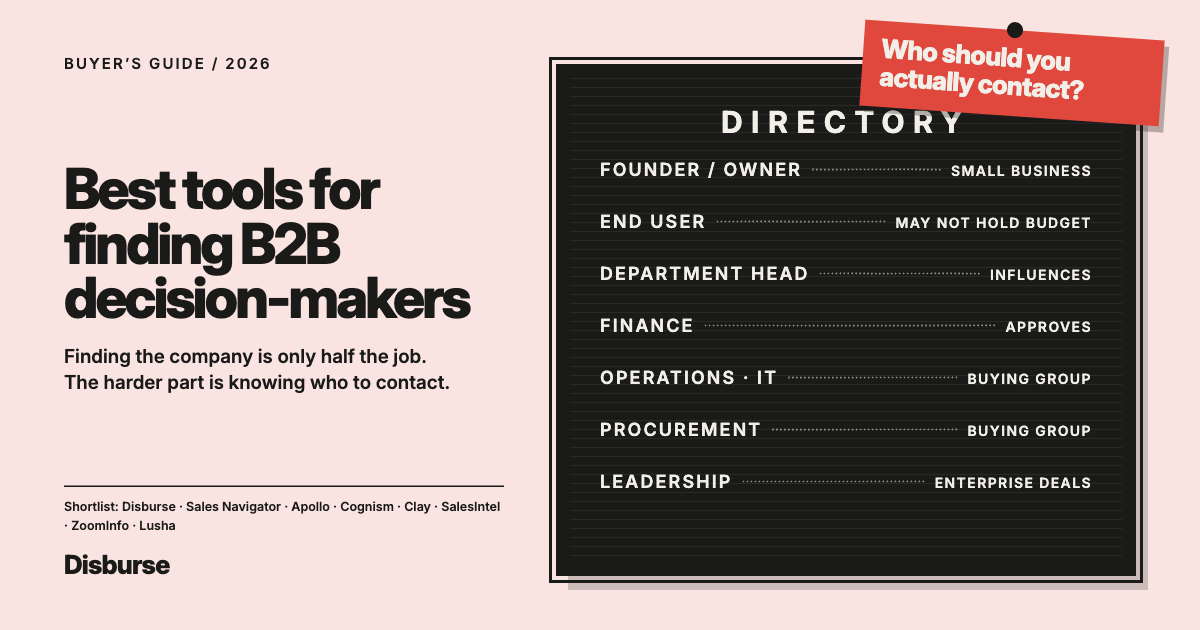
Finding a company you want to sell to is only half the job.
The harder question is:
Who should you actually contact?
Sometimes the answer is obvious.
If you sell to small businesses, the founder or owner may make the decision.
At larger companies, it becomes more complicated.
The person using your product may not control the budget.
The department head may influence the purchase but still need approval from finance.
An enterprise deal may involve several people across:
Operations
IT
Finance
Procurement
Leadership
That means the best tool for finding B2B decision-makers depends on what you are trying to uncover.
The short answer:
Disburse is best when you know the type of company or role you need and want to find the actual decision-maker quickly
LinkedIn Sales Navigator is strongest for understanding people and relationships inside an account
Apollo is strong for finding and engaging broader buying committees
Cognism is particularly relevant for EMEA teams that need verified mobile data
Clay is best when identifying the buyer requires custom research
SalesIntel stands out for human-verified decision-maker data
ZoomInfo is best suited to enterprise buying-group intelligence
Lusha is useful for straightforward decision-maker contact discovery
The right tool depends on whether the job is simply:
“Who is the CFO?”
or something more complex like:
“Who influences a seven-figure technology purchase across this multinational organisation?”
Best tools for finding B2B decision-makers
Tool
Disburse
Best for:
Finding specific B2B decision-makers using natural language
Why it stands out:
Find one person or relevant personas and retrieve structured B2B data
Main limitation:
Less account intelligence than enterprise platforms
LinkedIn Sales Navigator
Best for:
Understanding people and relationships inside accounts
Why it stands out:
LinkedIn’s professional graph, lead search and account research
Main limitation:
Usually needs another source for portable contact data
Apollo
Best for:
Finding and engaging buying committees
Why it stands out:
Deep search, AI, signals, contact data and outbound workflows
Main limitation:
Broader platform than some teams need
Cognism
Best for:
Reaching EMEA decision-makers by phone
Why it stands out:
Phone-verified mobile data, compliance and sales intelligence
Main limitation:
Custom pricing
Clay
Best for:
Custom decision-maker research
Why it stands out:
AI research, multi-provider enrichment and custom qualification
Main limitation:
More setup required
SalesIntel
Best for:
Human-verified decision-maker data
Why it stands out:
Human verification, Research on Demand and account intelligence
Main limitation:
Enterprise-oriented and custom priced
ZoomInfo
Best for:
Enterprise buying-group intelligence
Why it stands out:
Deep account, organisational and sales intelligence
Main limitation:
Often excessive for smaller teams
Lusha
Best for:
Straightforward decision-maker contact discovery
Why it stands out:
Contact data, AI search, enrichment and browser workflows
Main limitation:
Credit economics matter at scale
What is a B2B decision-maker?
A B2B decision-maker is someone with meaningful influence over whether a company buys a product or service.
That does not necessarily mean the CEO.
If you sell accounting software, the relevant person may be:
CFO
Finance Director
Head of Finance
If you sell recruitment services, it might be:
Talent Acquisition Director
HR leader
Department manager
Hiring manager
If you sell sales software, the buyer might be:
Head of Sales
CRO
RevOps leader
Founder
If you sell cybersecurity software, the decision may involve:
CISO
IT leadership
Procurement
Finance
This is why searching for “CEOs” is not the same as finding decision-makers.
A useful decision-maker tool should help answer two questions:
Which role is likely to matter?
and:
Who currently holds that role at this company?
Ideally, it should also help you contact them.
1. Disburse — best for finding specific B2B decision-makers using natural language
Disburse is particularly useful when you understand the business context but do not necessarily know the person’s name.
You can ask:
“Find the Head of Sales at this Australian software company.”
Or:
“Find the founder of this company.”
Or:
“Find the CFO at this Singaporean fintech company.”
That creates a simple workflow:
Company → relevant role → actual person → contact data
without manually searching company websites, LinkedIn profiles and search engines.
Can Disburse find one decision-maker?
Yes.
This matters because decision-maker research is often an individual lookup problem.
You may not need a 5,000-person prospect list.
You may simply want to know:
“Who runs operations here?”
Disburse can be used for that individual search.
The same workflow can then scale.
For example:
“Find Heads of Operations at these 30 companies.”
Or:
“Find Heads of Operations at Australian engineering businesses with 50 to 200 employees.”
The workflow does not fundamentally change.
Can you find decision-makers from an ICP?
Yes.
You can start with the target market rather than a predefined company.
For example:
“Find founders of Australian B2B SaaS companies with 20 to 100 employees.”
That defines both:
Company: Australian B2B SaaS, 20 to 100 employees
Persona: Founder
Another search might be:
“Find Heads of Sales at Singaporean fintech companies with more than 50 employees.”
The result can include available people, company and contact information.
What information can Disburse return?
Depending on availability, Disburse can return structured fields including:
Person
Name
Title
Seniority
Job function
Contact
Business email
LinkedIn URL
Available direct/mobile phone
Company
Company name
Domain
Industry
NAICS
Entity type
Revenue
Employee count
Locations
Specialties
Geography
City
Region
Country
Identifying the right person is only useful if the result contains enough information to actually work with.
Can Disburse find multiple decision-makers at one company?
Yes.
Not every sale has one buyer.
For larger organisations, you may want several relevant roles.
For example:
“Find the CFO, Head of Operations and Head of IT at these companies.”
That is often a better approach than searching for one “decision-maker”.
The goal is to identify the people relevant to the buying decision.
Can Disburse find decision-makers at similar companies?
Yes.
Another useful starting point is a strong existing customer.
For example:
“Find companies similar to this Australian software business.”
Then:
“Find the Head of Sales at each company.”
That creates a simple path:
Good customer → similar accounts → relevant persona → contact data
This is particularly useful for founders and small sales teams that understand what a good customer looks like but have not built a complex account-scoring model.
Can Disburse enrich decision-makers you already know?
Yes.
Sometimes you already know the person.
You may have:
An old CRM record
A LinkedIn URL
An email address
An event attendee
A company list
An incomplete prospect database
In that case, the problem is not discovery.
It is enrichment.
Disburse can enrich existing contact and company data, including CSV files containing thousands of records.
That means the same platform can handle:
“Who is the decision-maker?”
and:
“We already know who they are. Give us the information we are missing.”
Can AI use Disburse to find decision-makers?
Yes.
Disburse supports:
REST
MCP
That means compatible AI workflows can access B2B people and company data directly.
An AI workflow could ask:
“Who is the Head of Sales at this company?”
without requiring the user to leave the AI environment, open another database and manually copy the result back.
For teams increasingly working through AI assistants or internal agents, that is an important distinction.
Does Disburse have a Chrome extension?
Yes.
That is useful when decision-maker discovery begins while researching companies or people in the browser.
The user is not restricted to one interface for every research task.
Disburse pricing
Plan
Free
Price:
A$0
Monthly credits:
50
Growth
Price:
A$20/month
Monthly credits:
5,000
Scale
Price:
A$99/month
Monthly credits:
50,000
One credit represents one lead.
Available mobile numbers do not require an additional credit.
Growth supports up to five team members.
Scale supports unlimited team members.
Search is unlimited.
REST and MCP are available on the Free plan.
There is no annual lock-in.
Purchased Growth credit top-ups do not expire.
Where is Disburse strongest?
I would shortlist Disburse for:
Founders
Startups
Agencies
Recruiters
Small sales teams
APAC prospecting
Individual decision-maker lookup
Persona-based prospecting
Existing database enrichment
AI workflows
Its biggest strength here is simplicity.
If you can describe the person you are looking for, that can become the starting point.
What are Disburse’s limitations?
Disburse is not a full enterprise account-mapping platform.
If you need to:
Visualise organisational relationships
Understand mutual connections
Map complicated buying groups
Sales Navigator, Apollo or ZoomInfo may be stronger.
If you need to research unusual attributes about each stakeholder using multiple sources, Clay provides more flexibility.
When would I choose Disburse?
I would choose Disburse when the question is:
“Who is the right person at this company, and how can I contact them?”
It is particularly useful when that question needs to work just as easily for one company as it does for hundreds or thousands.
2. LinkedIn Sales Navigator — best for understanding people and relationships inside an account
Sales Navigator is one of the strongest tools for decision-maker research because its underlying data comes from LinkedIn’s professional network.
It lets users search leads and accounts using criteria such as:
Company
Geography
Seniority
Function
That is useful when you know the account but still need to work out who matters inside it.
For example, you may identify:
Department leader
Their manager
Other senior stakeholders
Recent hires
Existing connections into the account
That professional context is difficult for a conventional B2B database to replicate.
Why is Sales Navigator strong for complex accounts?
Imagine you sell enterprise HR software into a company with 2,000 employees.
Finding the CEO probably does not solve the prospecting problem.
You may need to know:
Who runs HR?
Who leads Talent?
Who owns HR technology?
Who reports to whom?
Does anyone on your team already know them?
This is where Sales Navigator becomes particularly useful.
How does AI help inside Sales Navigator?
Sales Navigator includes AI-assisted research through features such as:
Lead IQ
Account IQ
Lead IQ can summarise a person and their company.
Account IQ can help with broader account research and context.
This makes Sales Navigator useful not just for locating a profile, but for understanding the person and company before engagement.
What are Sales Navigator’s limitations?
Sales Navigator is not a conventional portable contact database.
If the final output needs:
Structured business emails
Mobile numbers
Company data
another B2B data provider may still be required.
This is why Sales Navigator often works well alongside Disburse, Cognism or another dedicated contact-data platform.
When would I choose Sales Navigator?
Choose Sales Navigator when the difficult part is not simply finding contact information.
Choose it when you need to understand:
Who matters
How they fit into the organisation
What professional relationships surround them
3. Apollo — best for finding and engaging buying committees
Apollo is particularly strong when decision-maker discovery becomes part of a broader outbound workflow.
Its search can use criteria such as:
Job title
Geography
Company size
Industry
Buyer intent
Apollo also supports natural-language prospecting through AI.
That makes it useful whether you know the exact role you need or want the platform to help identify likely prospects.
Why is Apollo useful when there are several decision-makers?
Modern B2B purchases often involve buying groups rather than one person.
Instead of only searching for:
“VP of Sales”
you may also need:
CRO
RevOps leader
Sales Operations
Finance
Procurement
depending on the product being sold.
Apollo is well suited to building broader account maps like this.
How do signals help?
Finding the right person matters.
Finding the right person at the right company at the right time may matter more.
Apollo can layer signal-based criteria alongside standard firmographics.
That helps teams prioritise decision-makers based on more than job title alone.
What happens after you find the decision-makers?
This is another Apollo strength.
The broader product supports outbound execution.
So a team can move through:
Find decision-makers → qualify → build list → engage
inside one environment.
What are Apollo’s limitations?
The broader platform is not necessary for every team.
If you already have:
CRM
Email infrastructure
Dialler
Outbound tools
you may only need the underlying B2B data.
When would I choose Apollo?
Choose Apollo when identifying decision-makers is part of a wider outbound process and you want:
Advanced targeting
Signals
Contact data
Execution
inside one platform.
4. Cognism — best for reaching EMEA decision-makers by phone
Cognism is particularly strong when the challenge is not simply finding the decision-maker but actually reaching them.
Its sales intelligence platform combines:
Relevant accounts
Contacts
Mobile data
Buying signals
AI-assisted insights
Company data
CRM integrations
Why does Cognism stand out for phone-led selling?
Cognism places significant emphasis on phone-verified mobile data.
That can be particularly valuable for EMEA teams where cold calling is a major part of the sales motion.
Can Cognism help prioritise accounts?
Yes.
Cognism also incorporates intent and buying signals.
That helps answer both:
Who should we contact?
and:
Which accounts should we prioritise?
What are Cognism’s limitations?
Pricing is custom.
For a small Australian startup simply trying to find founders or Heads of Sales, Cognism may be more platform than necessary.
Its strengths become more valuable when:
Mobile data
Compliance
Larger sales operations
are genuinely important.
When would I choose Cognism?
Choose Cognism when you sell heavily into EMEA and reaching decision-makers by phone is central to your prospecting motion.
5. Clay — best for custom decision-maker research
Clay becomes interesting when identifying the decision-maker requires more than searching a title.
Suppose you sell a specialist product and need:
“The senior person responsible for sustainability at Australian manufacturers that supply the defence industry.”
The company qualification itself may require custom research.
The relevant buyer’s title may also vary significantly from company to company.
That is where Clay’s combination of:
Data
Enrichment
AI research
becomes powerful.
How does Clay go beyond normal database fields?
Clay can begin with conventional people and company criteria, then use enrichment and AI research to add custom qualifiers.
That is useful when the question cannot be answered by standard database filters alone.
A workflow might look like:
Identify target account → research company → determine relevant persona → find person → enrich → qualify
What are Clay’s limitations?
That level of control requires setup.
If all you need is:
“Find the Head of Sales at this company.”
building a multi-step workflow is unnecessary.
When would I choose Clay?
Choose Clay when finding the decision-maker requires:
Custom research
Several data providers
Qualification logic
Information that is not stored in standard B2B fields
6. SalesIntel — best for human-verified decision-maker data
SalesIntel becomes particularly interesting when the decision-maker is valuable enough that verification matters more than speed or raw volume.
Its differentiation is the human research layer around the B2B data.
That can be especially useful for enterprise prospecting when automated sources do not contain the contact you need.
What is Research on Demand?
SalesIntel’s Research on Demand gives teams another route when a contact is missing.
Instead of simply returning no result, a human research team can investigate.
That can be valuable when you are targeting a relatively small number of high-value accounts.
Where is SalesIntel strongest?
I would consider SalesIntel when:
Human verification matters
High-value enterprise contacts matter
Technographics matter
CRM enrichment matters
Account intelligence matters
Hard-to-find people are common
What are SalesIntel’s limitations?
The platform is enterprise-oriented and pricing is custom.
It is less compelling when the main requirement is inexpensive self-service access to large volumes of ordinary B2B contacts.
When would I choose SalesIntel?
Choose SalesIntel when the value of finding the correct decision-maker justifies a deeper verification process.
7. ZoomInfo — best for enterprise decision-maker and buying-group intelligence
ZoomInfo becomes more relevant as account complexity increases.
At a 20-person company, there may genuinely be one obvious decision-maker.
At a multinational organisation, there may be:
Economic buyer
Functional buyer
Champion
Technical evaluator
Procurement stakeholder
Legal stakeholder
Executive sponsor
Finding one person’s email is not enough.
The job becomes understanding the buying group.
Where is ZoomInfo strongest?
ZoomInfo makes sense for:
Enterprise sales
ABM
Strategic account mapping
Large buying committees
Intent-led prospecting
Account intelligence
Large RevOps organisations
What are ZoomInfo’s limitations?
The platform is likely excessive if your sales motion is simple.
A founder asking:
“Who owns this recruitment agency?”
does not necessarily need enterprise revenue intelligence.
When would I choose ZoomInfo?
Choose ZoomInfo when understanding the entire enterprise account matters more than retrieving one contact.
8. Lusha — best for straightforward decision-maker contact discovery
Lusha is another strong option when you want to find relevant people and retrieve contact information without stepping into the complexity of an enterprise intelligence platform.
Its broader platform combines:
Contact data
Company data
AI prospecting
Enrichment
Browser workflows
CRM integrations
That makes it suitable for:
Individual contact research
Persona-based prospecting
Browser-led discovery
Where is Lusha strongest?
Lusha is useful when salespeople want to move through:
Find company → identify person → retrieve contact details → send into sales workflow
without building a more sophisticated GTM system.
Its browser extension is also useful when research begins on LinkedIn or company websites.
What are Lusha’s limitations?
At higher volume, teams need to pay attention to:
Credit consumption
Cost per usable contact
Phone-data economics
When would I choose Lusha?
Choose Lusha when you want established B2B contact data and sales intelligence in a relatively accessible prospecting environment.
What is the best tool for finding one decision-maker at a company?
For a straightforward individual lookup, Disburse is one of the simplest options.
You can ask:
“Find the CFO at this company.”
Or:
“Find the founder of this business.”
Sales Navigator is also useful if you want to research the person’s background and understand where they sit in the organisation.
For a high-value contact where verification matters heavily, Cognism or SalesIntel may also be worth testing.
What is the best tool for finding the right person at a company?
It depends on whether you already know the role.
If you know you need the:
Head of Sales
CFO
Founder
Disburse makes the search straightforward.
If you do not know who should own the problem, Sales Navigator can help you understand the organisation.
For complex enterprise buying groups, Apollo and ZoomInfo become more useful because the answer may involve several people rather than one.
What is the best tool for finding CEOs and founders?
For straightforward CEO and founder discovery, I would compare:
Disburse
Apollo
Lusha
Sales Navigator
For example:
“Find founders of Australian B2B SaaS companies with 20 to 100 employees.”
Disburse is particularly useful when company and persona requirements need to be combined in one natural-language request.
Sales Navigator adds professional context.
Apollo adds deeper filters, signals and outbound functionality.
What is the best tool for finding Heads of Sales?
Again, the answer depends on scale.
For one company:
“Find the Head of Sales at this company.”
Disburse is particularly straightforward.
For 500 companies:
“Find Heads of Sales at Australian software companies with 20 to 100 employees.”
Disburse can turn that description into a larger prospect dataset.
Apollo becomes more attractive when you also want:
Buyer intent
Hiring activity
Signals
layered into the search.
What is the best tool for mapping a buying committee?
For a true enterprise buying committee, I would look at:
Apollo
Sales Navigator
ZoomInfo
Apollo is strong when buying-group research needs to flow directly into prospecting and outbound.
Sales Navigator is particularly useful for understanding the people and relationships inside the account.
ZoomInfo becomes more relevant when deeper enterprise intelligence is required.
The important point is not to assume one senior contact represents the entire decision.
What is the best tool for finding decision-makers on LinkedIn?
LinkedIn Sales Navigator.
Its lead and account search is built around LinkedIn’s professional data.
It can help filter by:
Seniority
Function
Geography
Company
Its AI research can then add more context around the person and account.
If you need portable email or phone data afterwards, pair it with a dedicated B2B data provider.
What is the best tool for finding decision-makers’ email addresses?
If you already know the role or person you need, I would compare:
Disburse
Apollo
Cognism
Lusha
SalesIntel
The best provider depends heavily on:
Geography
Industry
Persona
Volume
Do not choose based only on a headline accuracy percentage.
Test the actual people your team sells to.
What is the best tool for finding decision-makers’ phone numbers?
For EMEA phone-led prospecting, Cognism should be high on the shortlist.
SalesIntel is also relevant where human verification matters.
Disburse includes available mobile data without requiring an additional credit.
The right choice still depends on geography and persona.
What is the best tool for finding Australian B2B decision-makers?
For Australian prospecting, Disburse should be high on the shortlist.
For example:
“Find the Managing Director of this Australian recruitment agency.”
“Find founders of Australian SaaS companies with 20 to 100 employees.”
“Find Heads of Operations at Australian engineering firms.”
Sales Navigator is also particularly useful when you need additional professional context around those people.
Apollo and other global databases should still be tested against the same Australian ICP.
Do not assume global database size automatically means stronger Australian coverage.
What is the best tool for finding decision-makers across APAC?
Disburse is particularly relevant for APAC-focused workflows because the same natural-language approach can work across different markets.
For example:
“Find Heads of Sales at Singaporean fintech companies.”
“Find founders of New Zealand software businesses.”
“Find Managing Directors of Australian recruitment agencies.”
“Find CFOs at Hong Kong professional-services companies.”
But APAC should not be treated as one data market.
Test:
Australia
Singapore
New Zealand
Hong Kong
Other target countries
separately.
What is the best tool for recruiters finding hiring decision-makers?
For recruitment business development, I would shortlist:
Disburse
Sales Navigator
Cognism
Sales Navigator is particularly useful for understanding organisational structure and identifying department leaders.
Disburse is useful when the recruiter already knows the persona and wants to turn it into contact data quickly.
For example:
“Find Heads of Engineering at Australian software companies with 50 to 200 employees.”
Cognism becomes more relevant for EMEA recruitment firms where phone outreach is central.
What is the best tool for agencies finding client decision-makers?
I would lean toward Disburse for straightforward agency prospecting.
Agency targeting changes constantly.
A marketing agency may need CMOs.
A software consultancy may need CTOs.
A recruitment company may need Talent Acquisition leaders.
A finance consultancy may need CFOs.
Instead of maintaining different workflows for each client, the request can simply describe the relevant company and persona.
Clay becomes more attractive when identifying the correct buyer requires custom research.
What is the best AI tool for finding decision-makers?
I would shortlist:
Disburse
Apollo
Clay
for different reasons.
Disburse is particularly useful when you want to describe the person or audience naturally and receive structured B2B data.
Apollo is stronger when AI discovery needs to combine with qualification, signals and outbound execution.
Clay is stronger when AI needs to research each company to determine who the relevant buyer is.
Sales Navigator also deserves consideration when AI-assisted professional and account research matters.
How do you identify the actual decision-maker?
Do not begin with a name.
Begin with the problem your product solves.
Ask:
Which department owns this problem?
Then:
Which role is accountable for the outcome?
Then:
Who currently holds that role?
For a smaller business, this may quickly lead to the founder.
For a larger organisation, you may identify several people.
That is normal.
Should you contact the CEO?
Only when the CEO is genuinely relevant.
One of the easiest ways to make B2B outreach look poorly targeted is to assume the most senior person is always the best prospect.
If you sell a specialist HR tool into a 5,000-person organisation, the CEO probably should not be your first contact.
If you sell a major business service to an eight-person company, the founder probably should.
Company size matters.
Deal size matters.
The type of product matters.
The organisational structure matters.
Seniority alone is not enough.
Should you contact more than one decision-maker?
For larger accounts, often yes.
The person who likes the product may not control the budget.
The person controlling the budget may not understand the technical requirement.
The technical evaluator may not own the business problem.
That is why enterprise prospecting increasingly focuses on buying groups.
For strategic accounts, identifying several relevant stakeholders is often more sensible than relying on one person.
How should you test tools for finding decision-makers?
Give every platform the same real task.
For example:
“Find the Head of Sales at 50 Australian B2B SaaS companies.”
Then compare:
Role accuracy: Did it identify the correct function?
Person accuracy: Does that person currently hold the role?
Seniority: Is the person senior enough to matter?
Email coverage: Is usable business email available?
Phone coverage: Is usable direct/mobile data available?
Company context: Is there enough information to understand the account?
Buying-group capability: Can you identify other relevant stakeholders?
Research: Can the platform explain why this person matters?
Workflow: How quickly can the result move into your sales process?
Economics: What does each usable decision-maker cost?
Do not test with random CEOs.
Use the actual:
Roles
Industries
Geographies
Company sizes
your sales team targets.
Which tool should you use to find B2B decision-makers?
My shortlist would be:
Best for natural-language decision-maker discovery: Disburse
Best for professional and relationship intelligence: LinkedIn Sales Navigator
Best for finding and engaging buying committees: Apollo
Best for EMEA phone-led decision-maker prospecting: Cognism
Best for custom decision-maker research: Clay
Best for human-verified decision-maker data: SalesIntel
Best for enterprise buying-group intelligence: ZoomInfo
Best for straightforward sales intelligence and contact lookup: Lusha
The important distinction is what happens around the person.
If you simply need:
“Who is the CFO?”
you do not need enterprise account intelligence.
If you need:
“Who influences a seven-figure technology purchase across this multinational organisation?”
you probably do.
So, what is the best tool for finding B2B decision-makers?
There is no universal winner.
For complex enterprise accounts, I would look closely at:
ZoomInfo
Apollo
Sales Navigator
For understanding professional relationships and researching people inside an organisation, Sales Navigator is particularly strong.
For EMEA teams that need to actually reach decision-makers by phone, Cognism has a compelling proposition.
For unusual buying personas that require custom research, Clay is more flexible.
For high-value contacts where human verification matters, SalesIntel deserves consideration.
And if the problem is simply moving from:
“This is the company and the type of person I need.”
to:
The actual person + usable B2B contact data
I would start with Disburse.
That might mean:
“Find the CFO at this company.”
Or:
“Find the founder of these 20 companies.”
Or:
“Find Heads of Sales at Australian SaaS businesses with 20 to 100 employees.”
Or:
“Find companies similar to our best customer, then find the relevant decision-maker at each.”
The advantage is that those are not separate workflows.
The same B2B data platform can move from one person to an entire target market, enrich records you already have and feed the resulting data into:
Browser workflows
REST
MCP
AI
The goal is not to find the most senior person.
It is to find the right person.
Frequently asked questions
What is the best tool for finding B2B decision-makers?
Disburse is particularly strong for natural-language decision-maker discovery.
Sales Navigator is strongest for professional and relationship research.
Apollo is strong for broader buying committees.
Cognism is particularly relevant for EMEA phone-led prospecting.
ZoomInfo is suited to enterprise account intelligence.
How do I find the decision-maker at a company?
Start by identifying:
Which department owns the problem your product solves.
The level of seniority required.
The role accountable for the outcome.
The person currently holding that role.
For larger purchases, identify several stakeholders rather than assuming there is one buyer.
What is the best tool for finding one person at a company?
Disburse is particularly straightforward when you know the role or person you need.
For example:
Head of Sales
CFO
Founder
Managing Director
What is the best tool for finding CEOs?
Disburse, Apollo, Lusha and Sales Navigator can all identify CEOs and founders.
The best choice depends on whether you need:
Simple contact data
Relationship research
Signals
Outbound functionality
What is the best tool for finding founders?
Disburse is particularly useful when founder discovery also includes company criteria.
For example:
“Find founders of Australian SaaS companies with 20 to 100 employees.”
What is the best tool for finding Heads of Sales?
Disburse is useful for straightforward Head of Sales discovery.
Apollo becomes more relevant when you also want to add signals such as buyer intent.
What is the best tool for finding CFOs?
Disburse, Apollo, Sales Navigator, Cognism and other B2B sales intelligence platforms can all identify finance leaders.
The best provider depends on geography, company size and the contact information required.
What is the best tool for finding multiple decision-makers at one company?
Apollo, Sales Navigator and ZoomInfo are particularly relevant for more complex buying groups.
What is the best tool for mapping a buying committee?
Apollo, Sales Navigator and ZoomInfo are strong options.
Sales Navigator is especially useful for understanding professional relationships.
Apollo can connect buying-group prospecting directly with outbound.
What is the best tool for finding decision-makers on LinkedIn?
LinkedIn Sales Navigator.
It combines LinkedIn’s professional data with advanced lead and account research.
What is the best tool for finding decision-makers’ emails?
Disburse, Apollo, Cognism, Lusha and SalesIntel are all worth testing.
Performance can vary substantially by:
Geography
Industry
Persona
What is the best tool for finding decision-makers’ phone numbers?
Cognism is particularly relevant for EMEA phone-led prospecting.
SalesIntel is also worth considering where human verification matters.
Disburse includes available mobile data without an additional credit.
What is the best tool for finding Australian B2B decision-makers?
Disburse is particularly relevant because company and persona criteria can be combined in natural language.
Other global providers should still be tested against your real Australian ICP.
What is the best tool for finding APAC decision-makers?
Disburse is worth testing across:
Australia
New Zealand
Singapore
Wider APAC
Coverage should be tested separately by country and persona.
What is the best tool for recruiters finding hiring managers?
Sales Navigator is useful for understanding organisational structure.
Disburse can identify relevant hiring personas and provide available B2B contact data.
Cognism is also worth considering for EMEA phone-led recruitment business development.
What is the best tool for agencies finding decision-makers?
Disburse is particularly useful for agencies because the target persona can change between campaigns without requiring a different prospecting workflow.
Clay is stronger when identifying the relevant buyer requires custom research.
What is the best AI tool for finding decision-makers?
Disburse is strong for natural-language B2B data requests.
Apollo is strong for AI-assisted discovery, qualification and outbound.
Clay is particularly useful for custom AI research.
Can AI find B2B decision-makers?
Yes.
Modern AI prospecting tools can:
Identify people and companies from natural-language criteria
Research accounts
Help determine relevant personas
Enrich contact data
The underlying contact data should still be tested for accuracy and freshness.
Should I contact the CEO or department head?
Contact the person who actually owns the problem your product solves.
At a small company, that may be the CEO or founder.
At a larger company, a department head or functional buyer is often more appropriate.
Is the decision-maker always the most senior person?
No.
The right person depends on:
Problem
Department
Company size
Deal size
Purchasing process
How many decision-makers are involved in a B2B sale?
There is no fixed number.
Smaller purchases may involve one or two people.
Complex enterprise deals can involve stakeholders across several departments.
Can Disburse find one specific decision-maker?
Yes.
Disburse can find one person, several people or a much larger audience.
Can Disburse find multiple personas at a company?
Yes.
You can target personas such as:
Founders
Heads of Sales
Finance leaders
Operations leaders
Other job functions
Can Disburse enrich decision-makers I already have?
Yes.
Disburse can enrich existing contact and company data, including uploaded CSVs containing thousands of records.
Can Disburse find decision-makers at similar companies?
Yes.
Disburse can identify similar companies and then find relevant personas inside those businesses.
Does Disburse have a Chrome extension?
Yes.
Does Disburse support MCP?
Yes.
Disburse supports MCP and REST so compatible AI and software workflows can access B2B data.
Which decision-maker tool is best overall?
There is no universal winner.
For straightforward natural-language decision-maker discovery, Disburse is one of the strongest options.
For LinkedIn relationship intelligence, Sales Navigator.
For buying committees and outbound, Apollo.
For EMEA phone data, Cognism.
For enterprise account intelligence, ZoomInfo.
APAC Prospectinglead generationEnterprise SalesSmall Sales TeamsB2B Contact DatabaseRevOpsLinkedIn ProspectingAI ProspectingNatural-Language SearchZoomInfoB2B DataSales ProspectingData EnrichmentBuyer IntentLushaDisburseABMClaySales IntelligenceLinkedIn Sales NavigatorIdeal Customer Profile (ICP)