Best Clay Alternatives for B2B Lead Generation in 2026
17 min readLachlan McBride White
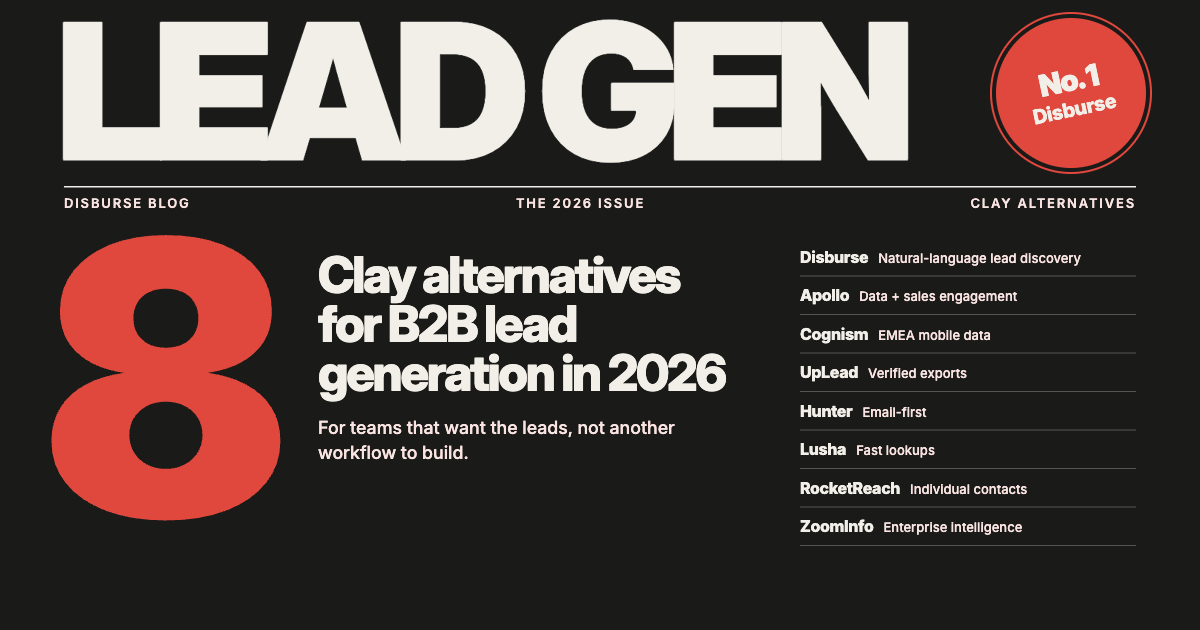
Clay is one of the most powerful B2B data-enrichment and GTM workflow platforms available in 2026.
It can combine data from hundreds of providers, run waterfall enrichment, use AI agents such as Claygent for web research, track signals and sync enriched records into CRMs.
But not every sales team needs that much infrastructure.
If your main goal is simply to find targeted B2B companies and contacts, Clay can be more workflow than you actually need.
Other platforms may be easier, cheaper or better suited depending on whether you prioritise:
Contact data
AI prospecting
Verified emails
Mobile numbers
Sales engagement
Enterprise intelligence
The short answer: For businesses that mainly want to describe their ICP and get usable B2B contact data back, Disburse is one of the strongest Clay alternatives in 2026.
Apollo is better if you also want outbound sales engagement.
Cognism is strong for EMEA mobile data.
UpLead is useful for verified contact exports.
Hunter suits email-first prospecting.
ZoomInfo is better for deep enterprise sales intelligence.
What are the best Clay alternatives for B2B lead generation in 2026?
The strongest alternatives include:
Disburse — best for simple, natural-language B2B lead discovery
Apollo — best for prospect data plus sales engagement
Cognism — best for EMEA mobile data and compliance-focused prospecting
UpLead — best for verified contact exports
Hunter — best for email-first lead generation
Lusha — best for fast contact lookup
RocketReach — best for individual professional contact discovery
ZoomInfo — best for enterprise sales intelligence
The best alternative depends on which part of Clay you are actually trying to replace.
Clay alternatives at a glance
Platform
Disburse
Best for:
Simple B2B prospect discovery
Main strength:
Natural-language search and structured contact data
Apollo
Best for:
Data + outbound sales execution
Main strength:
Broad prospecting and engagement platform
Cognism
Best for:
EMEA prospecting
Main strength:
Verified mobile data and compliance focus
UpLead
Best for:
Verified B2B contacts
Main strength:
Real-time email verification and simple contact credits
Hunter
Best for:
Email prospecting
Main strength:
Email finding, verification and outreach
Lusha
Best for:
Quick prospect lookup
Main strength:
Fast person-level contact data
RocketReach
Best for:
Broad professional research
Main strength:
Individual contact discovery
ZoomInfo
Best for:
Enterprise revenue teams
Main strength:
Deep account intelligence and enrichment
1. Disburse — best Clay alternative for simple B2B lead generation
Best for: Businesses that mainly want targeted companies and contacts without building an enrichment workflow first.
Disburse is designed around a much simpler prospecting process:
Describe who you want to find → retrieve the data.
For example:
“Find founders of Australian B2B SaaS companies with 10–100 employees.”
Or:
“Find Heads of Sales at Singaporean fintech companies with 50–200 employees.”
Or:
“Find CFOs at New Zealand manufacturing businesses with more than A$20 million in revenue.”
Disburse interprets the request and returns matching people and companies.
Available data can include:
Name
Job title
Seniority
Job function
Business email
Direct phone
LinkedIn URL
Company name
Company domain
Industry
NAICS
Entity type
Revenue
Employee count
Company locations
Specialties
City
Region
Country
Why choose Disburse instead of Clay?
The biggest difference is that Disburse removes much of the workflow-building layer.
Clay is designed for teams that want to decide:
Which providers to use
What to enrich
How waterfall logic should work
Which AI research should run
What signals matter
Where the data goes next
Disburse is designed for teams that mainly want the end result.
If the question is:
“Find 500 founders of Australian software companies with 20–100 employees and give me their contact data.”
Disburse is built around that request.
Why Disburse works well for APAC prospecting
APAC teams may need to switch quickly between markets.
For example:
“Find founders of SaaS companies in Australia, New Zealand and Singapore with 20–100 employees.”
Or:
“Find senior sales leaders at fintech companies in Singapore and Hong Kong.”
Or:
“Find Managing Directors at Australian and New Zealand engineering consultancies.”
Disburse lets the geography and ICP live directly inside the search.
The team does not need to build a separate workflow for each segment.
Disburse pricing
Disburse uses a simple model:
One credit = one lead.
Plan
Free
Price:
A$0
Included:
50 credits/month
Growth
Price:
A$20/month
Included:
5,000 credits/month, up to 5 team members
Scale
Price:
A$99/month
Included:
50,000 credits/month, unlimited team members
Enterprise
Price:
Custom
Included:
Custom requirements
Searching is unlimited.
Mobile numbers do not cost extra credits.
There is no annual lock-in.
Growth top-up credits never expire.
Where Clay is stronger
Clay is much stronger when a team needs:
Multi-provider waterfall enrichment
AI web research
CRM enrichment
Signal tracking
Custom workflows
Enrichment orchestration
Advanced GTM automation
Verdict: Choose Disburse if you mainly need targeted B2B lead data. Choose Clay if you want to build and control the enrichment system around that data.
2. Apollo — best for lead data plus sales engagement
Best for: Teams that want prospecting and outbound sales execution in one platform.
Apollo is a broader sales platform.
It combines:
B2B contact data
Prospecting
Enrichment
Sales engagement
Calling
Outbound tools
This makes it a useful Clay alternative for teams that want more than contact data but do not necessarily want to build a modular GTM workflow.
Why choose Apollo instead of Clay?
Apollo can be attractive when the desired workflow is:
Find leads → add them to a sequence → contact them → manage outbound activity
That is more turnkey than building the equivalent workflow across several providers in Clay.
Where Disburse may be better
If the team already has its preferred outbound tools and simply needs B2B data, Apollo may still be broader than necessary.
Disburse remains the more focused choice when the job is:
“Give us the right companies and people.”
Verdict: Choose Apollo for a broader sales platform. Choose Disburse for a focused B2B data layer.
3. Cognism — best for EMEA mobile data
Best for: Teams focused heavily on Europe and the UK where verified mobile data and compliance matter.
Cognism provides:
Contact data
Company data
Firmographic filters
Technographic filters
AI research
Mobile verification
Why choose Cognism instead of Clay?
Cognism can be preferable when a team does not want to assemble multiple enrichment providers.
Instead, it provides an established contact-data source with a strong focus on mobile information.
Its strengths include:
Business emails
Mobile numbers
Company data
Technology usage
On-demand mobile verification
EMEA-focused prospecting
Where Disburse may be better
For APAC-focused teams, Cognism’s European positioning may matter less.
Disburse also offers a lighter self-service model and focuses more directly on natural-language ICP discovery.
Verdict: Choose Cognism for EMEA-heavy phone prospecting. Choose Disburse for simpler contact discovery, especially for APAC-focused workflows.
4. UpLead — best for verified B2B contact exports
Best for: Teams that want a conventional B2B database with strong email verification.
UpLead is a more traditional contact-data alternative to Clay.
Its strengths include:
Verified emails
Phone numbers
Company search
Contact exports
CRM integrations
Conventional search filters
Its credit model is also straightforward.
One credit unlocks one contact and includes available email and mobile direct-dial data.
UpLead pricing
Plan
Essentials
Price:
US$99/month
Included:
170 credits/month
Plus
Price:
US$199/month
Included:
400 credits/month
Professional
Price:
Custom
Included:
Custom annual pricing
The source article also lists an annual Essentials option at US$74/month, billed annually, for 2,040 credits per year.
Where Disburse may be better
Disburse is more aggressive on lead volume and more centred on natural-language search.
Growth provides:
5,000 leads per month for A$20.
That compares with 170 monthly credits on UpLead’s US$99 Essentials plan.
Both use simple contact-based credit concepts.
But Disburse is more suited to high-volume prospect discovery at low cost.
Verdict: Choose UpLead for a familiar verified-database experience. Choose Disburse for simpler, high-volume natural-language lead generation.
5. Hunter — best for email-first lead generation
Best for: Teams where finding and verifying business emails is the main job.
Hunter has expanded from an email finder into a broader B2B prospecting product.
Its tools include:
B2B database
Email finding
Email verification
Lead enrichment
AI Assistant
Email outreach
Why choose Hunter instead of Clay?
Hunter is a better fit when the workflow is mainly:
Find companies → find emails → verify emails → run outreach
That is much narrower than Clay’s multi-source enrichment model.
Where Disburse may be better
Disburse provides a broader prospect record.
It can return available:
Business email
Phone number
LinkedIn URL
Company data
Revenue
Employee count
Geography
Specialties
If you need full B2B prospect records rather than mainly email data, Disburse is the stronger fit.
Verdict: Choose Hunter for email-first workflows. Choose Disburse for broader B2B contact discovery.
6. Lusha — best for fast person-level contact lookup
Best for: Salespeople who already know who they want and mainly need contact details.
Lusha is a straightforward B2B contact-data tool commonly used for quick email and phone discovery.
Its biggest strength is ease of use when researching a particular person or company.
Why choose Lusha instead of Clay?
You may prefer Lusha if you do not need:
Waterfalls
Workflow logic
Custom AI research
CRM orchestration
Complex enrichment chains
and instead just want quick contact lookup.
Where Disburse may be better
Lusha is most useful when you already know who you want.
Disburse is designed to help with the step before that.
You can ask:
“Find Heads of Operations at Australian logistics companies with 100–500 employees.”
and use the search itself to build the prospect list.
Verdict: Choose Lusha for lookup. Choose Disburse for ICP-to-list discovery.
7. RocketReach — best for individual professional research
Best for: Recruiters, partnerships teams and business-development users looking up specific professionals.
RocketReach is a broad professional contact database.
It is useful where the process begins with:
“I know who this person is. How can I contact them?”
rather than:
“Who are all the people who fit this market?”
Why choose RocketReach instead of Clay?
RocketReach requires much less workflow setup if the goal is simply professional contact discovery.
It can be useful for:
Recruitment
Partnerships
PR
Business development
Executive research
Where Disburse may be better
Disburse is more relevant when the starting point is an ICP.
For example:
“Find Finance Directors at Australian manufacturing businesses with 100–500 employees.”
The tool helps identify the people as well as return their data.
Verdict: Choose RocketReach for known-person lookup. Choose Disburse when you need to discover the people first.
8. ZoomInfo — best for enterprise sales intelligence
Best for: Large revenue teams that need deep intelligence around accounts.
ZoomInfo sits at almost the opposite end of the spectrum from Disburse.
Like Clay, it can solve much more than contact discovery.
But it does so through a large enterprise sales-intelligence platform rather than a configurable multi-provider workflow builder.
Typical strengths include:
Account intelligence
Buyer intent
Technographics
CRM enrichment
Organisational insights
Account prioritisation
Enterprise workflows
Why choose ZoomInfo instead of Clay?
ZoomInfo can make sense if a large organisation wants one mature enterprise intelligence provider rather than building its own data architecture across many sources.
Where Disburse may be better
If the requirement is simply:
“Find these companies and give us the people.”
Both Clay and ZoomInfo may represent more infrastructure than necessary.
Verdict: Choose ZoomInfo for enterprise sales intelligence. Choose Disburse for straightforward B2B contact discovery.
Why are teams looking for Clay alternatives?
Clay is extremely powerful.
But it is not designed to be the simplest possible prospecting product.
Teams may look for alternatives because they:
Mainly need contact data
Do not have dedicated RevOps resources
Do not want to build enrichment workflows
Want simpler pricing
Want a more turnkey prospecting experience
Already have an outbound stack
Need lower-cost high-volume lead data
Want an ICP-to-list workflow rather than an enrichment table
Do not need hundreds of data providers
Want fewer systems to configure
That does not mean Clay is unnecessarily complicated.
Its complexity is valuable when the team needs the control.
The question is whether your prospecting problem requires it.
What should you look for in a Clay alternative?
Start by identifying the part of Clay you actually need.
Prospect discovery
Do you mainly need to find companies and decision-makers?
If so, a focused platform such as Disburse may be enough.
Contact-data accuracy
Do you mainly care about verified business emails and mobile numbers?
Providers such as UpLead or Cognism may be worth considering.
Sales execution
Do you also want:
Email sequences
Calling
Outbound functionality
Apollo is more directly designed around that model.
Enrichment
Do you need:
Multiple data sources
Waterfall logic
CRM maintenance
Enrichment workflows
If so, Clay may still be the strongest fit.
AI research
Do you need an AI agent to research custom information from public web sources?
Claygent is a genuine Clay advantage.
APAC prospecting
Does the platform work well for the countries, industries and seniority levels you target across:
Australia
New Zealand
Singapore
Hong Kong
Other APAC markets
Complexity
Do you want to configure how the data is assembled?
Or do you simply want the data returned?
This may be the most important distinction.
What is the simplest Clay alternative?
For businesses mainly looking for B2B prospect data, Disburse is one of the simplest Clay alternatives.
The process is:
Describe the ICP → search → retrieve the leads
For example:
“Find founders of Australian SaaS businesses with 20–100 employees.”
There is no requirement to:
Configure a waterfall
Select enrichment providers
Build a table
Define enrichment formulas
Set up workflow logic
That makes Disburse especially suitable for founders, small sales teams and agencies that know who they want and mainly need the resulting contacts.
What is the best Clay alternative for APAC prospecting?
For teams focused on APAC, Disburse is particularly relevant because regional ICPs can be expressed directly.
For example:
“Find founders of B2B SaaS businesses in Australia, New Zealand and Singapore with 20–100 employees.”
Or:
“Find senior sales leaders at fintech companies in Singapore and Hong Kong.”
Or:
“Find Managing Directors of Australian and New Zealand engineering consultancies.”
Clay’s multi-provider model may be more useful when the team wants to combine several data sources to maximise regional coverage.
The decision is often:
Simple APAC prospect discovery
or
Configurable APAC enrichment
What is the best Clay alternative for small sales teams?
For a small team mainly needing B2B data, Disburse is likely one of the easiest options to justify.
Growth costs:
A$20/month for 5,000 credits and up to five team members.
Clay provides much more workflow functionality.
So the products are not directly comparable on price alone.
But for a five-person sales team whose main requirement is contact data, Disburse is much more focused.
What is the best Clay alternative for AI prospecting?
This depends on what you mean by AI prospecting.
Disburse is a strong option when you want an AI assistant or agent to request B2B contacts directly through REST or MCP.
Apollo is more suitable when you want AI connected to a broader sales and engagement platform.
Clay itself remains one of the strongest options when AI needs to handle:
Prospecting
Enrichment
Custom research
Workflow actions
Multiple providers
The distinction is:
Disburse = AI asks for the data.
Clay = AI interacts with an enrichment and GTM workflow.
What is the best Clay alternative for verified contact data?
UpLead is a strong conventional alternative.
It focuses on:
Verified emails
Contact accuracy
Mobile direct dials
Simple contact credits
Cognism is another strong option where mobile verification and European coverage are important.
Disburse is more compelling when the requirement combines contact data with:
Natural-language ICP discovery
Higher-volume usage
APAC prospecting
What is the best Clay alternative for cold email?
Hunter is especially strong for email-first workflows because it combines:
Email discovery
Verification
Outreach
Apollo is a better fit where the company wants a wider sales-engagement platform.
Disburse is strong where the team already has an email tool and mainly needs structured B2B contacts feeding into it.
What is the best Clay alternative for high-volume lead generation?
For straightforward B2B contact volume, Disburse is especially competitive.
High-volume comparison
Plan
Disburse Growth
Price:
A$20/month
Lead volume:
5,000 leads/month
Disburse Scale
Price:
A$99/month
Lead volume:
50,000 leads/month
Clay Free
Price:
Free
Lead volume:
500 Actions + 100 Data Credits/month
Clay Launch
Price:
Around US$167/month
Lead volume:
15,000 Actions/month
Clay Growth
Price:
Around US$446/month
Lead volume:
40,000 Actions + broader workflow functionality
With Disburse:
One credit equals one lead
Mobile numbers cost no extra credits
Searching is unlimited
Clay uses a broader Actions + Data Credits model because users may be doing much more work per prospect.
That can include:
Enrichment
AI research
Signals
Automation
If the only desired output is a contact list, Disburse’s model is simpler.
Is Disburse a good Clay alternative?
Yes, if the part of Clay you need is prospect sourcing and contact data.
Disburse is not designed to reproduce:
Claygent
Multi-provider waterfalls
CRM auto-enrichment
Custom workflow logic
Signal tracking
Data orchestration
But if your main workflow is:
Find companies → find contacts → retrieve emails and phones → export
then Disburse can remove much of the setup around the process.
That makes it especially relevant for teams without dedicated GTM operations resources.
Is Clay worth it if you only need lead lists?
It can be.
But much of Clay’s value comes from what happens around the list.
Its strongest capabilities include:
Waterfall enrichment
AI research
CRM sync
Signals
Workflow automation
If those features improve your process, Clay can be extremely powerful.
If you mainly need:
“Give me 1,000 people matching this ICP.”
a narrower product may be easier and more economical.
Which Clay alternative should you choose in 2026?
For teams mainly looking to find B2B companies and contacts, Disburse should be near the top of the shortlist.
It combines:
Natural-language prospect discovery
Structured company and person data
Business emails
Direct phone numbers
LinkedIn URLs
APAC-focused use cases
REST access
MCP access
AI workflow compatibility
Unlimited searching
One-credit-per-lead pricing
High-volume plans
No annual lock-in
Choose Apollo if you want contact data plus sales engagement.
Choose Cognism if EMEA mobile data and verification matter most.
Choose UpLead if you want a traditional database with real-time email verification.
Choose Hunter if email finding and verification are the main job.
Choose Lusha or RocketReach if individual contact lookup is the main requirement.
Choose ZoomInfo if your organisation needs deep enterprise account intelligence.
And keep Clay if your team genuinely needs:
Multi-provider enrichment
Claygent
CRM automation
Signals
GTM workflow control
The real question is not:
“Which tool has more capabilities than Clay?”
It is:
“How much of Clay’s capability do we actually need to generate leads?”
If the answer is mainly finding the right companies and people, Disburse can be the simpler alternative.
Frequently asked questions
What is the best Clay alternative?
There is no single best alternative for every use case.
Disburse is especially strong for straightforward B2B contact discovery.
Apollo is stronger for sales engagement.
Cognism is strong for EMEA mobile data.
UpLead is strong for verified contact exports.
What is the best Clay alternative for B2B lead generation?
If lead generation mainly means identifying ICP-fit companies and decision-makers and retrieving contact data, Disburse is one of the strongest alternatives.
What is the easiest Clay alternative?
For simple B2B prospect discovery, Disburse is designed to have a lower setup burden.
Users describe the target audience and retrieve the data rather than building enrichment workflows.
What is the best Clay alternative for APAC?
Disburse is especially relevant for teams prospecting across Australia, New Zealand, Singapore and other APAC markets.
Actual provider coverage should still be tested against the specific markets and roles being targeted.
What is the best Clay alternative for small businesses?
Disburse is especially suitable for smaller B2B teams mainly needing prospect data.
Apollo may be more suitable if the team also needs built-in sales engagement.
Hunter is useful for email-first workflows.
What is the best Clay alternative for RevOps?
There may not be a better direct replacement if:
Multi-provider enrichment
CRM automation
Custom GTM workflows
are the main requirements.
Clay remains especially strong in those areas.
What is the best Clay alternative for verified emails?
UpLead is a strong option and focuses heavily on verified contact data.
What is the best Clay alternative for mobile numbers?
The answer depends heavily on geography.
Cognism is particularly strong for verified EMEA mobile data.
Disburse includes available mobile numbers without extra credit charges.
What is the best Clay alternative for cold email?
Hunter is strong for email finding and verification.
Apollo is stronger if you also want email sequencing.
Disburse is suitable if you already have an outbound platform and need the prospect data feeding into it.
Is Disburse cheaper than Clay?
For simple contact retrieval, Disburse’s self-serve plans are much lower priced.
Disburse Growth costs A$20/month for 5,000 leads.
The source article lists Clay Launch at around US$167/month.
Clay includes much more enrichment and automation functionality, so the products are not directly equivalent.
Does Clay have a free plan?
Yes.
The source article states that Clay’s Free plan includes:
500 Actions per month
100 Data Credits per month
Unlimited seats and tables
Multi-provider waterfalls
Claygent access
Can Disburse replace Clay?
It can replace Clay for teams that mainly need prospect discovery and structured B2B contact data.
It does not replace Clay’s deeper enrichment, AI research and workflow capabilities.
Is Apollo a Clay alternative?
Yes.
Apollo is especially relevant when teams want B2B contact data combined with sales engagement rather than a configurable enrichment platform.
Is UpLead a Clay alternative?
Yes.
It is especially relevant for teams that mainly want verified B2B contacts rather than complex enrichment.
Is Hunter a Clay alternative?
Yes, for email-centred prospecting.
Hunter combines B2B discovery, email finding, verification, enrichment and outreach.
Which is better, Clay or Disburse?
Clay is better for advanced multi-provider enrichment, AI research and GTM automation.
Disburse is likely better when the main requirement is simply finding targeted B2B companies and contacts quickly and using that data elsewhere.
Which Clay alternative offers the best value?
For straightforward high-volume contact discovery, Disburse offers a strong value proposition.
For workflow automation and enrichment, Clay’s higher cost may be justified by its wider capabilities.
APAC Prospectinglead generationCold EmailSmall Sales TeamsB2B Contact DatabaseRevOpsAI ProspectingNatural-Language SearchB2B DataSales ProspectingData EnrichmentDisburseUpLeadClay AlternativeClayB2B Lead ListsWaterfall EnrichmentIdeal Customer Profile (ICP)B2B Prospect List