Best B2B Prospecting Tools in 2026
23 min readLachlan McBride White
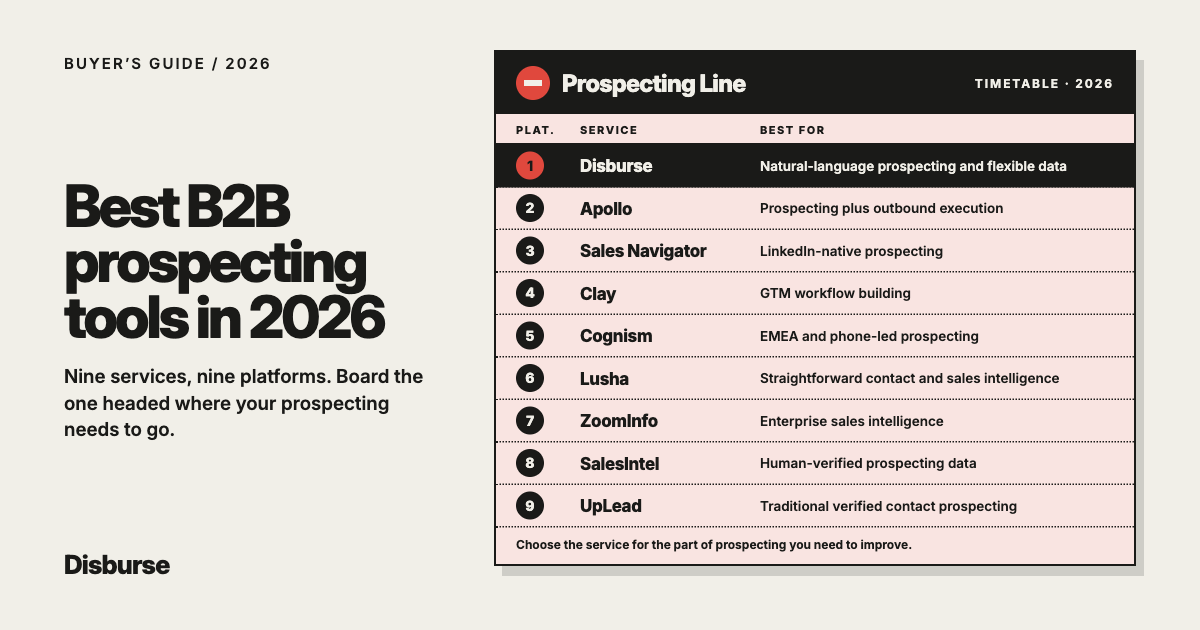
The best B2B prospecting tool depends on which part of prospecting you are trying to improve.
If your problem is finding the right companies and people, you need strong B2B data.
If your team spends most of its day on LinkedIn, Sales Navigator may be more useful.
If you want prospecting and outbound sequences in one place, Apollo makes more sense.
If you are building sophisticated enrichment and signal-based workflows, Clay sits in a different category again.
That is why choosing a prospecting tool based on the longest feature list is usually the wrong approach.
The short answer: In 2026, the strongest B2B prospecting tool depends on the job.
Disburse is best for natural-language B2B prospecting and flexible data workflows
Apollo is best for prospecting plus outbound sales execution
LinkedIn Sales Navigator is strongest for LinkedIn-native prospecting
Clay is best for sophisticated GTM workflows
Cognism stands out for EMEA and phone-led prospecting
Lusha is useful for straightforward contact prospecting and sales intelligence
ZoomInfo is designed for enterprise account intelligence
SalesIntel stands out for human-verified prospecting data
UpLead is a strong traditional verified contact database
There is no reason the same product should win every category.
Best B2B prospecting tools in 2026
Tool
Disburse
Best for:
Natural-language B2B prospecting and flexible data workflows
Starting price:
Free, Growth A$20/month
Why it stands out:
Find and enrich people and companies without a complicated workflow
Apollo
Best for:
Prospecting plus outbound execution
Starting price:
Free, paid plans available
Why it stands out:
Combines prospect data with sales engagement
LinkedIn Sales Navigator
Best for:
LinkedIn-native prospecting
Starting price:
From A$154.99/month in Australia
Why it stands out:
Professional network, account research and relationship context
Clay
Best for:
GTM workflow building
Starting price:
Free, paid plans available
Why it stands out:
Multi-provider enrichment, AI research and automation
Cognism
Best for:
EMEA and phone-led prospecting
Starting price:
Custom
Why it stands out:
Mobile data, verification and European prospecting
Lusha
Best for:
Straightforward contact prospecting and sales intelligence
Starting price:
Free and paid plans
Why it stands out:
Browser-based contact access and enrichment
ZoomInfo
Best for:
Enterprise sales intelligence
Starting price:
Custom
Why it stands out:
Deep account intelligence for larger revenue teams
SalesIntel
Best for:
Human-verified prospecting data
Starting price:
Custom
Why it stands out:
Human verification, technographics and enrichment
UpLead
Best for:
Traditional verified contact prospecting
Starting price:
Paid self-service plans
Why it stands out:
Simple search, contact unlocks and verification
What is a B2B prospecting tool?
A B2B prospecting tool helps you identify, research or reach potential business customers.
That covers a surprisingly wide range of software.
Some tools mainly help answer:
“Who should we sell to?”
Others:
“Who works at this company?”
Others:
“How can I contact this person?”
And others:
“Which prospects should we prioritise, enrich and put into an outbound campaign?”
A modern prospecting stack can include:
People and company data
Business emails
Mobile phone numbers
LinkedIn research
ICP targeting
Company enrichment
Contact enrichment
Buyer intent
Job-change signals
AI research
Lead scoring
Outbound sequencing
Workflow automation
The best tool therefore depends heavily on which jobs you actually need help with.
1. Disburse — best for natural-language B2B prospecting
Disburse is a B2B data platform built around a simple idea:
Describe the people or companies you need instead of building your prospecting process around database filters.
You can use it to find one person:
“Find the Head of Sales at this Australian software company.”
A small group:
“Find the founders of these 10 companies.”
Or a broader audience:
“Find founders of Australian B2B SaaS companies with 20 to 100 employees.”
You can also start with data you already have.
For example:
“Enrich this CSV of 2,000 contacts with available person and company information.”
Or start from a strong customer:
“Find companies similar to this business, then find the founders at those companies.”
That makes Disburse useful across several stages of prospecting rather than only the initial search.
What can Disburse do?
Disburse supports:
Individual contact search
Company search
Natural-language B2B search
Targeted audience discovery
Business email data
Available direct and mobile phone data
LinkedIn URLs
Contact enrichment
Company enrichment
CSV enrichment
Similar-company discovery
Persona finding
Chrome extension prospecting
REST
MCP
AI workflows
The same platform can handle:
Quick contact lookup → broader prospecting → enrichment → similar-company research
Disburse pricing
Plan
Free
Price:
A$0
Monthly credits:
50
Growth
Price:
A$20/month
Monthly credits:
5,000
Scale
Price:
A$99/month
Monthly credits:
50,000
One credit represents one lead.
Available mobile numbers do not require additional credits.
Growth supports up to five team members.
Scale supports unlimited team members.
Searching is unlimited.
REST and MCP are available from the Free plan.
Where is Disburse strongest?
I would put Disburse near the top of the shortlist for:
Founder-led sales
Small B2B sales teams
Agencies
Recruiters
APAC-focused prospecting
Businesses that already have an outbound stack
Teams working inside ChatGPT, Claude or AI agents
Companies moving between prospect discovery and enrichment
Businesses that need larger contact volumes
Its biggest advantage is that it does not force every prospecting job into the same workflow.
You can start with:
A person
A company
An ICP
A spreadsheet
An example customer
An AI prompt
What are Disburse’s limitations?
Disburse is more focused on B2B data than on running the entire sales process.
It is not trying to replace your:
CRM
Sequencing platform
Dialler
Enterprise intent platform
RevOps stack
If you want native sequencing and calling, Apollo may be a better fit.
If you want enterprise account intelligence, ZoomInfo goes much deeper.
If you want a sophisticated multi-provider enrichment engine, Clay offers more configuration.
When would I choose Disburse?
I would choose Disburse when the core prospecting problem is:
“We know roughly who we want to reach. Give us an easy way to find, enrich and use the relevant B2B data.”
For teams that already have the rest of the sales stack sorted, that may be all the prospecting infrastructure they need.
2. Apollo — best for prospecting and outbound execution in one platform
Apollo is one of the strongest all-round prospecting platforms.
Its main advantage is that finding the prospect is only the beginning.
Teams can also use Apollo for:
People and company search
Contact enrichment
Email sequencing
Calling
Workflow automation
Buyer signals
CRM workflows
Sales engagement
Where is Apollo strongest?
Apollo makes particular sense for an SDR team that wants to move from:
Find prospects → build a list → put them into a sequence → manage outreach
without stitching together several products.
For a new sales team building its stack from scratch, that can be very attractive.
What are Apollo’s limitations?
Its biggest strength can also be unnecessary.
If you already use dedicated tools for:
Email
Calling
CRM
Automation
you may not need your data provider to reproduce those functions.
Apollo also has more configuration than a focused B2B data tool.
When would I choose Apollo?
Choose Apollo when consolidating prospecting and outbound execution is the priority.
If your outreach side is already sorted and you mainly need flexible contact and company data, compare Apollo with Disburse.
3. LinkedIn Sales Navigator — best for LinkedIn-native prospecting
Sales Navigator is different from most tools in this list.
Its advantage is not simply having another set of contact records.
It is built on LinkedIn’s professional network.
That gives sellers access to:
Professional histories
Account relationships
Mutual connections
Job changes
Company activity
Lead alerts
Professional networks
LinkedIn messaging
For relationship-led selling, that context can be extremely valuable.
Where is Sales Navigator strongest?
I would choose Sales Navigator when prospecting involves:
Researching people on LinkedIn
Identifying connections into accounts
Tracking target buyers
Warm introductions
Relationship-led sales
Account research
LinkedIn outreach
What are Sales Navigator’s limitations?
Sales Navigator is not a conventional contact database.
If you need:
Portable email addresses
Direct phone numbers
Structured B2B datasets
Large-scale enrichment
you will often need another data provider alongside it.
For some teams, the more useful stack is:
Sales Navigator + Disburse
One provides professional and relationship intelligence.
The other provides flexible people, company and contact data.
When would I choose Sales Navigator?
Choose it if LinkedIn is where your reps actually prospect.
If LinkedIn is only one of several channels, I would not expect Sales Navigator to solve the entire B2B data problem.
4. Clay — best for sophisticated GTM workflows
Clay is one of the most powerful prospecting tools available, but calling it a prospect database undersells what it does.
Clay lets teams:
Combine multiple providers
Build enrichment waterfalls
Research prospects with AI
Monitor signals
Score leads
Automate GTM workflows
Where is Clay strongest?
Clay is excellent when your workflow looks like:
Find accounts → enrich from several providers → research with AI → detect signals → score → route
That gives RevOps and growth teams a high level of control.
What are Clay’s limitations?
Clay requires more setup.
If your requirement is simply:
“Find 500 relevant decision-makers and give me their contact data.”
building an enrichment waterfall may be unnecessary.
When would I choose Clay?
Choose Clay when building and optimising the prospecting infrastructure itself is important.
Choose something more focused if you mainly need the resulting data.
5. Cognism — best for EMEA and phone-led prospecting
Cognism deserves particular consideration for businesses selling across the UK and Europe.
Its offering includes:
Targeted list building
Firmographic filtering
Technographic filtering
AI company research
AI search
CSV enrichment
Mobile data
Verification
Buyer intent
Cognism uses a relatively straightforward contact-based credit model.
Where is Cognism strongest?
Cognism is particularly attractive when:
EMEA is a major market
Cold calling is important
Mobile data matters
Compliance matters
On-demand verification matters
Buyer intent is useful
What are Cognism’s limitations?
Pricing is custom rather than straightforward self-service pricing.
It can also be more platform than a small APAC sales team needs if the primary requirement is simply B2B contact and company data.
When would I choose Cognism?
I would choose Cognism for a European sales team where phone prospecting is a major part of the sales motion.
For an Australian startup focused mainly on APAC, I would test Cognism against more flexible self-service options first.
6. Lusha — best for straightforward contact prospecting and sales intelligence
Lusha is one of the more established names in B2B contact data.
It combines:
Contact discovery
Enrichment
Browser prospecting
CRM integrations
API access
Broader sales intelligence
Where is Lusha strongest?
Lusha makes sense for salespeople who want:
Easy contact lookup
Browser-based prospecting
B2B email and phone data
Enrichment
CRM-connected workflows
Wider sales intelligence around each contact
It is a mature and familiar product.
What are Lusha’s limitations?
Credit consumption can become important for teams that rely heavily on phone data.
At higher volumes, the right metric is not the subscription price.
It is:
Cost per usable prospect
When would I choose Lusha?
Choose Lusha when you like its broader sales intelligence environment and your prospecting workflow fits comfortably within its credit model.
For high contact volumes or more flexible AI-led workflows, compare it with Disburse.
7. ZoomInfo — best for enterprise prospecting and account intelligence
ZoomInfo sits at the enterprise end of prospecting.
It is not simply trying to help a rep find an email address.
The wider value is the depth of intelligence around accounts and buyers.
Large revenue organisations can use ZoomInfo for:
Account prioritisation
Contact research
Company intelligence
Buyer intent
Enrichment
Account-based selling
Sales operations
Enterprise segmentation
Where is ZoomInfo strongest?
ZoomInfo is particularly relevant for:
Enterprise sales organisations
Large RevOps teams
ABM strategies
Complex account research
Organisations with substantial CRM datasets
Teams needing deeper account intelligence
What are ZoomInfo’s limitations?
Pricing is generally custom.
The broader platform makes much more sense when the business has enough sales infrastructure to use it properly.
For a founder trying to find 1,000 prospects, it is likely excessive.
When would I choose ZoomInfo?
I would choose ZoomInfo when prospecting is part of a sophisticated enterprise sales intelligence strategy.
I would not start there simply because I needed B2B contact data.
8. SalesIntel — best for human-verified prospecting data
SalesIntel has a clear differentiator:
Human verification.
Its platform includes:
Contact and account data
Mobile numbers
Firmographics
Technographics
Account and industry news
Buyer intent
Enrichment
Chrome extension access
Research on Demand
Where is SalesIntel strongest?
SalesIntel is particularly useful when:
Data verification is very important
Hard-to-find decision-makers matter
Technographics matter
CRM enrichment is a major requirement
Buyer intent matters
The sales organisation is large
Its human research layer can be useful when automated databases do not contain the contact you need.
What are SalesIntel’s limitations?
It is not really positioned as a lightweight self-service prospecting tool.
Pricing is custom, and smaller teams may not need the wider enterprise intelligence package.
When would I choose SalesIntel?
Choose SalesIntel when verified data and enterprise enrichment are worth more to you than lightweight self-service prospecting.
9. UpLead — best traditional B2B prospecting database
UpLead is one of the more straightforward choices in this category.
Its workflow is familiar:
Search → filter → unlock → export
One contact credit can include the available email and mobile direct dial.
UpLead also supports:
Company data
Enrichment
Chrome workflows
CRM integrations
Verified email data
Where is UpLead strongest?
UpLead is a good fit for teams that want:
A conventional search interface
Verified emails
Mobile direct dials
Company data
Enrichment
Chrome extension access
CRM integrations
Clear contact-based credits
What are UpLead’s limitations?
Its self-service allowances are relatively modest compared with tools designed for much higher data volumes.
Team access also moves toward higher-tier plans.
When would I choose UpLead?
Choose UpLead if you want a traditional verified contact database and only need a few hundred carefully selected prospects each month.
What is the best B2B prospecting tool for startups?
For most startups, I would begin with:
Disburse
Apollo
Sales Navigator
Choose Disburse if:
You already have your outreach tools and mainly need to find and enrich the right B2B data.
It is particularly useful for founder-led sales because the founder can simply describe the audience:
“Find founders of Australian professional-services companies with 20 to 100 employees.”
Choose Apollo if:
You need both prospect data and software for running outbound.
For a new sales team, bundling those capabilities together can be useful.
Choose Sales Navigator if:
LinkedIn is central to the sales process and relationship context matters.
Many startups may ultimately use Sales Navigator alongside one of the other two.
What is the best B2B prospecting tool for small sales teams?
I would shortlist:
Disburse
Apollo
Lusha
Sales Navigator
Disburse is particularly strong when the team wants data without another large sales platform.
Apollo is better when the team also needs outreach.
Lusha offers a more established contact and intelligence environment.
Sales Navigator makes sense when LinkedIn research is central to the day-to-day workflow.
A small sales team does not necessarily need to choose only one.
A five-person team could reasonably use:
Sales Navigator for research + Disburse for structured B2B data
What is the best B2B prospecting tool for finding decision-makers?
If the decision-maker is already known, several tools can work.
If you know the company but not the person, Disburse makes the workflow simple:
“Find the Head of Operations at this company.”
If you are mapping a complex enterprise buying committee, SalesIntel or ZoomInfo may provide more useful account-level intelligence.
Sales Navigator is also strong when you want to understand how different decision-makers are connected.
The right tool depends on whether the job is:
Finding the person
or:
Understanding the whole account
What is the best B2B prospecting tool for natural-language search?
Disburse.
This is the clearest category for it.
Instead of building a prospect search from dozens of fields, the user can describe the audience normally.
For example:
“Find Heads of Sales at Australian cybersecurity companies with 50 to 200 employees.”
The same approach works for one person:
“Find the founder of this company.”
For enrichment:
“Enrich these existing contacts with available company data.”
And for expansion:
“Find companies similar to these customers and identify the founders.”
Natural language is not simply replacing a filter box.
It becomes the way the user interacts with the underlying B2B data.
What is the best prospecting tool for LinkedIn?
LinkedIn Sales Navigator.
That is a relatively easy category to award.
Sales Navigator is built on LinkedIn’s network, giving it professional and relationship context that third-party B2B databases cannot reproduce in exactly the same way.
If your reps live inside LinkedIn, it should be one of the first tools you consider.
That does not mean it needs to be the only one.
Pairing Sales Navigator with a dedicated data platform can provide:
LinkedIn intelligence + portable contact data
What is the best prospecting tool for cold calling?
For European prospecting, Cognism would be high on my shortlist because phone data and verification are major parts of its proposition.
SalesIntel is worth testing when human-verified mobile data matters.
UpLead can include available mobile direct dials within a contact unlock.
Disburse includes available mobile data without an additional credit.
I would not choose a phone-data platform solely from vendor claims.
Build a list of 50 to 100 real prospects and compare how many usable numbers each platform returns.
What is the best prospecting tool for cold email?
Apollo makes a strong case if you want:
Prospect data + email sequencing
inside the same product.
If you already have an email platform you like, the decision becomes more about the underlying data.
In that case, Disburse, UpLead and Lusha are all worth comparing.
The right answer depends on whether you need the product to:
Find the email
Send the email
Do both
What is the best prospecting tool for APAC?
For teams prospecting across APAC, I would put Disburse high on the shortlist and then test it against one or two larger global providers using real prospects.
For example:
“Find founders of Australian B2B SaaS businesses with 20 to 100 employees.”
“Find Heads of Sales at Singaporean fintech companies.”
“Find Managing Directors at New Zealand recruitment agencies.”
“Find the CFO at this Hong Kong professional-services company.”
The important point is not to treat APAC as one market.
Coverage for an Australian SaaS founder may be very different from coverage for a senior executive in Japan or Singapore.
Compare:
Correct companies
Correct people
Current job titles
Email availability
Phone availability
Company-data completeness
Usable contacts
Total cost
That is more meaningful than a vendor claiming billions of records globally.
What is the best prospecting tool for agencies?
I would compare Disburse and Clay.
They suit two different agency models.
Choose Disburse when:
Client briefs change constantly, but the agency does not want to build complex infrastructure.
One client might need:
“Find the Managing Director at these 20 companies.”
Another:
“Find 2,000 Australian SaaS founders.”
Another:
“Enrich these 5,000 existing records.”
Another:
“Find companies similar to our best customers and identify the decision-makers.”
Those can all be handled through the same B2B data platform.
Choose Clay when:
The agency wants to build reusable multi-provider enrichment workflows and is comfortable managing the extra complexity.
What is the best prospecting tool for recruiters?
For recruitment, I would look at:
Sales Navigator
Disburse
Cognism
SalesIntel
Sales Navigator is extremely useful for professional research.
Disburse is strong when the workflow moves between:
Individual search
Market mapping
Client prospecting
Database enrichment
Cognism is worth testing for EMEA phone-led business development.
SalesIntel becomes interesting when human verification is particularly important.
For an Australian recruitment agency building business-development audiences across APAC, I would probably test Disburse and Sales Navigator together first.
What is the best prospecting tool for AI workflows?
I would split this between Disburse and Clay.
Choose Disburse if you want an AI assistant or agent to directly access B2B data.
Disburse supports REST and MCP, so a compatible workflow can ask:
“Find the Head of Sales at this company.”
“Find 500 Australian SaaS founders.”
“Enrich this contact file.”
“Find businesses similar to these customers.”
Choose Clay when the AI sits inside a larger enrichment system involving:
Several data providers
Web research
Signals
Scoring
Routing
In simple terms:
Disburse is strong when AI needs the data.
Clay is strong when you want to engineer the whole prospecting workflow around the data.
What is the best prospecting tool for enrichment?
There is no single winner.
For straightforward contact and company enrichment:
Disburse
UpLead
For complex multi-provider enrichment:
- Clay
For large-scale CRM enrichment:
SalesIntel
Cognism
ZoomInfo
Disburse is particularly useful when enrichment is not the only job.
The same platform can:
Enrich a CSV → find one person → search a new ICP → identify similar companies
What is the best prospecting tool for finding similar companies?
Disburse and Clay are both worth considering, for different reasons.
With Disburse, the request can be simple:
“Find companies similar to this Australian software business, then find their Heads of Sales.”
This is useful when a successful customer is easier to describe than the underlying ICP.
Clay becomes stronger when similar-company research is part of a broader workflow involving:
Enrichment
Scoring
Automated research
What is the best prospecting tool for enterprise sales?
For enterprise sales, I would look most closely at:
ZoomInfo
SalesIntel
Cognism
ZoomInfo makes sense when deep account intelligence is central.
SalesIntel is compelling when:
Human verification
Technographics
Ongoing CRM enrichment
matter.
Cognism is particularly relevant for EMEA-focused teams with strong phone-outreach requirements.
At enterprise level, I would run a proper data evaluation rather than choosing from a comparison page alone.
What is the cheapest B2B prospecting tool?
There is no useful answer without defining what you need.
A cheap email-finding tool can become expensive if you also need phone data.
An expensive platform may save money if it replaces:
Sequencing
Dialling
Enrichment
For B2B contact and company data specifically, Disburse has a very low self-service entry point:
Free: 50 credits/month
Growth: A$20/month for 5,000 credits
Scale: A$99/month for 50,000 credits
But the better metric is:
Cost per useful prospect for the workflow your team actually runs.
Should you use one prospecting tool or several?
Often several.
A prospecting stack might look like:
Sales Navigator for LinkedIn and relationship research
Disburse for people, company and contact data
An outbound platform for sequencing
A CRM for pipeline management
A more technical team might add Clay for orchestration.
Another company may prefer Apollo because it places more functionality in one platform.
Neither approach is inherently better.
Every additional product has a financial and operational cost.
The goal should not be to build the most impressive GTM stack.
It should be to make prospecting easier.
How should you evaluate B2B prospecting tools?
Do not test them using random contacts.
Use the work your sales team actually does.
I would choose 50 to 100 representative prospects and evaluate:
Targeting: Can the tool express your ICP?
Company coverage: Does it find the companies you care about?
People coverage: Does it identify the right decision-makers?
Freshness: Are job titles and employers current?
Email coverage: How many usable emails are available?
Phone coverage: How many usable direct or mobile numbers are available?
Enrichment: Can it improve data you already have?
Workflow: How much work is required to go from an idea to usable prospects?
Portability: Can you move the data into the rest of your stack?
Economics: What does each usable prospect actually cost?
This usually gives you a more useful answer than simply choosing the vendor with the biggest advertised database.
Which B2B prospecting tool should you choose in 2026?
Here is the shortlist I would use:
Best for natural-language B2B prospecting: Disburse
Best for data plus outbound execution: Apollo
Best for LinkedIn prospecting: LinkedIn Sales Navigator
Best for sophisticated GTM workflows: Clay
Best for EMEA and phone prospecting: Cognism
Best for straightforward contact sales intelligence: Lusha
Best for enterprise sales intelligence: ZoomInfo
Best for human-verified prospecting data: SalesIntel
Best traditional verified prospect database: UpLead
The right answer depends on the problem.
That sounds obvious, but it is often ignored in B2B software comparisons.
A company with a working CRM, outbound platform and dialler does not necessarily benefit from buying another platform that includes all three.
A two-person startup also probably does not need an enterprise account-intelligence system simply because it has more features.
So, what is the best B2B prospecting tool in 2026?
There is no single best tool.
If I were building an outbound team from scratch and wanted prospecting and sales engagement together, I would seriously consider Apollo.
If the sales process revolved around LinkedIn relationships and account research, I would want Sales Navigator.
If I had a sophisticated RevOps team building custom data workflows, Clay would be difficult to ignore.
For enterprise sales intelligence, ZoomInfo belongs on the shortlist.
For EMEA phone-led selling, Cognism has a strong proposition.
And if the main problem was simply getting the right B2B people and company data into the workflows my team already uses, I would start with Disburse.
That is especially true when prospecting changes from day to day.
Sometimes you need one person.
Sometimes you need 2,000.
Sometimes you already have 2,000 and need better data about them.
Sometimes you know your best customer and want to find businesses that look similar.
Sometimes an AI agent needs the data rather than a salesperson sitting inside another dashboard.
Disburse can handle those different starting points without turning prospecting into a larger software project.
For founders, agencies, lean sales teams and businesses selling across APAC, that balance between flexibility, simplicity and usable data is particularly compelling.
Frequently asked questions
What is the best B2B prospecting tool in 2026?
There is no universal winner.
Disburse is particularly strong for natural-language B2B prospecting.
Apollo is strong for prospecting plus outbound.
Sales Navigator is strong for LinkedIn.
Clay is strong for GTM workflows.
Cognism is strong for EMEA phone data.
ZoomInfo is strong for enterprise sales intelligence.
What is the best prospecting tool for startups?
Disburse and Apollo are two strong starting points.
Choose Disburse if you mainly need flexible B2B data.
Choose Apollo if you also want outbound sales execution inside the same platform.
What is the best prospecting tool for small B2B teams?
Disburse is particularly useful for small teams that already have their CRM and outreach tools.
Apollo, Lusha and Sales Navigator are also worth considering depending on the sales process.
What is the best prospecting tool for finding B2B contacts?
Disburse, Apollo, Cognism, Lusha, SalesIntel and UpLead can all find B2B contacts.
The best choice depends on:
Geography
Coverage
Enrichment
Volume
Workflow
What is the best prospecting tool for finding one person?
Several tools can do this.
Disburse can be used for one individual contact as well as larger prospecting and enrichment workflows.
What is the best prospecting tool for natural-language search?
Disburse.
Users can describe the person, company or audience they want directly in plain language.
What is the best LinkedIn prospecting tool?
LinkedIn Sales Navigator.
It is built specifically around LinkedIn’s professional network, account intelligence and relationship context.
What is the best prospecting tool for cold calling?
Cognism is particularly worth testing for EMEA phone-led prospecting.
SalesIntel, UpLead and Disburse are also worth comparing depending on market and volume.
What is the best prospecting tool for cold email?
Apollo is particularly useful if you want prospect data and email sequencing together.
If you already have an outbound platform, compare dedicated data providers such as Disburse, UpLead and Lusha.
What is the best prospecting tool for APAC?
Disburse is particularly relevant for teams selling across:
Australia
New Zealand
Singapore
Wider APAC
Actual coverage should still be tested against your market and personas.
What is the best prospecting tool for Australia?
Disburse is a strong option for Australian B2B prospecting, particularly where:
Natural-language search
Enrichment
Flexible data workflows
matter.
What is the best prospecting tool for Europe?
Cognism is particularly strong for EMEA prospecting, especially where:
Mobile data
Compliance
Phone verification
are important.
What is the best prospecting tool for agencies?
Disburse is strong for agencies that need:
Contact discovery
Company discovery
Enrichment
Similar-company workflows
Clay is stronger for agencies building sophisticated repeatable GTM workflows.
What is the best prospecting tool for recruiters?
Sales Navigator is strong for professional research.
Disburse is useful when recruiters also need:
Market mapping
Client prospecting
Contact enrichment
Company discovery
What is the best prospecting tool for AI agents?
Disburse is particularly useful when AI needs direct B2B data access through REST and MCP.
Clay is stronger when the agent sits inside a more sophisticated multi-provider GTM workflow.
What is the best prospecting tool for enrichment?
Clay is strongest for sophisticated multi-provider enrichment.
SalesIntel is strong for enterprise CRM enrichment.
Disburse is useful when enrichment needs to sit alongside everyday people and company prospecting.
What is the best prospecting tool for enterprise sales?
ZoomInfo, SalesIntel and Cognism are all strong candidates.
The best choice depends on:
Geography
Verification
Enrichment
Account intelligence
Sales methodology
What is the easiest B2B prospecting tool to use?
That depends on the workflow.
Disburse is particularly straightforward if you prefer describing what you need in natural language.
Sales Navigator is intuitive for teams that already prospect heavily through LinkedIn.
Can Disburse enrich existing prospect data?
Yes.
Existing contact and company lists can be enriched, including uploaded CSV files containing thousands of records.
Can Disburse find one person?
Yes.
Disburse can find one individual, a small group or a much larger target audience.
Can Disburse find similar companies?
Yes.
Disburse can identify companies similar to a target business and then find relevant personas within them.
Does Disburse have a Chrome extension?
Yes.
Does Disburse support REST and MCP?
Yes.
Should I use Sales Navigator with a B2B database?
Often, yes.
Sales Navigator is strong for LinkedIn research and relationship intelligence.
A dedicated B2B data platform can provide portable:
Contact data
Company data
Email data
Phone data
How should I choose a prospecting tool?
Test the tool using real prospects from your ICP.
Compare:
Targeting
Company coverage
Contact coverage
Data freshness
Email availability
Phone availability
Enrichment
Workflow
Integrations
Cost per usable prospect
Which B2B prospecting tool is best overall?
There is no universal winner.
For natural-language B2B prospecting and flexible data workflows, Disburse is one of the strongest choices.
For outbound execution, Apollo.
For LinkedIn prospecting, Sales Navigator.
For GTM orchestration, Clay.
For enterprise intelligence, ZoomInfo.
APAC Prospectinglead generationCold EmailSmall Sales TeamsB2B Contact DatabaseFounder-Led SalesLinkedIn ProspectingApolloAI ProspectingNatural-Language SearchZoomInfoB2B DataSales ProspectingData EnrichmentLushaDisburseUpLeadB2B Sales ToolsCold CallingClayB2B Lead ListsSales IntelligenceLinkedIn Sales NavigatorIdeal Customer Profile (ICP)B2B Prospect List