Best B2B Contact Databases in 2026
22 min readLachlan McBride White
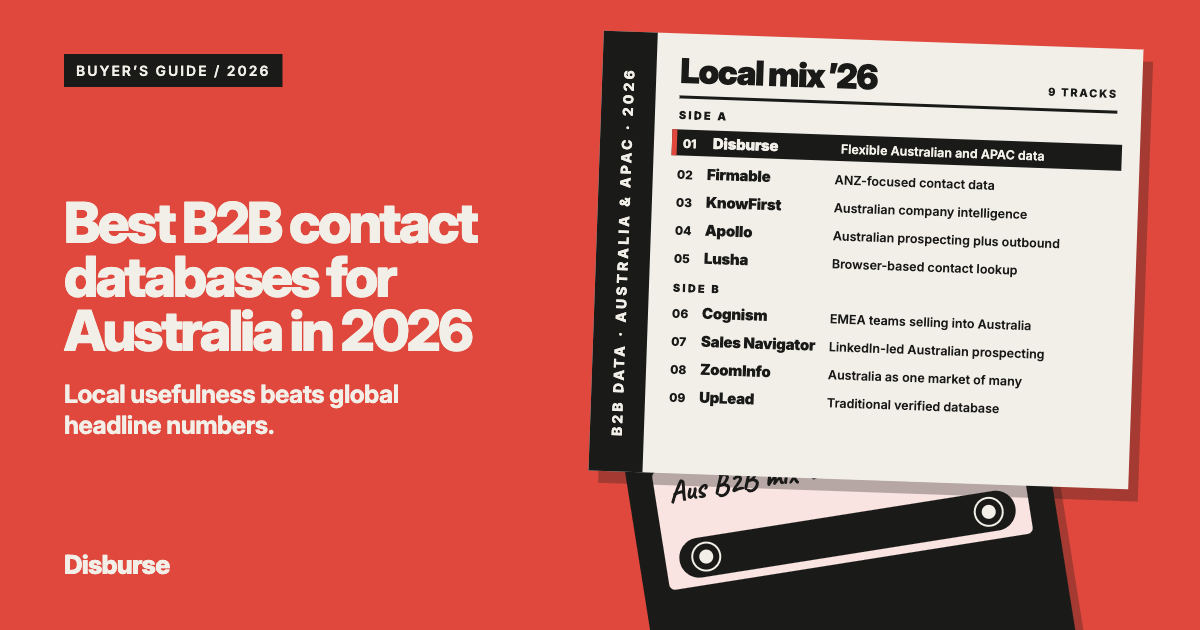
There is no single best B2B contact database for every sales team.
The right choice depends on what you are actually trying to do.
A startup looking for 500 highly targeted prospects has very different needs from an enterprise sales organisation maintaining millions of CRM records.
A recruiter searching for one executive needs something different from a RevOps team building an automated enrichment system.
A European sales team that relies heavily on phone outreach should also evaluate different things from an Australian founder prospecting across APAC.
The short answer: In 2026, the strongest B2B contact database depends on the job.
Disburse is best for natural-language B2B prospecting, enrichment and flexible data workflows
Apollo is strong for B2B data plus outbound sales execution
ZoomInfo is built for enterprise sales intelligence
Cognism is particularly strong for EMEA and phone-led prospecting
Clay is best for sophisticated GTM and enrichment workflows
Lusha is useful for straightforward sales intelligence and contact lookup
SalesIntel stands out for human-verified B2B data
UpLead is a strong traditional verified contact database
LinkedIn Sales Navigator is best when LinkedIn relationship intelligence is central to the sales motion
The important thing is to choose based on the work your team actually does, not which vendor claims to have the biggest database.
Best B2B contact databases in 2026
Platform
Disburse
Best for:
Natural-language prospecting and flexible B2B data
Pricing approach:
Free, Growth A$20/month, Scale A$99/month
Main strength:
Find, enrich and use B2B data without a complex workflow
Apollo
Best for:
Prospecting plus outbound sales execution
Pricing approach:
Free, paid plans available
Main strength:
Large prospecting platform combined with outreach
ZoomInfo
Best for:
Enterprise sales intelligence
Pricing approach:
Custom
Main strength:
Deep company and account intelligence
Cognism
Best for:
European and phone-led prospecting
Pricing approach:
Custom
Main strength:
EMEA data, mobile data and verification
Clay
Best for:
Custom GTM and enrichment workflows
Pricing approach:
Free, paid plans available
Main strength:
Multi-provider enrichment and automation
Lusha
Best for:
Straightforward sales intelligence and contact lookup
Pricing approach:
Free and paid credit plans
Main strength:
Easy access to email and phone data
SalesIntel
Best for:
Human-verified B2B data
Pricing approach:
Custom
Main strength:
Human verification and enterprise enrichment
UpLead
Best for:
Traditional verified B2B contact database
Pricing approach:
Paid self-service plans
Main strength:
Simple contact-based credits and email verification
LinkedIn Sales Navigator
Best for:
LinkedIn relationship prospecting
Pricing approach:
Paid subscription
Main strength:
Professional network and relationship intelligence
What is a B2B contact database?
A B2B contact database gives businesses access to information about companies and the people who work at them.
Depending on the platform, that can include:
Name
Job title
Seniority
Job function
Business email
Direct or mobile phone number
LinkedIn profile
Company name
Company domain
Industry
Company size
Revenue
Location
Technologies used
Buying signals
Buyer intent
But the category has changed considerably.
A B2B database used to mean:
Search filters → export spreadsheet
In 2026, many platforms can also:
Enrich existing records
Find similar companies
Connect directly to CRMs
Feed AI agents
Identify buying signals
Automate prospecting workflows
Run outbound campaigns
That is why database size alone is becoming a poor way to compare B2B data providers.
1. Disburse — best for natural-language B2B prospecting
Disburse takes a different approach from the traditional contact database.
Instead of starting with a long set of filters, you can describe what you need.
For example:
“Find founders of Australian B2B SaaS companies with 20 to 100 employees.”
Or:
“Find Heads of Sales at Singaporean fintech companies with more than 50 employees.”
But Disburse is not limited to prospect-list creation.
You can find one specific person:
“Find the Head of Sales at this company.”
You can enrich data you already have:
“Enrich this CSV of 2,000 contacts with available person and company information.”
Or use a strong existing customer to discover new accounts:
“Find companies similar to this business, then find the founders at those companies.”
What can Disburse do?
Disburse supports:
Individual contact search
Targeted people and company discovery
Natural-language search
Business email data
Available direct and mobile phone data
LinkedIn URLs
Company information
Contact enrichment
Company enrichment
CSV enrichment
Similar-company discovery
Persona finding
Chrome extension workflows
REST
MCP
AI workflows
The key distinction is flexibility.
Your starting point might be:
A person’s name
A company
An ICP
An existing spreadsheet
A strong customer
An AI prompt
You do not need a different product for each workflow.
Disburse pricing
Plan
Free
Price:
A$0
Credits:
50/month
Growth
Price:
A$20/month
Credits:
5,000/month
Scale
Price:
A$99/month
Credits:
50,000/month
Growth supports up to five team members.
Scale supports unlimited team members.
Searching is unlimited.
One credit represents one lead.
Available mobile numbers do not cost additional credits.
REST and MCP are available on the Free plan.
There is no annual lock-in.
Where is Disburse strongest?
Disburse makes particular sense for:
Startups
Founders
Agencies
Recruiters
Lean sales teams
AI-first businesses
Teams working with larger contact volumes
Businesses prospecting across APAC
Companies that already have their preferred sales stack
It is also particularly relevant for businesses increasingly working inside ChatGPT, Claude or other AI environments rather than wanting every sales workflow to live inside another SaaS dashboard.
What are Disburse’s limitations?
Disburse is not designed to replace every part of the sales technology stack.
If you need:
Extensive native buyer intent
Outbound sequencing
Advanced ABM infrastructure
Large-scale technographics
Enterprise revenue intelligence
there are broader platforms on this list.
For some teams, that focus is the appeal.
For others, it is a limitation.
When would I choose Disburse?
I would choose Disburse when the core problem is:
“We need an easy way to find and enrich B2B people and company data, and we want that data to work wherever we already work.”
It is particularly compelling when:
Natural-language search
AI access
Enrichment
High contact volume
Simple pricing
matter.
2. Apollo — best for B2B data plus outbound sales execution
Apollo is one of the most comprehensive products in this category.
It combines a large people and company database with sales engagement.
That means you can find prospects and continue into:
Email sequences
Calling
Workflow automation
AI-assisted prospecting
Buyer intent
CRM workflows
Deal management
Apollo also supports advanced filters, buying signals and lookalike functionality on eligible plans.
Where is Apollo strongest?
Apollo is particularly strong for SDR and BDR teams that want:
Database + prospecting + outreach
inside one product.
That can reduce the number of separate tools needed to run outbound.
What are Apollo’s limitations?
Its breadth can also be unnecessary.
If you already have:
An outbound platform
CRM
Dialler
Automation stack
you may end up paying for functionality that overlaps with software you already use.
Its credit system also requires closer attention than simply comparing headline database size.
When would I choose Apollo?
I would choose Apollo for a startup or sales team that wants one platform to handle a large part of the outbound process.
If I only needed the B2B data layer, I would compare it with Disburse.
3. ZoomInfo — best for enterprise sales intelligence
ZoomInfo sits at the enterprise end of the market.
It is better understood as a sales intelligence platform than simply a database of email addresses.
Its value comes from the intelligence surrounding:
Accounts
Companies
People
Buying activity
Segmentation
Where is ZoomInfo strongest?
ZoomInfo is worth considering when you have:
A substantial sales organisation
RevOps resources
Complex account-based selling
Enterprise CRM requirements
A need for deep company intelligence
Sophisticated segmentation
Significant budget for sales intelligence
It becomes especially relevant when account intelligence matters as much as the contact record itself.
What are ZoomInfo’s limitations?
For a five-person startup looking for a few thousand prospects, ZoomInfo can simply be more platform than necessary.
The buying process and product scope make more sense when the business has the team and infrastructure to use it properly.
When would I choose ZoomInfo?
I would choose ZoomInfo when buying an enterprise sales intelligence system rather than simply solving a B2B contact-data problem.
4. Cognism — best for European and phone-led B2B prospecting
Cognism deserves serious consideration from businesses prospecting heavily across the UK and Europe.
Its current product supports areas such as:
Targeted list building
Firmographic targeting
Technographic targeting
AI company research
AI persona building
AI search
CSV enrichment
Mobile data
Verification
Buyer intent
Its credit model is also relatively straightforward:
1 credit = 1 revealed contact
Where is Cognism strongest?
I would put Cognism high on the shortlist if:
Europe is a major market
Mobile numbers matter
Phone outreach is important
Verification matters
Compliance is a major consideration
What are Cognism’s limitations?
Smaller teams may prefer transparent self-service pricing.
If your focus is primarily Australia and APAC, it is also worth testing Cognism directly against other providers rather than assuming its EMEA strengths translate equally across every region.
When would I choose Cognism?
I would choose Cognism for an EMEA-focused sales team where reaching prospects by phone is a major part of the sales motion.
5. Clay — best for GTM data and enrichment workflows
Clay is not really a traditional B2B contact database.
It is better described as a platform for building data and GTM workflows across multiple providers.
You can:
Build enrichment waterfalls
Use AI research
Monitor signals
Enrich records
Score prospects
Connect data to CRMs and other systems
Where is Clay strongest?
Clay is excellent when your workflow looks like:
“Find these companies, run several enrichment providers, research each account with AI, score them, monitor signals and send qualified records into our CRM.”
That is much more sophisticated than simply retrieving an email address.
What are Clay’s limitations?
Power comes with complexity.
A smaller team may not want to build and maintain an enrichment system simply to get B2B contact data.
When would I choose Clay?
I would choose Clay if I had a sophisticated RevOps or growth function and wanted to design my own GTM data infrastructure.
If I wanted to ask for B2B data and receive it without building that infrastructure, I would choose something simpler.
6. Lusha — best for straightforward sales intelligence and contact lookup
Lusha has evolved beyond simple contact lookup.
It offers:
Prospecting
Enrichment
Browser workflows
API access
Wider sales intelligence functionality
Its credit structure varies depending on the information retrieved.
That can matter if your team routinely needs both email and phone information.
Where is Lusha strongest?
Lusha makes sense for teams that want:
An established sales intelligence platform
Familiar prospecting workflows
Browser-based research
Contact-by-contact discovery
It can work particularly well for reps moving between:
LinkedIn
CRM records
Direct contact research
What are Lusha’s limitations?
Credit economics become more important when phone numbers are central to the workflow.
That matters increasingly as volume grows.
When would I choose Lusha?
I would choose Lusha for a team that likes its broader sales intelligence environment and wants flexible contact-by-contact prospecting.
For higher-volume complete contact records, I would compare cost per usable prospect rather than plan price alone.
7. SalesIntel — best for human-verified B2B contact data
SalesIntel has one of the clearest points of differentiation in the market:
Human verification.
Its human-verified contact records are reverified regularly, and SalesIntel reports approximately 95% accuracy for those records.
SalesIntel also goes well beyond basic contact information.
Its platform includes:
Contact and account data
Firmographics
Technographics
Buyer intent
Enrichment
Account and industry news
Research on Demand
Chrome extension access
CRM integrations
Where is SalesIntel strongest?
SalesIntel is compelling when:
Contact verification is critical
CRM enrichment matters
Technographics matter
Account intelligence matters
Human research adds value
Its Research on Demand capability is also unusual.
If a contact is missing, human researchers can investigate the record.
What are SalesIntel’s limitations?
A founder or small sales team may not need the wider intelligence infrastructure around the contact data.
Quote-based purchasing also makes immediate price comparison more difficult.
When would I choose SalesIntel?
I would choose SalesIntel for a larger GTM organisation where:
Human verification
CRM enrichment
Technographics
Account intelligence
are genuinely important.
8. UpLead — best traditional verified B2B contact database
UpLead is one of the more straightforward products in this category.
It follows the classic database model:
Search → filter → unlock → export
One contact credit can provide access to the available contact data.
UpLead also emphasises verified emails and supports broader functionality such as:
Enrichment
Technographics
Advanced filters
API access on eligible plans
Buyer intent on higher tiers
Where is UpLead strongest?
UpLead is a good fit for businesses that do not want anything especially complicated.
If you understand traditional database filters and want verified contact data, the workflow is easy to grasp.
What are UpLead’s limitations?
Its self-service contact allowances are more modest for teams that need thousands of records each month.
That may not matter if you only need a carefully selected audience.
It matters much more at higher volume.
When would I choose UpLead?
I would choose UpLead if I wanted a conventional verified B2B database and expected to work with relatively modest contact volumes.
9. LinkedIn Sales Navigator — best for LinkedIn relationship prospecting
Sales Navigator deserves inclusion even though it is not a conventional contact database.
Its value comes from LinkedIn’s professional network.
That provides a different type of sales intelligence, including:
Career history
Connections
Company relationships
Job changes
Account activity
Lead alerts
LinkedIn messaging
Relationship context
For relationship-led selling, that information can be more valuable than another static database record.
Where is Sales Navigator strongest?
It is difficult to beat when your sales strategy relies on:
LinkedIn research
Relationship selling
Warm introductions
Tracking individual buyers
Following target accounts
Understanding professional networks
What are Sales Navigator’s limitations?
It is not a direct substitute for a conventional B2B contact database when you need:
Portable business emails
Phone data
Structured company data
Large-scale exports
That is why many sales teams use Sales Navigator alongside another data provider.
When would I choose Sales Navigator?
I would choose Sales Navigator when LinkedIn itself is central to the sales process.
I would often pair it with a dedicated B2B data platform rather than expecting it to solve every contact-data requirement.
Which B2B contact database is best for startups?
For most startups, I would shortlist Disburse and Apollo first.
The choice depends on what is missing from your stack.
If you need:
B2B data + outbound execution
Apollo is extremely compelling.
If you already have outbound tools and mainly need:
B2B data + enrichment + flexible prospecting
Disburse is likely the better fit.
The economics matter too.
A startup can begin with Disburse for free and move to 5,000 monthly credits for A$20 without committing to an enterprise contract.
I would be less likely to start a small company on ZoomInfo or SalesIntel unless there were specific enterprise intelligence requirements.
Which B2B contact database is best for small sales teams?
I would look at:
Disburse
Apollo
UpLead
Lusha
Choose Disburse when flexibility, contact volume, enrichment and AI workflows matter.
Choose Apollo when you also want sequencing and outbound execution.
Choose UpLead when you want a conventional database with a strong verification proposition.
Choose Lusha when you want contact data inside a broader sales intelligence workflow.
Which B2B contact database is best for enterprise sales teams?
ZoomInfo, SalesIntel and Cognism deserve closer consideration.
ZoomInfo is a strong candidate for broad enterprise sales intelligence.
SalesIntel stands out when human verification and ongoing enrichment matter.
Cognism deserves particular consideration for European teams and phone-heavy prospecting.
At this level, I would not choose based on a simple feature table.
I would run a real data evaluation against:
Your ICP
Regions
Sales process
Enrichment requirements
Contact channels
before signing a significant annual contract.
Which B2B database is best for finding phone numbers?
There is no universal winner.
For European phone-led prospecting, Cognism should be high on the shortlist because mobile data and verification are central to its proposition.
SalesIntel is also worth evaluating where human-verified mobile data matters.
UpLead can include an available mobile direct dial in its contact model.
Disburse includes available mobile data without charging an additional credit.
With Lusha, phone data uses more credits than email data, so the economics should be checked if phone prospecting is a major channel.
The best approach is to test 50 to 100 real prospects from your ICP and compare usable numbers.
Which B2B database is best for email addresses?
UpLead deserves consideration because email verification is central to its product.
SalesIntel is also strong if human verification matters.
But I would not choose a provider based only on a headline accuracy percentage.
Test a representative sample from your own market.
A provider performing well for US enterprise software executives may not perform identically for:
Australian recruitment owners
Singaporean fintech founders
New Zealand agency directors
Which B2B database is best for AI prospecting?
I would shortlist Disburse and Clay, for different reasons.
Disburse is the simpler option when the goal is to let AI find and work with B2B data.
It supports REST and MCP, so compatible AI workflows can request:
“Find the CFO at this company.”
“Find 100 Australian SaaS founders.”
“Enrich this contact file.”
“Find companies similar to these customers and identify the Heads of Sales.”
Clay is stronger when you want to build a sophisticated AI-driven GTM workflow involving:
Multiple data providers
Research steps
Enrichment waterfalls
Signals
Automation
The difference is essentially:
Disburse gives AI access to B2B data.
Clay gives you infrastructure for building a wider GTM data system.
Which B2B database is best for natural-language prospecting?
Disburse.
This is where its approach is clearest.
Instead of thinking about database syntax, the user describes the audience:
“Find founders of Australian SaaS companies with 20 to 100 employees.”
Natural language also works for narrower tasks:
“Find the CEO of this company.”
And more involved workflows:
“Find companies similar to these customers, then find the Head of Sales at each.”
Salespeople generally think about an ICP as a business description, not a set of database fields.
That is what makes natural-language search particularly useful.
Which B2B database is best for enrichment?
It depends on the complexity.
Straightforward contact and company enrichment
Disburse and UpLead are both worth considering.
Enterprise CRM enrichment
SalesIntel and ZoomInfo deserve attention.
Sophisticated multi-provider enrichment
Clay is the standout.
Clay can run provider waterfalls and connect enrichment into broader GTM workflows.
Disburse is useful when enrichment is one of several jobs the same platform needs to handle.
For example:
Enrich an existing CSV → search an ICP → find one person → discover similar companies
without changing tools.
Which B2B database is best for APAC?
I would put Disburse on the shortlist, then test it against one or two larger global providers using your real ICP.
For example:
“Find founders of Australian B2B SaaS companies with 20 to 100 employees.”
“Find Heads of Sales at Singaporean fintech companies.”
“Find Managing Directors at New Zealand recruitment agencies.”
“Find CFOs at Hong Kong professional-services businesses.”
The important word is:
Test.
Australia, Singapore, New Zealand, Hong Kong, Japan and the rest of APAC are not one homogeneous B2B data market.
Run the same representative sample through each provider and measure:
Correct companies found
Correct people found
Current job titles
Email availability
Phone availability
Company-data completeness
Total usable records
Cost per usable record
That tells you far more than the database-size number on a vendor’s homepage.
Which B2B database is best for agencies?
I would lean toward Disburse or Clay, depending on the agency.
Disburse is stronger when the agency needs flexibility without much infrastructure.
One client might need:
“Find the Managing Director at these 30 companies.”
Another:
“Find 2,000 Australian SaaS founders.”
Another may provide an existing database that needs enrichment.
Another may say:
“These five businesses are our best customers. Find similar companies and the right decision-maker at each.”
These are different jobs, but they can all be handled through the same B2B data platform.
Clay makes more sense for an agency building sophisticated repeatable enrichment systems across clients.
Which B2B database is best for recruiters?
For recruitment business development, I would look closely at:
Disburse
Cognism
Sales Navigator
SalesIntel
Sales Navigator is particularly useful for professional research and relationship context.
Cognism is worth evaluating for EMEA mobile data.
SalesIntel can be useful when human verification and difficult-to-find decision-makers matter.
Disburse is useful when the recruiter moves between:
Individual research
Market mapping
Client prospecting
Database enrichment
Similar-company discovery
Which B2B contact database has the best data?
There is no credible universal answer.
A provider can perform extremely well for one:
Geography
Company size
Industry
Job function
and differently elsewhere.
Vendor accuracy figures can be useful context.
They are not a substitute for testing.
For example, UpLead and SalesIntel both publish strong accuracy claims, but they use different verification methodologies.
Neither claim proves that every search will return the same accuracy for every target market.
How should you test a B2B contact database?
Before committing to an expensive annual contract, create a representative test set.
I would use around 50 to 100 prospects across several segments.
Then evaluate:
ICP coverage: Does it find the companies and people you actually target?
Role accuracy: Is the person still at the company and in the correct role?
Email coverage: How many usable business emails are returned?
Phone coverage: How many usable direct or mobile numbers are returned?
Company data: Are headcount, industry, geography and other fields useful?
Workflow: How quickly can you move from an idea to usable data?
Enrichment: Can it improve the records you already have?
Portability: Can the data move into the systems where your team works?
Cost: What does each genuinely usable contact cost?
Scale: Does pricing still make sense at your expected monthly volume?
The winner may not be the platform with the biggest database.
It is the platform returning the most useful records for your market at a price and in a workflow your team can sustain.
Do you need more than one B2B data tool?
Sometimes.
There is a tendency to look for one platform that does everything.
That is not always the best approach.
A sales team might use:
Sales Navigator for relationship and LinkedIn intelligence
Disburse for B2B contact and company data
An outbound platform for sequencing
A CRM for pipeline management
Another team may prefer Apollo because it consolidates more of those functions.
A sophisticated RevOps team might use Clay to orchestrate several data sources.
There is no inherent advantage in having either one tool or five.
The better stack is the one that gives your team reliable B2B data without unnecessary complexity.
How I would choose a B2B contact database in 2026
If I were choosing today, I would narrow the market based on the actual job.
For natural-language B2B prospecting: Disburse
For a startup wanting data plus outbound: Apollo
For enterprise sales intelligence: ZoomInfo
For European phone-led prospecting: Cognism
For custom GTM workflows: Clay
For straightforward sales intelligence and contact lookup: Lusha
For human-verified B2B data: SalesIntel
For a traditional verified contact database: UpLead
For LinkedIn relationship selling: LinkedIn Sales Navigator
There is no contradiction in having nine different winners.
These products increasingly solve different versions of the same underlying problem.
The wrong question is:
“Which company has the biggest database?”
The better question is:
“Which platform is best at the B2B data job my team actually needs to perform?”
So, what is the best B2B contact database in 2026?
For most businesses, there is no universal winner.
If you are a large enterprise building a sophisticated account-intelligence program, ZoomInfo deserves consideration.
If Europe and phone prospecting are central to your sales motion, Cognism is one of the first platforms I would test.
If you want B2B contact data combined with outbound sales execution, Apollo is difficult to ignore.
If you want to build highly customised GTM data workflows across several providers, Clay is the more powerful option.
If human verification is your priority, SalesIntel has a clear point of difference.
If LinkedIn relationships drive your sales process, Sales Navigator remains difficult to replace.
And if you want a flexible B2B data platform that can move between:
Finding one person
Finding an entire target market
Enriching data you already have
Finding similar companies
Identifying relevant personas
Working directly with AI
Disburse is one of the strongest options in the category in 2026.
That distinction matters.
Disburse does not need to be the biggest sales intelligence platform to be useful.
For many businesses, the better product is the one that makes moving from:
“Who should we target?”
to:
Usable B2B data
as straightforward as possible.
Frequently asked questions
What is the best B2B contact database in 2026?
There is no single best platform for every company.
Disburse is particularly strong for natural-language B2B prospecting.
Apollo is strong for B2B data plus outbound.
ZoomInfo is suited to enterprise sales intelligence.
Cognism is strong for EMEA phone data.
Clay is strong for GTM data workflows.
SalesIntel stands out for human-verified contact data.
What is the best B2B database for startups?
Disburse and Apollo are two strong options.
Disburse is particularly relevant if you already have your sales tools and mainly need flexible B2B data.
Apollo is strong if you also want outbound sales functionality.
What is the best B2B database for small businesses?
Disburse is particularly attractive for smaller businesses because it offers:
A free plan
5,000 monthly credits for A$20 on Growth
No annual lock-in
Apollo, UpLead and Lusha are also worth comparing depending on your workflow.
What is the best B2B database for enterprise companies?
ZoomInfo is one of the strongest enterprise sales intelligence options.
SalesIntel and Cognism should also be evaluated depending on:
Verification requirements
Geography
Buyer intent
Enrichment needs
What is the best B2B database for finding emails?
UpLead is worth considering because verification is central to its product.
SalesIntel is another strong option where human verification matters.
Actual accuracy should always be tested against your ICP.
What is the best B2B database for finding phone numbers?
Cognism is particularly strong for EMEA phone-led prospecting.
SalesIntel emphasises verified mobile data.
Disburse includes available mobile numbers without charging additional credits.
What is the best B2B database for Australia?
Disburse is particularly relevant for Australian and APAC-focused prospecting.
The best approach is still to test any provider against a representative sample of Australian companies and decision-makers.
What is the best B2B database for natural-language prospecting?
Disburse.
It is built around natural-language B2B data requests, allowing users to describe the people and companies they want rather than relying entirely on traditional filters.
What is the best B2B database for AI agents?
Disburse is particularly relevant because it supports REST and MCP.
Clay is another strong option when the goal is to build more complex AI-driven enrichment and GTM workflows.
What is the best B2B database for enrichment?
Clay is particularly powerful for multi-provider enrichment.
SalesIntel is strong for enterprise CRM enrichment.
Disburse is useful when enrichment needs to sit alongside:
Prospect discovery
Company research
Similar-company discovery
AI workflows
Is Apollo the best B2B database?
Apollo is one of the strongest options for teams wanting B2B contact data and outbound execution in one product.
If you mainly need the B2B data layer, other platforms may be more focused.
Is ZoomInfo the best B2B database?
ZoomInfo is one of the strongest enterprise sales intelligence platforms.
It can be unnecessarily broad for smaller businesses that mainly need contact and company data.
Is Cognism the best B2B database?
Cognism is particularly strong for EMEA prospecting, mobile data and verification.
It should be evaluated against your actual target geography and sales motion.
Is Clay a B2B contact database?
Not in the traditional sense.
Clay is better described as a GTM data and enrichment platform that can use multiple providers, AI research and automated workflows.
Is LinkedIn Sales Navigator a B2B contact database?
Not exactly.
Sales Navigator is a professional prospecting and relationship-intelligence platform rather than a conventional email and phone database.
It is often used alongside a dedicated B2B contact-data provider.
What is the cheapest B2B contact database?
It depends on the amount and type of data required.
Disburse has:
Free at A$0 with 50 monthly credits
Growth at A$20 with 5,000 monthly credits
Scale at A$99 with 50,000 monthly credits
Another provider may still offer better value if its data or functionality is materially better for your particular market.
Should I choose a B2B database based on database size?
No.
Database size says very little about how well a provider covers your specific ICP.
Test relevant contacts and compare:
Coverage
Accuracy
Available data
Workflow
Cost per usable record
Should I use one B2B database or multiple providers?
Either can work.
Smaller teams often benefit from keeping the stack simple.
More sophisticated RevOps teams may combine several providers through a platform such as Clay.
What should I test before buying a B2B contact database?
Test real contacts from your ICP and compare:
Company coverage
Person coverage
Current titles
Email availability
Phone availability
Enrichment quality
Workflow
Integrations
Total cost per usable contact
Which B2B contact database should I choose?
Choose based on the job your team actually needs to perform.
For natural-language prospecting and flexible B2B data, start with Disburse.
For outbound execution, consider Apollo.
For enterprise intelligence, consider ZoomInfo.
For EMEA phone data, consider Cognism.
For custom GTM workflows, consider Clay.
For human verification, consider SalesIntel.
For traditional verified contact search, consider UpLead.
For LinkedIn relationship selling, consider LinkedIn Sales Navigator.
APAC Prospectinglead generationEnterprise SalesSmall Sales TeamsB2B Contact DatabaseRevOpsApolloAI ProspectingNatural-Language SearchZoomInfoB2B DataSales ProspectingData EnrichmentBuyer IntentDisburseB2B Sales ToolsB2B Lead ListsSales IntelligenceLinkedIn Sales NavigatorIdeal Customer Profile (ICP)