Best B2B Contact Databases for Startups
25 min readLachlan McBride White
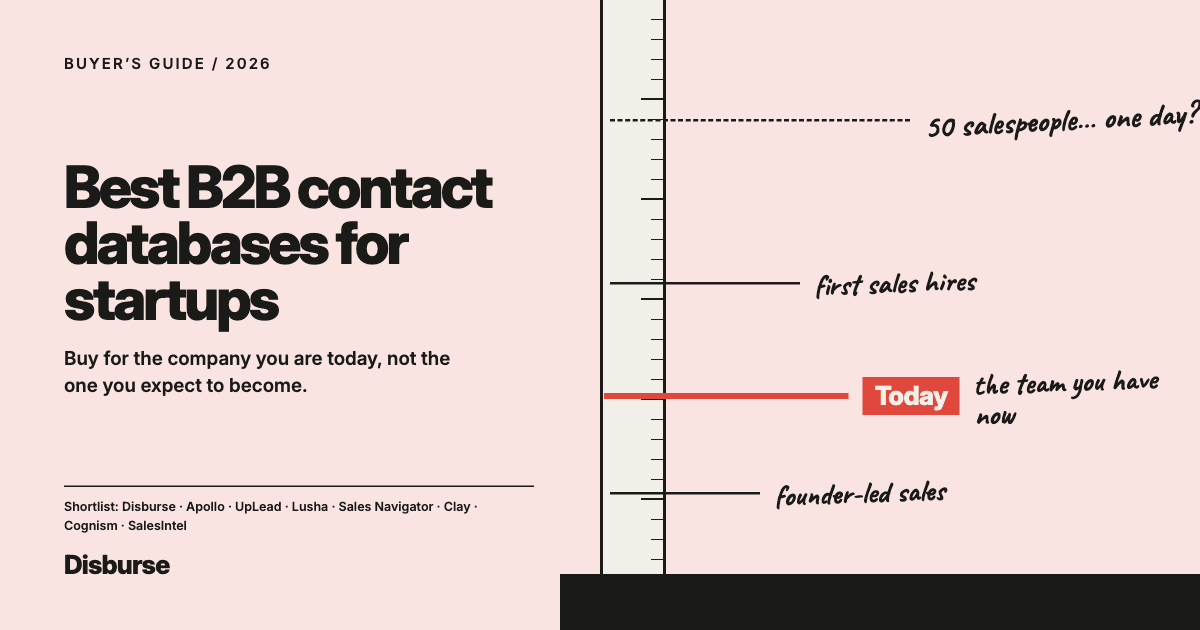
Startups have a habit of buying sales software for the company they expect to become rather than the company they are today.
You probably do not need an enterprise sales intelligence platform because you plan to have 50 salespeople one day.
You need a B2B contact database that helps the team you have now answer questions like:
Who should we sell to?
Who is the right person at that company?
How can we contact them?
Can we find another 500 prospects like our best customers?
Can we enrich the leads already sitting in our CRM?
For most startups, the best B2B database is one that is:
Affordable enough to experiment with
Flexible enough to change as the ICP changes
Simple enough that founders and early sales hires will actually use it
The short answer:
Disburse is best for startups that primarily need flexible, affordable B2B data without committing to a larger sales platform
Apollo is one of the strongest options for startups building prospecting and outbound from scratch
UpLead is a good traditional verified contact database
Lusha is useful for browser-led prospecting
LinkedIn Sales Navigator is particularly useful for founder-led relationship selling
Clay is best for startups ready to build a more sophisticated GTM data system
Cognism makes sense for EMEA startups that rely heavily on phone outreach
SalesIntel is most relevant when a startup sells high-value enterprise products and contact verification matters more than volume
Best B2B contact databases for startups
Platform
Disburse
Best for:
Flexible, affordable B2B data
Entry point:
Free, Growth A$20/month
Why startups should consider it:
Natural-language search, enrichment, lookalikes, Chrome, REST and MCP
Apollo
Best for:
Building an early outbound stack
Entry point:
Free and paid plans
Why startups should consider it:
B2B data plus prospecting, signals and outbound execution
UpLead
Best for:
Traditional verified contact data
Entry point:
From US$99/month
Why startups should consider it:
Straightforward contact unlocks and verified emails
Lusha
Best for:
Browser-led prospecting
Entry point:
Free plan available
Why startups should consider it:
Contact data, Chrome extension, enrichment and sales intelligence
LinkedIn Sales Navigator
Best for:
Founder-led LinkedIn prospecting
Entry point:
Paid subscription
Why startups should consider it:
Professional research and relationship context
Clay
Best for:
Startups building custom GTM systems
Entry point:
Free and paid plans
Why startups should consider it:
Multi-provider data, AI research and automation
Cognism
Best for:
EMEA startups reliant on phone outreach
Entry point:
Custom
Why startups should consider it:
Mobile data, verification and compliance
SalesIntel
Best for:
High-value enterprise prospecting
Entry point:
Custom
Why startups should consider it:
Human verification and deeper sales intelligence
What should a startup look for in a B2B contact database?
Startups should evaluate B2B data differently from established sales organisations.
Your ICP will probably change.
Your sales team may change.
Your outbound process will change.
You may discover that the person you thought was the buyer is actually an influencer and someone else controls the budget.
That makes flexibility unusually important.
Can you experiment without a major commitment?
A startup might spend Monday targeting SaaS founders and discover by Friday that Heads of Sales at professional-services firms respond better.
That is normal.
Your B2B database should make those experiments inexpensive.
Long contracts, restrictive seats and expensive implementation are much harder to justify when the sales motion is still evolving.
Can it find one person as easily as 1,000?
Early-stage prospecting is inconsistent.
One minute the founder wants:
“Find the Head of Partnerships at this company.”
The next request is:
“Find 500 founders of Australian B2B SaaS companies.”
You should not necessarily need separate tools for:
Individual contact lookup
Broader prospect discovery
Can you change the ICP easily?
A startup’s targeting can change every week.
You may begin with:
Australian SaaS companies with 10 to 50 employees.
Then narrow it to:
Australian B2B SaaS companies with 20 to 100 employees and a Head of Sales.
Then discover that:
Singaporean fintech businesses with 50 to 200 employees
are an even better segment.
The database should not make every adjustment feel like rebuilding the prospecting system.
Can you enrich the data you already have?
Startups accumulate messy data quickly.
You may already have:
People the founder knows
Old CRM records
Newsletter subscribers
Event contacts
Previous prospect lists
Free-trial users
Company lists
Contacts sourced manually through LinkedIn
Before buying another 10,000 leads, work out whether the data you already have can be improved.
Does the pricing work at startup scale?
The cheapest monthly subscription is not necessarily the cheapest source of data.
A US$50 plan that gives you 100 genuinely useful prospects may be more expensive than a plan that costs more but provides thousands.
The better metric is:
Cost per usable prospect
not:
Cost per month
Also check:
Whether email and phone use credits differently
Whether seats cost extra
Whether unused credits expire
Whether API access costs more
Whether annual contracts are required
1. Disburse — best for startups that want flexible B2B data without a large sales stack
Disburse is particularly well suited to startups because it can handle several different B2B data jobs without requiring the business to commit to one rigid prospecting workflow.
You can:
Find one person
Find a small group
Build a larger audience
Find companies
Enrich existing records
Find businesses similar to an existing customer
Identify relevant personas inside those businesses
That matters when the startup is still working out what its go-to-market motion should look like.
Start with a question, not a filter panel
Suppose you are a founder trying to build your first outbound campaign.
You might ask:
“Find founders of Australian B2B SaaS companies with 20 to 100 employees.”
Or:
“Find Heads of Sales at Singaporean fintech companies with more than 50 employees.”
Or simply:
“Find the Head of Sales at this company.”
Disburse uses the request to find relevant people and companies and return structured B2B data.
That makes it particularly useful for founders who understand their market but do not necessarily want to become experts in operating a prospecting database.
Can you start with your best customer?
Yes.
Startups often struggle to define an ICP formally.
But ask a founder to name their three best customers and they can usually answer immediately.
That creates another way to prospect.
Start with:
“Find companies similar to this business.”
Then:
“Find the founders at those companies.”
Or:
“Find the Heads of Sales at those companies.”
That creates a simple path:
Existing customer → similar companies → relevant people → contact data
For a startup still learning where it wins, that can be more practical than building a perfect ICP scoring model.
Can Disburse find one person?
Yes.
Not every startup prospecting job is a campaign.
Sometimes the founder has just found a company and wants to know:
“Who runs sales there?”
Or:
“Who founded this business?”
Or:
“Who is the CFO?”
Disburse can be used for that individual lookup.
This matters because early-stage sales often happens account by account.
You do not need to build an entire prospect list every time.
Can Disburse build larger prospect lists?
Yes.
When the startup wants to scale an experiment, the same workflow can become:
“Find 500 Heads of Sales at Australian software companies with 20 to 100 employees.”
The output can include available information such as:
Name
Title
Seniority
Job function
Business email
LinkedIn URL
Direct/mobile phone
Company name
Company domain
Industry
Employee count
Revenue
Location
Specialties
That data can then move into the rest of the startup’s sales stack.
Can Disburse enrich the leads you already have?
Yes.
Imagine you have a CSV containing 2,000 contacts.
Some have names.
Some have emails.
Some have company information.
Most are incomplete.
Disburse can enrich existing people and company records using available identifiers and append additional available B2B data.
For startups, this can be particularly valuable because early CRM data tends to come from everywhere.
The answer is not always to buy more leads.
Sometimes it is to make the leads you already have more useful.
Can Disburse work inside AI workflows?
Yes.
Disburse supports:
REST
MCP
That means compatible AI workflows can access B2B data directly.
Instead of:
AI assistant → database → spreadsheet → AI assistant
the B2B data layer can become part of the AI workflow itself.
For startups increasingly operating inside ChatGPT, Claude or internal agents, that can be useful.
Does Disburse have a Chrome extension?
Yes.
If prospecting begins while the founder or salesperson is browsing the web, Disburse can also be used through Chrome.
That makes the platform useful across:
Natural-language search
Browser research
Structured data workflows
AI workflows
Disburse pricing for startups
Plan
Free
Price:
A$0
Monthly credits:
50
Users:
1
Growth
Price:
A$20/month
Monthly credits:
5,000
Users:
Up to 5
Scale
Price:
A$99/month
Monthly credits:
50,000
Users:
Unlimited
One credit represents one lead.
Available mobile numbers do not consume an additional credit.
Search is unlimited.
REST and MCP are included from the Free tier.
There is no annual lock-in.
Purchased Growth credit top-ups do not expire.
For an early-stage startup, Growth is particularly compelling because up to five team members can share 5,000 monthly credits for A$20.
Where does Disburse fit best?
I would shortlist Disburse if your startup:
Has a founder-led sales motion
Has a small sales team
Changes targeting regularly
Already has an outbound platform
Wants higher data volume without high software spend
Needs both discovery and enrichment
Wants to find similar companies
Uses AI heavily
Sells across Australia or APAC
Does not want an annual commitment
When might another tool be better?
If you need your B2B database to also run your outbound sequences, Apollo offers a broader product.
If you need sophisticated multi-provider enrichment and custom research logic, Clay gives you more control.
If your team primarily sells through LinkedIn relationships, Sales Navigator is particularly useful.
If you are phone-heavy and focused on EMEA, Cognism deserves serious consideration.
When would I choose Disburse?
I would choose Disburse when the startup’s requirement is:
“We need access to good B2B people, company and contact data, but we do not want to build our entire sales stack around the database.”
2. Apollo — best for startups building prospecting and outbound together
Apollo is probably the most important alternative for a startup to compare with Disburse.
The reason is simple.
Apollo does much more than provide B2B contact data.
It combines:
Contact and company data
Prospecting
AI
Signals
Enrichment
Outbound sales execution
For a startup building its sales stack from zero, that breadth can be a major advantage.
Why does Apollo work well for startups?
The biggest advantage is what happens after the prospect is found.
Apollo can continue into the wider sales process.
Instead of thinking:
Database + outbound platform + prospecting tools
you can consolidate more of the workflow.
It also supports much more sophisticated targeting as the startup matures.
You may begin with:
“Heads of Sales at SaaS companies.”
Then progress to more specific segments using:
Firmographics
Buyer intent
Signals
Lookalikes
AI-assisted targeting
Does Apollo offer startup pricing?
The source notes that eligible early-stage startups can receive a significant discount on selected Apollo plans for their first year.
Because startup programs and pricing can change, confirm current eligibility directly before making a decision.
The key point is that a startup discount can materially change Apollo’s economics if you are also replacing other outbound tools.
What are Apollo’s limitations for startups?
You may simply not need all of it.
If you already have an outbound platform you like, the value equation changes.
Per-seat pricing also becomes more important as the team grows.
The question is not whether Apollo is a good product.
It is whether your startup needs:
The wider sales platform
or mainly:
The data
When would I choose Apollo?
Choose Apollo if you are building your startup’s outbound stack from scratch and want:
Prospect data + outbound execution
in the same environment.
3. UpLead — best for startups that want a traditional verified contact database
UpLead is a good option for startups that do not want a new way of prospecting.
They just want a database.
The workflow is simple:
Search → filter → find person → unlock contact → export
That is easy to understand.
Where is UpLead strong?
UpLead is useful for teams that care about:
Traditional search
Verified email data
Available mobile direct dials
Enrichment
Technographics
Advanced filters
CRM workflows
It is more capable than a basic email finder.
What is the startup trade-off?
Volume.
A few hundred contacts per month may be perfectly reasonable for founder-led, highly targeted outbound.
It looks very different if the startup wants several thousand new contacts each month.
That is why headline subscription price is not enough.
Look at:
The actual number of usable contacts you need
When would I choose UpLead?
Choose UpLead if you want a familiar contact-centric database and care more about carefully selected records than high self-service volume.
4. Lusha — best for straightforward browser-led startup prospecting
Lusha is a well-established B2B sales intelligence platform and is particularly useful when founders or early salespeople prospect while browsing LinkedIn and the web.
Its platform combines:
Contact data
Browser prospecting
Enrichment
AI-oriented workflows
CRM integrations
Wider sales intelligence
That gives a startup a relatively easy way to test the workflow.
Why is Lusha more than a contact lookup tool?
It would be outdated to describe Lusha as only an email and phone finder.
Its current platform includes broader:
Prospecting
Enrichment
AI workflows
CRM workflows
That makes it a legitimate startup prospecting option.
What should startups watch with Lusha?
Phone economics.
If your sales motion relies heavily on both:
Email
Phone
calculate how credits are consumed before comparing the plan with alternatives.
A tool that looks inexpensive for email-only prospecting can look very different for multichannel outreach.
When would I choose Lusha?
Choose Lusha if your startup wants:
Established B2B contact data
Strong browser-based prospecting
CRM workflows
Broader sales intelligence
5. LinkedIn Sales Navigator — best for founder-led relationship prospecting
Sales Navigator is not really a conventional B2B contact database.
But for some startups, it may be more valuable than one.
Early sales often depends heavily on:
Founder networks
Mutual connections
Warm introductions
LinkedIn activity
Account research
Job changes
Direct outreach
Sales Navigator gives founders professional context that a standard contact database cannot reproduce exactly.
Where does Sales Navigator work particularly well?
Imagine you are targeting 50 high-value accounts.
You probably do not want to blast 10,000 people.
You want to know:
Who runs the relevant department?
Who recently joined?
Do we have a mutual connection?
Who else belongs in the buying group?
That is where Sales Navigator is particularly useful.
What is the limitation?
Sales Navigator is not designed primarily to give you a portable B2B contact database containing emails and phone numbers.
That means startups often pair it with a dedicated data provider.
For example:
Sales Navigator + Disburse
can make sense when Sales Navigator is used for:
Account research
Relationship intelligence
while Disburse provides the underlying B2B data.
When would I choose Sales Navigator?
Choose Sales Navigator if your startup sells into relatively high-value accounts and founder-led relationship building is an important part of the sales process.
6. Clay — best for startups building a sophisticated GTM engine
Clay is extremely powerful.
It is also easy for an early startup to buy because everyone says it is powerful, then spend more time building workflows than selling.
The question is not:
“Is Clay good?”
It clearly is.
The question is:
“Do we actually need Clay yet?”
What does Clay do differently?
Clay can bring together many different data sources rather than relying on one database.
It can support:
Multi-provider enrichment
Enrichment waterfalls
AI-powered web research
Signals
Scoring
Automation
CRM workflows
That allows a startup to build processes such as:
Find accounts → enrich people → find email → find phone → research website → qualify with AI → score → send to CRM
That is much more sophisticated than ordinary database prospecting.
When does Clay make sense for a startup?
Clay becomes compelling when the startup has:
A repeatable ICP
Meaningful outbound volume
Someone who owns GTM operations
Custom research requirements
Multiple data providers
Sophisticated enrichment logic
Automation worth scaling
At that point, flexibility becomes an advantage rather than overhead.
When would I not choose Clay?
If you have not yet proven that anyone responds to your outbound, I would hesitate to spend significant time engineering the perfect data pipeline.
First prove the sales motion.
Then automate the parts worth automating.
When would I choose Clay?
Choose Clay when the startup is ready to build a real GTM data system rather than simply access B2B contacts.
7. Cognism — best for EMEA startups with a phone-led sales motion
Cognism becomes much more interesting when a startup sells heavily across the UK and Europe and phone outreach matters.
Its positioning around:
Mobile data
Verification
Compliance
makes it particularly relevant to that sales motion.
Why might a startup pay more for Cognism?
Imagine you sell a £30,000 annual product.
You only need 300 target accounts.
Your salespeople call heavily.
In that situation, paying more for the right contacts and better phone coverage can make much more sense than buying tens of thousands of cheap records.
This is why there is no universally “cheap” B2B database.
The value of the contact depends on what you sell.
What are Cognism’s limitations for early startups?
Pricing is custom rather than simple self-service pricing.
That creates more friction if you are a two-person company that wants to test an outbound hypothesis this week.
When would I choose Cognism?
Choose Cognism if your startup:
Sells primarily into EMEA
Relies heavily on calling
Values verified mobile data
Values compliance
enough to justify a more sales-led buying process.
8. SalesIntel — best for startups selling high-value enterprise products
SalesIntel would not be my default recommendation for every startup.
But it becomes interesting when the startup is small while its customers are very large.
That distinction matters.
A five-person startup selling US$100,000 enterprise contracts has very different data requirements from a five-person startup selling a US$99 monthly subscription.
Where does SalesIntel fit?
SalesIntel places significant emphasis on:
Human verification
Deeper sales intelligence
Research on Demand
Enrichment
Technographics
Research on Demand can be useful when a high-value contact is difficult to find through automated sources.
That makes sense when the number of prospects is small but each opportunity is worth a lot.
When would I choose SalesIntel?
Choose SalesIntel when your startup has an enterprise sales motion and:
Contact quality
Research
Account intelligence
matter more than inexpensive volume.
What is the best B2B database for a pre-seed startup?
At pre-seed, keep it simple.
Your main objective is probably learning:
Who responds?
Which industries care?
Which titles understand the problem?
Which company sizes convert?
Which messaging works?
I would start with:
Disburse
Apollo
Disburse is particularly attractive if you already have your preferred email or sales tools and primarily need flexible B2B data.
Apollo is particularly attractive if you also need to establish the outbound infrastructure.
Do not spend thousands building an enterprise prospecting stack before you know who actually wants the product.
What is the best B2B database for a seed-stage startup?
At seed stage, the answer depends on whether the GTM motion has stabilised.
If you are still testing ICPs, Disburse remains particularly useful because targeting can change easily.
If you are building an SDR team and want:
Data + outbound
Apollo becomes compelling.
If your outbound process is sophisticated enough to justify custom enrichment and automation, Clay becomes more interesting.
If you are moving upmarket, tools such as Cognism, SalesIntel and eventually ZoomInfo may become relevant depending on:
Geography
Deal size
Sales motion
What is the best free B2B contact database for startups?
Several providers offer free entry points.
Disburse Free includes:
50 monthly credits
Unlimited search
REST
MCP
One user
Apollo, Lusha and Clay also offer free plans or entry points.
The best free plan depends on what you are testing.
If you want to test:
B2B data access
your priorities will differ from someone testing:
Outbound execution
or:
Complex enrichment workflows
What is the cheapest B2B database for a startup?
Do not answer this by comparing subscription prices alone.
Imagine:
Tool A: A$20 and 5,000 useful leads
Tool B: US$99 and 170 contacts
Tool C: US$49 per user but also replaces part of your sales stack
Those products are not directly comparable.
The better comparison is:
Cost per usable prospect + software replaced
Disburse Growth is A$20 per month for 5,000 monthly credits and up to five users.
Other platforms may cost more but provide additional functionality.
The right choice depends on what you actually need.
What is the best B2B database for founder-led sales?
Disburse and Sales Navigator are particularly interesting for founder-led sales, for different reasons.
Disburse lets the founder convert what they know about the market into a direct data request:
“Find founders of Australian SaaS companies with 20 to 100 employees.”
Sales Navigator is valuable when the founder wants to:
Research the person
Understand professional history
Find a relationship path into the account
Apollo is another strong option if the founder also needs to run outbound campaigns.
What is the best B2B database for Australian startups?
Disburse should be high on the shortlist.
Typical searches might include:
“Find founders of Australian B2B SaaS companies with 20 to 100 employees.”
“Find Heads of Sales at Australian cybersecurity companies.”
“Find Managing Directors at Australian recruitment agencies.”
Australian startups should still test global providers such as Apollo, Lusha, UpLead and Cognism against a representative sample of their actual market.
A database claiming hundreds of millions of contacts globally does not automatically mean it has the best data for the 2,000 Australian companies you care about.
What is the best B2B database for APAC startups?
For APAC, test by country.
Do not treat APAC as one market.
Your audience may include:
Australia
New Zealand
Singapore
Hong Kong
Other markets later
Run the same representative test in each.
Disburse is particularly relevant to APAC-focused workflows because natural-language targeting makes it easy to change:
Geography
Company characteristics
Personas
But coverage should still be tested against your actual ICP.
What is the best B2B database for a startup doing cold email?
If you already have an outbound platform, I would compare:
Disburse
UpLead
Lusha
If you need outbound infrastructure as well, Apollo becomes particularly compelling.
The most important metric is not:
How many emails are in the database?
It is:
How many relevant prospects have usable emails?
What is the best B2B database for a startup doing cold calling?
If EMEA is your market, investigate Cognism.
For Australia and APAC, test several providers against your actual personas.
Disburse includes available mobile numbers without an additional credit.
UpLead can include available mobile direct dials.
Lusha also provides phone data, but phone-heavy teams should carefully calculate credit usage.
What is the best B2B database for a startup using AI?
This is becoming a more meaningful buying criterion.
A startup may increasingly work inside an AI assistant rather than opening 10 SaaS dashboards.
Disburse supports:
MCP
REST
which allows compatible AI and software workflows to access B2B data directly.
Clay is particularly strong when AI needs to perform:
Custom research
Multi-provider enrichment
Workflow automation
Apollo incorporates AI into a broader sales platform.
So the question becomes:
Do you need AI access to B2B data?
AI prospecting inside a sales platform?
or:
A configurable AI GTM workflow?
Those are different problems.
Is Apollo or Disburse better for startups?
It depends on what you need around the data.
Choose Apollo if you want:
Contact and company data
Advanced prospecting
Signals
Sales engagement
Outbound execution
More of your early sales stack in one platform
Choose Disburse if you want:
Natural-language B2B data access
Individual contact lookup
Larger prospect audiences
Enrichment
Similar-company discovery
Persona discovery
Chrome prospecting
REST
MCP
High self-service data volume
Low multi-user cost
Neither approach is inherently better.
One is a broader sales platform.
The other is a focused B2B data layer.
Is Clay worth it for an early-stage startup?
Sometimes.
But I would not make it automatic.
Clay can be excellent value if you are actually using:
Custom enrichment
AI research
Signals
Workflow automation
If you have not yet established your ICP or proven your outbound motion, you may be introducing sophistication too early.
Do the process manually enough times to understand it.
Then automate the parts that are worth automating.
Should a startup buy ZoomInfo?
Usually not at the very beginning.
That is not a criticism of ZoomInfo.
It is a stage question.
Enterprise sales intelligence becomes valuable when you have:
Enterprise accounts
Established sales processes
Large datasets
ABM
Buying committees
Intent
RevOps
Significant CRM enrichment needs
A founder trying to book their first 20 outbound meetings has a different problem.
Buy enterprise infrastructure when you have an enterprise problem.
How many B2B contacts does a startup actually need?
Probably fewer than you think.
If you have not proven that 100 highly relevant prospects respond to the offer, buying 100,000 contacts will not fix the problem.
Start with a tight audience.
For example:
100 founders of Australian B2B SaaS companies with 20 to 100 employees.
Test:
Targeting
Message
Channel
Response
Meetings
Conversion
If it works, scale.
If it does not, learn why before buying more data.
A startup does not win outbound by having the largest spreadsheet.
How should startups test a B2B contact database?
Give every provider the same assignment.
For example:
“Find 100 Heads of Sales at Australian B2B SaaS companies with 20 to 100 employees.”
Then compare:
ICP fit: How many companies genuinely meet the criteria?
Persona fit: Did it find the right people?
Freshness: Do those people still work there?
Email coverage: How many usable business emails are available?
Phone coverage: How many usable phone numbers are available?
Company data: Is there enough information to qualify the account?
Flexibility: How easily can you change the ICP?
Enrichment: Can you improve existing records?
Workflow: How quickly can the data get where you need it?
Economics: What does each genuinely usable prospect cost?
Then repeat the test with another segment.
One 100-person sample is more useful than a homepage claiming hundreds of millions of records.
Which B2B contact database should a startup choose?
My shortlist would be:
Best for flexible startup B2B data: Disburse
Best for building an outbound stack: Apollo
Best traditional verified database: UpLead
Best for browser-led contact prospecting: Lusha
Best for founder-led LinkedIn selling: LinkedIn Sales Navigator
Best for sophisticated GTM workflows: Clay
Best for EMEA phone-led startups: Cognism
Best for high-value enterprise prospecting: SalesIntel
Those winners reflect different startup sales motions.
That is more useful than pretending one platform should win every category.
So, what is the best B2B contact database for startups?
There is no universal winner.
If I were building an outbound sales stack from nothing, I would seriously consider Apollo.
It combines B2B data with a much wider set of sales tools.
If I were building a sophisticated GTM data operation with custom enrichment and AI research, I would look at Clay.
If I sold primarily through LinkedIn relationships, Sales Navigator would probably be part of the stack.
If I were an EMEA startup dependent on phone outreach, I would investigate Cognism.
If I wanted a conventional verified database and relatively modest contact volume, UpLead would be a credible option.
But if the startup already has its sales tools and mainly needs a flexible B2B data layer, I would start with Disburse.
The reason is not simply price.
It is that startups change.
Today you might need:
One Head of Sales.
Tomorrow:
500 founders matching a new ICP.
Next week:
Your existing 2,000 contacts enriched.
Then:
Companies similar to the three customers that just converted.
And six months from now, the team may want that same data inside an AI workflow instead of another SaaS dashboard.
A startup B2B database should accommodate that change.
It should not force you to predict your entire go-to-market system before you have finished discovering it.
Frequently asked questions
What is the best B2B contact database for startups?
Disburse is particularly strong for startups that want flexible B2B data without a larger sales platform.
Apollo is one of the strongest choices if outbound execution is also required.
UpLead is a good traditional verified database.
Clay is better for sophisticated GTM workflows.
What is the best B2B database for an early-stage startup?
Disburse and Apollo are the first two I would test.
Disburse is suited to flexible B2B data access.
Apollo is particularly useful when the startup also needs to establish its outbound sales stack.
What is the best free B2B database for startups?
Disburse, Apollo, Lusha and Clay all offer free ways to test their products.
The best free option depends on whether you are testing:
Contact data
Prospecting
Outbound execution
Enrichment
AI workflows
Does Apollo offer startup pricing?
Apollo has offered startup-specific discounts for eligible early-stage companies.
Because startup-program eligibility and pricing can change, confirm the current offer directly before relying on it in your buying decision.
What is the best B2B database for founder-led sales?
Disburse is particularly useful for translating a founder’s understanding of an ICP into natural-language data searches.
Sales Navigator is valuable when relationship and professional context matter.
What is the best B2B database for a startup sales team?
Disburse and Apollo are strong starting points.
Disburse works well when the team already has its sales tools.
Apollo can combine prospect data with outbound execution.
What is the best B2B database for Australian startups?
Disburse is particularly relevant for Australian startup prospecting.
Global providers should still be tested against representative Australian companies and personas rather than relying on global database-size claims.
What is the best B2B database for APAC startups?
Disburse is worth testing across:
Australia
New Zealand
Singapore
Hong Kong
Wider APAC
Test each country independently because coverage can vary by geography and persona.
What is the cheapest contact database for a startup?
Compare cost per usable contact rather than subscription price alone.
Also factor in:
Seats
Phone credits
Enrichment
API access
Software replaced
Annual commitments
What is the best contact database for startup cold email?
Apollo is particularly attractive if you also need outbound sequencing.
If you already have an email platform, Disburse, UpLead and Lusha are worth comparing.
What is the best database for startup cold calling?
Cognism is particularly relevant for EMEA phone-led prospecting.
For Australia and APAC, test several providers against the actual personas you target.
What is the best database for startups using ChatGPT or Claude?
Disburse supports MCP and REST, making it particularly relevant when B2B data needs to be accessed through compatible AI workflows.
Clay is stronger when you want sophisticated multi-provider AI research and enrichment workflows.
Is Apollo good for startups?
Yes.
Apollo combines:
Contact and account data
AI
Prospecting
Signals
Outbound functionality
It is particularly useful when the startup wants more of its early sales stack in one platform.
Is UpLead good for startups?
Yes, particularly for startups that want a conventional verified contact database and do not need very high monthly volumes.
Is Lusha good for startups?
Yes.
Lusha is particularly relevant for:
Browser-led prospecting
Contact discovery
CRM workflows
Broader sales intelligence
Teams using a lot of phone data should calculate credit economics carefully.
Is Clay good for startups?
Yes, particularly once a startup has a repeatable outbound motion worth automating.
Clay is much more useful when sophisticated enrichment and workflow orchestration solve a real existing problem.
Should startups use ZoomInfo?
Usually only when the startup has an enterprise sales problem that justifies enterprise sales intelligence.
Very early startups will often get more value from simpler and more flexible prospecting tools.
Can Disburse find one contact?
Yes.
Disburse can find:
One person
A small group
A much larger audience
Can Disburse build startup prospect lists?
Yes.
A startup can describe the companies and personas it wants and use Disburse to find matching B2B people and company data.
Can Disburse enrich an existing startup CRM or CSV?
Yes.
Disburse can enrich existing contact and company records, including uploaded CSVs containing thousands of contacts.
Can Disburse find companies similar to our customers?
Yes.
Disburse can identify similar companies and then find relevant personas inside those businesses.
Does Disburse have a Chrome extension?
Yes.
Does Disburse support MCP?
Yes.
Disburse supports MCP and REST for compatible AI and software workflows.
How many leads should a startup buy?
Start with enough highly relevant prospects to test the ICP and sales motion properly.
A tightly targeted sample of 100 prospects can teach an early startup more than tens of thousands of loosely relevant records.
Should a startup sign an annual B2B data contract?
Only when the economics and workflow justify it.
If your ICP and sales process are still changing quickly, month-to-month flexibility can be particularly valuable.
Which B2B contact database is best overall for startups?
There is no universal winner.
For flexible and affordable B2B data, Disburse is one of the strongest options.
For a broader outbound platform, Apollo.
For conventional verified contact search, UpLead.
For sophisticated GTM workflows, Clay.
For EMEA phone-led prospecting, Cognism.
APAC Prospectinglead generationCold EmailSmall Sales TeamsB2B Contact DatabaseFounder-Led SalesLinkedIn ProspectingApolloAI ProspectingNatural-Language SearchB2B DataSales ProspectingData EnrichmentLushaDisburseUpLeadB2B Sales ToolsClayB2B Lead ListsSales IntelligenceLinkedIn Sales NavigatorIdeal Customer Profile (ICP)