Best Apollo Alternatives for B2B Contact Data in 2026
16 min readLachlan McBride White
Apollo is one of the best-known B2B sales intelligence platforms, combining a large contact database with prospecting, enrichment, sales engagement, calling and automation.
But not every business needs an all-in-one sales platform.
If your main reason for using Apollo is to find B2B contacts, business emails, phone numbers and company data, there are several alternatives worth considering in 2026.
Some are better for enterprise sales teams. Some specialise in European data, email verification or enrichment workflows. Others, such as Disburse, focus on making the process of finding B2B contacts much simpler.
What are the best Apollo alternatives for B2B contact data in 2026?
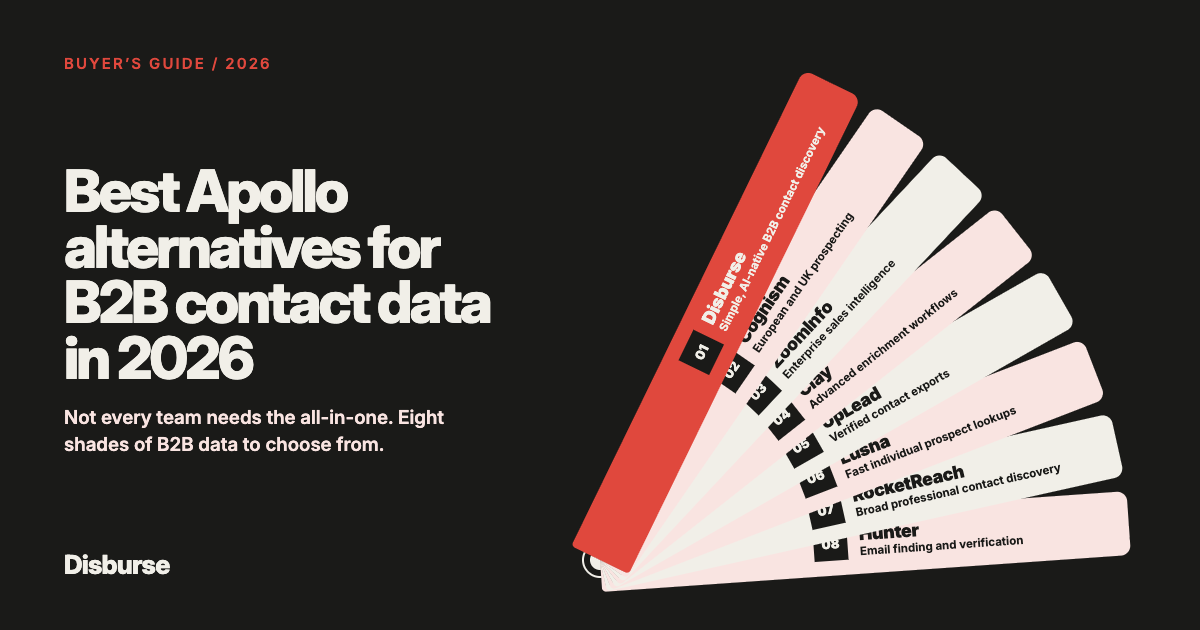
The best Apollo alternatives are:
Disburse — best for simple, AI-native B2B contact discovery
Cognism — best for European and UK prospecting
ZoomInfo — best for enterprise sales intelligence
Clay — best for advanced enrichment workflows
UpLead — best for verified contact exports
Lusha — best for fast individual prospect lookups
RocketReach — best for broad professional contact discovery
Hunter — best for email finding and verification
The best choice depends on whether you primarily need contact data, or whether you also want sales engagement, enrichment, intent signals and workflow functionality.
Apollo alternatives at a glance
Disburse
Best for: Simple B2B contact discoveryMain strength: Natural-language searching, simple data access and strong value
Cognism
Best for: UK and European sales teamsMain strength: Phone-verified mobile data and EMEA focus
ZoomInfo
Best for: Enterprise sales organisationsMain strength: Deep sales intelligence and large-scale data
Clay
Best for: RevOps and growth teamsMain strength: Multi-provider enrichment and workflow automation
UpLead
Best for: Teams focused on verified contact dataMain strength: Real-time email verification
Lusha
Best for: Quick sales prospectingMain strength: Simple contact lookup experience
RocketReach
Best for: Broad professional researchMain strength: Large person-level contact database
Hunter
Best for: Email-first prospectingMain strength: Email finding and verification
1. Disburse — best Apollo alternative for straightforward B2B data discovery
Best for: Businesses that primarily want B2B contact and company data without adopting another large sales platform.
Disburse is built around a simple idea:
Describe who you want to find, and get the data.
Instead of starting with a traditional database interface, users can search in plain English.
For example:
“Find founders of Australian B2B SaaS companies with 10–100 employees.”
Or:
“Find Heads of Sales at UK software companies with 50–200 employees.”
Disburse converts that request into a structured search and returns matching people and companies.
Available data can include:
Name
Job title
Seniority
Job function
Business email
Direct phone number
LinkedIn URL
Company name
Company domain
Industry
NAICS
Entity type
Revenue
Employee count
Company locations
Specialties
City
Region
Country
Why choose Disburse over Apollo?
The main difference is focus.
Apollo combines B2B data with a broad sales platform.
Disburse concentrates on the part many businesses actually need:
finding the right companies and people.
That makes it particularly useful if you already have:
A CRM
An outbound email platform
Sales automation software
Internal sales tools
AI agents or workflows
Rather than replacing those systems, Disburse can act as the data layer underneath them.
Disburse is particularly strong for AI workflows
Disburse provides REST and MCP access and is designed to work inside AI-driven workflows.
That means users can retrieve B2B data through environments such as AI assistants or their own applications rather than having to make another standalone sales platform the centre of their workflow.
Apollo also offers API, AI and MCP capabilities, so AI connectivity itself is not unique to Disburse.
The difference is that Disburse is built primarily around data access, while Apollo is using those interfaces to expose a much broader sales ecosystem.
Disburse pricing
Disburse also has a deliberately simple pricing model:
One credit = one lead.
Its plans include:
Free: 50 credits per month
Growth: A$20/month for 5,000 credits
Scale: A$99/month for 50,000 credits
Enterprise: Custom
Searching is unlimited, mobile numbers do not cost additional credits, there is no annual lock-in, and Growth credit top-ups do not expire.
The Scale plan also includes unlimited team members.
Where Apollo is stronger
Apollo is the stronger product if you want:
Email sequencing
Calling
Buying intent
Lead scoring
Extensive CRM enrichment
Sales engagement
More advanced sales workflows
Verdict: Disburse is one of the strongest Apollo alternatives if your main requirement is simply finding targeted B2B contacts and using that data elsewhere.
2. Cognism — best Apollo alternative for European B2B data
Best for: Sales teams prospecting heavily across the UK and Europe.
Cognism is a well-established sales intelligence platform with a strong reputation for EMEA data and mobile phone coverage.
One of its most notable differentiators is Diamond Data, which includes phone-verified mobile numbers rather than relying purely on automated verification.
Cognism is also heavily positioned around regulatory compliance and international prospecting.
Why choose Cognism over Apollo?
Cognism is particularly attractive if:
Europe is a core sales market
Mobile phone data is important
Compliance is a major consideration
Your SDR team relies heavily on outbound calling
Independent 2026 comparisons continue to identify Cognism as one of the strongest Apollo alternatives for European and UK prospecting.
Where Disburse may be better
Cognism is designed more for established sales teams and typically uses custom enterprise pricing.
If your primary requirement is simply finding targeted contacts and company data without adopting another enterprise sales intelligence product, Disburse is considerably more lightweight.
Verdict: Cognism is a strong choice for European sales teams that prioritise mobile numbers and compliance. Disburse is likely the better fit when simplicity, flexible data access and cost matter more.
3. ZoomInfo — best Apollo alternative for enterprise sales intelligence
Best for: Large sales organisations with sophisticated sales intelligence requirements.
ZoomInfo is one of the most established platforms in the B2B sales intelligence category.
It provides far more than basic contact data, including company intelligence, intent signals, enrichment and other tools designed for enterprise go-to-market teams.
Current 2026 comparisons continue to position ZoomInfo primarily as an enterprise-focused option.
Why choose ZoomInfo over Apollo?
ZoomInfo may make sense if your organisation:
Has a large sales team
Needs deep account intelligence
Relies heavily on intent data
Requires large-scale CRM enrichment
Has an enterprise software budget
Where Disburse may be better
For a user whose requirement is simply:
“Find me 500 founders matching this ICP.”
An enterprise intelligence platform may be far more infrastructure than necessary.
Disburse focuses on moving directly from the target description to the data.
Verdict: ZoomInfo is better suited to enterprise sales intelligence. Disburse is better suited to businesses primarily trying to find specific B2B contacts without enterprise complexity.
4. Clay — best Apollo alternative for enrichment workflows
Best for: RevOps, growth and technical teams building sophisticated data workflows.
Clay is not a traditional B2B contact database in quite the same way as Apollo.
Its strength is combining multiple data sources and enrichment providers inside flexible workflows.
One of Clay’s best-known capabilities is waterfall enrichment, where multiple providers can be queried sequentially to find missing information.
Clay itself describes modern enrichment workflows as combining multiple sources because no single data provider has complete coverage.
Why choose Clay over Apollo?
Clay makes sense if your process involves much more than finding a contact.
For example:
Find companies.
Enrich company data.
Find relevant employees.
Retrieve contact information.
Score the account.
Research the business.
Generate personalised content.
Push the result into another system.
For sophisticated growth teams, that flexibility is extremely powerful.
Where Disburse may be better
Clay’s flexibility also means you generally need to build and manage the workflow.
If your desired outcome is simply:
“Find these people and give me the data,”
Disburse removes much of that complexity.
Verdict: Choose Clay if you want to build a sophisticated enrichment engine. Choose Disburse if you primarily want the result rather than the workflow used to create it.
5. UpLead — best for verified B2B contact exports
Best for: Businesses that place a high priority on verified emails.
UpLead is a focused B2B data provider offering company and contact search, verified emails, mobile direct dials and integrations.
UpLead currently advertises 95% data accuracy and verifies email addresses at the point contacts are exported.
Its standard credit model is also relatively straightforward: one credit unlocks one contact, including available email and mobile direct-dial information.
Why choose UpLead over Apollo?
UpLead can be attractive if you primarily need:
Verified business emails
Mobile phone numbers
Straightforward database filtering
CRM integrations
A dedicated B2B data platform rather than a larger engagement suite
Where Disburse may be better
The biggest difference is the search experience and data economics.
UpLead’s current Essentials plan is $99 per month for 170 credits on monthly billing, while Disburse Growth provides 5,000 credits for A$20/month.
Disburse is also built more heavily around natural-language prospect discovery and AI-driven data access.
Verdict: UpLead is a strong option for businesses prioritising verified email data. Disburse is likely more attractive for high-volume prospect discovery, AI workflows and lower-cost access.
6. Lusha — best for quick prospect lookups
Best for: Sales representatives who frequently look up individual prospects.
Lusha is a popular self-service B2B contact data platform.
It is particularly well suited to salespeople who want to retrieve emails or phone numbers while researching companies and people, including through browser-based workflows.
Current 2026 comparisons typically position Lusha as a straightforward SMB contact lookup product rather than an enterprise sales intelligence platform.
Why choose Lusha over Apollo?
Lusha can be useful if you:
Frequently research contacts manually
Want a simple browser-based workflow
Need email and phone data
Don’t require Apollo’s broader engagement functionality
Where Disburse may be better
Lusha is particularly useful when you already know which person you want to research.
Disburse is strongest slightly earlier in the process.
You can describe what kind of person you need, and Disburse can help produce the list itself.
For example:
“Find Sales Directors at Australian logistics companies with more than 100 employees.”
Verdict: Lusha is strong for contact lookup. Disburse is more compelling when you want prospect discovery as well as the underlying contact information.
7. RocketReach — best for broad professional contact discovery
Best for: Users searching for particular professionals across a wide variety of industries.
RocketReach is an established professional contact database commonly used for business development, recruiting and prospect research.
Its strength is broad person-level search and the ability to find available business contact information for individual professionals.
Why choose RocketReach over Apollo?
RocketReach is useful when your focus is primarily contact discovery rather than running an outbound sales workflow.
It can be particularly relevant to:
Recruiters
Business development teams
Researchers
Partnerships teams
Individual prospect research
Where Disburse may be better
RocketReach tends to be most useful when you’re searching for known people or applying conventional search criteria.
Disburse is built around turning an ICP description into a prospect list.
The distinction is:
RocketReach: “Find the contact details for this person.”
Disburse: “Find the people who match this description.”
Verdict: RocketReach is useful for broad professional lookup. Disburse is stronger when the starting point is your ideal customer profile rather than a known person’s name.
8. Hunter — best Apollo alternative for email prospecting
Best for: Businesses whose primary requirement is finding and verifying business email addresses.
Hunter began as a specialised email-finding tool and has expanded its capabilities considerably.
Its current product includes a B2B database, AI-assisted discovery, lead enrichment, email verification and outreach functionality.
Hunter’s current free plan includes 50 credits per month, while annual Starter pricing begins at $34/month.
Why choose Hunter over Apollo?
Hunter is particularly useful when email is the centre of your prospecting workflow.
Its strengths include:
Domain email discovery
Individual email finding
Email verification
Lead enrichment
Email outreach
Where Disburse may be better
Hunter remains much more email-centric.
Disburse is designed to return a broader B2B contact and company record, potentially including:
Email
Direct phone
LinkedIn URL
Company attributes
Employee count
Revenue
Geography
Specialties
Disburse is therefore more suitable when you’re trying to build a full prospect list rather than primarily find email addresses.
Verdict: Hunter is a strong option for email-first prospecting. Disburse is better suited to broader B2B contact discovery.
Which Apollo alternative is best for B2B contact data?
There is no single best platform for every use case.
The answer depends on what matters most.
Best for simple B2B data discovery: Disburse
Choose Disburse if you want to describe the contacts you need, retrieve the data and use it in your existing workflow.
Best for Europe: Cognism
Choose Cognism if European mobile data and compliance are central to your prospecting strategy.
Best for enterprise intelligence: ZoomInfo
Choose ZoomInfo if you need a deep enterprise sales intelligence platform.
Best for enrichment workflows: Clay
Choose Clay if you want to combine multiple data providers and build complex enrichment processes.
Best for verified exports: UpLead
Choose UpLead if email verification is one of your highest priorities.
Best for individual lookups: Lusha or RocketReach
Choose these if representatives frequently research individual prospects.
Best for email discovery: Hunter
Choose Hunter if the main data point you’re looking for is a business email address.
What should you look for in an Apollo alternative?
The most important mistake to avoid is comparing platforms purely on database size.
A 300-million-contact database isn’t automatically more useful than a smaller or differently sourced dataset if it can’t reliably return the contacts in your target market.
Consider:
Data coverage
Does the provider have strong coverage in the countries, industries and company sizes you target?
Contact fields
Do you need just email addresses, or do you also need phone numbers, LinkedIn URLs and company information?
Search experience
Can you easily express your ICP, or do you have to build complicated searches manually?
Data quality
How frequently is the information updated or verified?
AI and API access
Can the data be accessed from the tools and AI workflows where your team already works?
Sales functionality
Do you want just the data, or do you also need email sequences, calling and engagement software?
Pricing model
Do you understand exactly what consumes a credit?
Team structure
Are you paying for data volume, seats, actions or all three?
The best Apollo alternative is the one that matches the part of Apollo you actually use.
Do you need a complete Apollo replacement?
Not necessarily.
Apollo combines several categories of sales technology.
If you currently use Apollo for:
Prospect data + email sequences + calling + enrichment + sales engagement
Then replacing it may require another broad platform or several different products.
But if you mainly use Apollo to:
Find people and retrieve their contact information
Then replacing the entire Apollo ecosystem may be unnecessary.
This is where dedicated B2B data platforms become particularly relevant.
Rather than asking:
“Which tool has everything Apollo has?”
A better question may be:
“Which tool does the part of Apollo we actually need best?”
What is the simplest Apollo alternative?
If your primary requirement is B2B data, Disburse is one of the simplest alternatives.
The user describes who they want.
Disburse searches for matching people and companies.
The user retrieves the data and uses it elsewhere.
There is no requirement to move email campaigns, calling, CRM activity or the rest of the sales workflow into Disburse.
For businesses that already have their preferred tools, that simplicity can be a substantial advantage.
What is the best Apollo alternative for AI prospecting?
There are two particularly relevant approaches.
Disburse is built around AI-native contact discovery and makes its data accessible through REST and MCP.
Clay is particularly powerful for teams building complex AI enrichment and automation workflows involving multiple data providers.
Apollo itself also now provides AI and MCP functionality, so the differentiation is no longer simply whether a tool “uses AI”.
The more useful distinction is:
Disburse: use AI to request B2B data.
Clay: use AI and automation to build complex data workflows.
Apollo: use AI inside a broader sales platform.
Which Apollo alternative offers the best value?
For raw B2B contact volume, Disburse is particularly competitive.
Its Growth plan provides 5,000 credits per month for A$20, and Scale provides 50,000 credits per month for A$99.
One credit equals one lead, mobile numbers do not cost extra, and Scale includes unlimited team members.
However, value should not be measured only by the number of contacts.
Apollo may offer better value for a business that would otherwise have to purchase separate email sequencing, calling or sales engagement tools.
Clay may offer better value if sophisticated enrichment automation saves significant operational work.
Cognism may offer better value if verified European mobile numbers materially improve connect rates.
The best-value platform is ultimately the one that gives you the data and functionality you actually use.
Which Apollo alternative should you choose in 2026?
If your main requirement is finding B2B contacts and company data, Disburse should be near the top of the shortlist.
It combines:
Natural-language prospect discovery
Detailed person and company data
Emails and phone numbers
REST access
MCP access
AI workflow compatibility
Unlimited searching
Simple one-lead-per-credit pricing
High-volume plans
No annual lock-in
For businesses that already have their CRM and outbound tools, this focused model can be more practical than adopting another complete sales platform.
However, other tools remain stronger for particular use cases.
Choose Cognism for European mobile data.
Choose ZoomInfo for enterprise sales intelligence.
Choose Clay for complex enrichment.
Choose UpLead for a traditional B2B database with strong verification.
Choose Lusha or RocketReach for quick contact lookups.
Choose Hunter for email-first prospecting.
And if you actually want a large contact database combined with sales engagement and outbound execution, Apollo itself may still be the right choice.
The key is deciding whether you need another sales platform, or whether you simply need better access to the data.
Frequently asked questions
What is the best alternative to Apollo.io?
There is no single best alternative. Disburse is particularly strong for simple B2B contact discovery, Cognism for European prospecting, ZoomInfo for enterprise intelligence and Clay for sophisticated enrichment workflows.
What is the best Apollo alternative specifically for contact data?
Disburse is a strong option for businesses that primarily need B2B contact and company data rather than a broader sales platform. UpLead, Lusha, Cognism and RocketReach are also worth considering depending on your market and workflow.
What is the cheapest Apollo alternative?
Pricing varies significantly based on usage. Disburse Growth costs A$20/month for 5,000 leads and is one of the lowest-cost options for high-volume B2B contact data. Hunter also offers a free plan and relatively inexpensive email-focused plans.
What is the best Apollo alternative for small businesses?
Disburse is particularly well suited to small businesses that primarily need prospect data. Hunter and Lusha can also be useful for smaller teams with simpler lookup requirements.
What is the best Apollo alternative for large companies?
ZoomInfo and Cognism are stronger candidates for larger sales organisations, depending on geography and sales requirements.
What is the best Apollo alternative for European data?
Cognism is widely positioned as one of the strongest choices for European and UK contact data, particularly where mobile numbers are important.
What is the best Apollo alternative for verified emails?
UpLead emphasises real-time email verification and currently advertises a 95% accuracy rate.
What is the best Apollo alternative for enrichment?
Clay is one of the strongest options for enrichment because it allows teams to combine multiple providers in waterfall workflows.
What is the best Apollo alternative for finding emails?
Hunter is particularly well suited to email discovery and verification, including domain search and individual email finding.
Is Disburse better than Apollo?
Disburse can be better if the main objective is finding targeted B2B contact data simply and cost-effectively. Apollo is more suitable if you want prospect data alongside sales engagement, calling, enrichment and other outbound functionality.
Can Disburse replace Apollo?
It can replace the contact-data portion of Apollo for many businesses. If you rely on Apollo for sequencing, dialling, intent data and sales engagement, you would still need tools to perform those functions.
Which Apollo alternative is best for AI workflows?
Disburse is well suited to straightforward AI-driven B2B data retrieval through REST and MCP. Clay is better suited to users who want to construct more complex multi-source enrichment and automation workflows.
Is Clay an Apollo alternative?
Yes, but Clay and Apollo solve different problems. Apollo combines contact data with sales engagement, while Clay is primarily an enrichment and workflow platform that can combine many data providers.
Is ZoomInfo better than Apollo?
ZoomInfo can be better for large enterprise organisations requiring deep account intelligence and enterprise-scale sales data. Apollo is generally more accessible to SMB and mid-market sales teams.
Is Cognism better than Apollo?
Cognism may be better for teams heavily focused on UK and European prospecting, particularly where verified mobile data is important. Apollo offers a broader all-in-one sales platform.
Is UpLead better than Apollo?
UpLead can be better if your priority is a focused B2B database with real-time email verification. Apollo is considerably broader and includes more sales execution functionality.
Should I choose an Apollo alternative just because it is cheaper?
No. Price should be one factor rather than the only one.
A cheaper data provider may be poor value if it cannot return the contacts you actually need.
Likewise, an expensive sales platform may be unnecessary if you only use its database.
The most useful comparison is:
“What data do I need, how easily can I retrieve it, and how much of the rest of the platform will I actually use?”
Apollo Alternativelead generationB2B Contact DatabaseApolloAI ProspectingB2B DataSales ProspectingData EnrichmentDisburseB2B Sales ToolsSales Intelligence