Best AI Prospecting Tools in 2026
23 min readLachlan McBride White
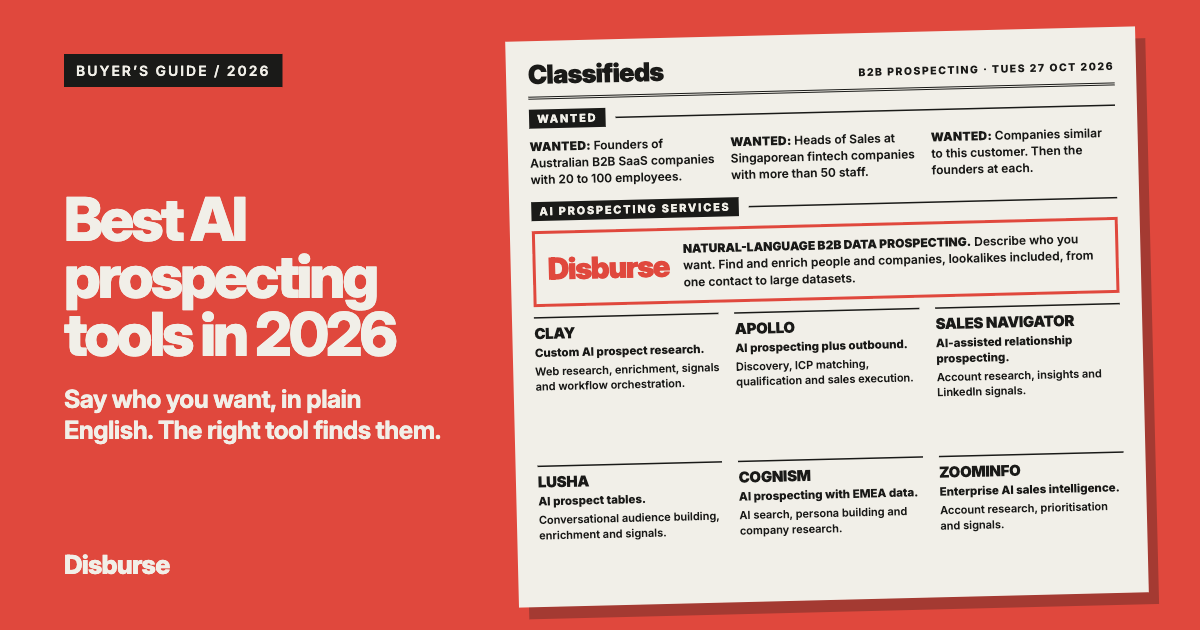
AI prospecting has moved well beyond writing personalised cold emails.
The better AI prospecting tools in 2026 can help sales teams:
Find potential customers
Identify decision-makers
Research accounts
Enrich contact data
Prioritise prospects
Build target audiences
Automate parts of the prospecting workflow
But these tools are not all solving the same problem.
Clay is extremely powerful if you want custom AI research and enrichment workflows.
Apollo combines AI prospecting with a wider outbound sales platform.
LinkedIn Sales Navigator applies AI to LinkedIn’s professional and relationship data.
Lusha now supports conversational audience building and AI-powered prospect tables.
Disburse takes a more focused approach by using natural language and AI workflows to find and enrich B2B people and company data, from one contact through to much larger datasets.
The short answer: In 2026, the best AI prospecting tool depends on the job.
Disburse is best for natural-language B2B data prospecting
Clay is best for sophisticated AI research and GTM workflows
Apollo is best for AI prospecting plus outbound execution
LinkedIn Sales Navigator is best for AI-assisted LinkedIn prospecting
Lusha is strong for conversational prospect tables and sales intelligence
Cognism is strong for AI prospecting with an EMEA and phone-data focus
ZoomInfo is suited to enterprise AI sales intelligence
There is no meaningful reason one tool should win every category.
Best AI prospecting tools in 2026
Tool
Disburse
Best for:
Natural-language B2B data prospecting
What AI helps with:
Finding people and companies, enrichment, lookalikes and AI-accessible B2B data
Clay
Best for:
Custom AI prospect research
What AI helps with:
Web research, enrichment, signals and workflow orchestration
Apollo
Best for:
AI prospecting plus outbound
What AI helps with:
Prospect discovery, ICP matching, qualification, research and sales execution
LinkedIn Sales Navigator
Best for:
AI-assisted relationship prospecting
What AI helps with:
Lead research, account insights, messaging and LinkedIn signals
Lusha
Best for:
AI prospect tables and sales intelligence
What AI helps with:
Conversational audience building, enrichment, signals and prospect data
Cognism
Best for:
AI prospecting with EMEA data
What AI helps with:
AI search, persona building, company research and contact data
ZoomInfo
Best for:
Enterprise AI sales intelligence
What AI helps with:
Account research, prioritisation, signals and revenue intelligence
What is an AI prospecting tool?
An AI prospecting tool uses artificial intelligence to help identify, research, qualify, enrich or prioritise potential customers.
That can mean several very different things.
At the simplest level, AI can turn a plain-English request into a prospect search:
“Find founders of Australian B2B SaaS companies with 20 to 100 employees.”
At another level, AI can research every company in a list and answer questions that do not exist as traditional database fields.
It might:
Analyse a website
Summarise a prospect
Identify buying signals
Score an account
Suggest who a rep should prioritise
Enrich missing information
Feed data into an agent
The more useful question in 2026 is not:
“Does this platform have AI?”
Almost every major sales platform does.
The better question is:
“What useful prospecting work can its AI actually do?”
1. Disburse — best for natural-language B2B data prospecting
Disburse is a B2B data platform designed to make finding and working with people and company data more conversational.
Instead of translating an ICP into a long set of filters, you can describe what you need.
For example:
“Find founders of Australian B2B SaaS companies with 20 to 100 employees.”
Or:
“Find Heads of Sales at Singaporean fintech companies with more than 50 employees.”
It can also be much narrower.
If you only need one person:
“Find the Head of Sales at this company.”
The same platform can then be used for other prospecting jobs.
For example:
“Enrich this CSV of 2,000 contacts with available person and company data.”
Or:
“Find companies similar to this customer, then find the founders at those companies.”
That is what makes Disburse interesting as an AI prospecting tool.
The AI interaction is not only being used after the prospect has already been found.
It can help the user get to the underlying B2B data in the first place.
What can Disburse find?
Disburse can work with data including:
Names
Job titles
Seniority
Job functions
Business emails
LinkedIn URLs
Available direct and mobile numbers
Company names
Domains
Industries
NAICS classifications
Entity types
Revenue
Employee counts
Company locations
Specialties
City
Region
Country
Those fields can be combined into natural-language requests.
For a salesperson, that means thinking about the audience as an ICP rather than thinking about database syntax.
AI prospecting does not have to mean building a huge list
Sometimes the job is:
“Find 2,000 people matching this ICP.”
Sometimes it is:
“Who is the CFO of this company and how can I contact them?”
Both are legitimate prospecting tasks.
Disburse can move between:
Individual research
Small groups
Larger audiences
without requiring a different workflow.
Can Disburse enrich existing prospects?
Yes.
AI prospecting should not always start from zero.
Most established businesses already have prospect data.
It may simply be incomplete.
A company can upload an existing CSV containing thousands of contacts and use Disburse to add available person and company information.
That makes the existing database part of the AI workflow rather than forcing the team to rebuild its audience.
Can Disburse find similar companies?
Yes.
Another useful starting point is a company you already know is a strong fit.
For example:
“Find companies similar to this business.”
Then:
“Find the Head of Sales at each.”
That creates a simple prospecting path:
Successful customer → similar companies → relevant people → contact data
For founder-led and smaller sales teams, that can be much easier than building a complicated scoring model.
Can AI agents use Disburse?
Yes.
Disburse supports:
REST
MCP
That matters because the prospecting interface does not have to be the Disburse website.
Compatible AI workflows can access B2B data directly.
That opens workflows where an AI assistant can help:
Find people
Find companies
Find similar businesses
Enrich existing data
without requiring the user to manually move between several prospecting tools.
Disburse pricing
Plan
Free
Price:
A$0
Monthly credits:
50
Growth
Price:
A$20/month
Monthly credits:
5,000
Scale
Price:
A$99/month
Monthly credits:
50,000
One credit represents one lead.
Available mobile numbers do not require an additional credit.
Growth supports up to five team members.
Scale supports unlimited team members.
Search is unlimited.
REST and MCP are available on the Free plan.
There is no annual lock-in.
Where is Disburse strongest?
I would shortlist Disburse for:
Founders
Startups
Agencies
Recruiters
Lean sales teams
APAC prospecting
AI-first companies
Teams already using ChatGPT or Claude
Companies that already have an outbound stack
Businesses moving between prospect discovery and enrichment
What are Disburse’s limitations?
Disburse is not trying to become an AI sales platform for every stage of the revenue cycle.
It does not have:
Clay’s workflow-building depth
Apollo’s outbound execution
LinkedIn’s relationship graph
ZoomInfo’s enterprise intelligence layer
If those are the problems you need to solve, there may be stronger choices.
When would I choose Disburse?
I would choose Disburse when the main requirement is:
“I want to tell an AI who or what I’m looking for and get usable B2B data back.”
That is a very different requirement from asking AI to manage the entire sales process.
2. Clay — best for custom AI prospect research and GTM workflows
Clay is one of the most capable AI prospecting platforms available.
Its strength is not simply finding a name and email.
Clay allows teams to combine:
Multiple data providers
Enrichment
Web research
Signals
AI models
Workflow logic
Claygent is particularly important here.
It can research information that may not exist as a standard database field.
For example:
“Does this company’s website mention expanding into Australia?”
Or:
“Does this business sell through channel partners?”
Or:
“Does the careers page suggest they are building an enterprise sales team?”
That creates prospecting possibilities that traditional databases struggle with.
Where is Clay strongest?
Clay is particularly strong when the workflow looks like:
Find accounts → enrich them → research each company with AI → identify signals → score → find people → route
Clay also supports multi-provider enrichment waterfalls.
What are Clay’s limitations?
Its flexibility creates complexity.
You need to decide:
What to research
Which data providers to use
How enrichment should work
What should happen to the results
For a RevOps or growth team, that control can be valuable.
For a founder who simply wants:
“Find the right 500 prospects.”
it may be more infrastructure than necessary.
When would I choose Clay?
Choose Clay when building the prospecting system is part of the job.
If you want sophisticated AI research, multiple providers, signals, enrichment logic and automation, Clay is one of the strongest options.
3. Apollo — best all-in-one AI prospecting and outbound platform
Apollo has become much more than a large B2B contact database.
Its AI functionality can help teams:
Search for people and companies
Find ICP-matched prospects
Score leads
Qualify leads
Summarise relevant information
Save prospects into lists
Apollo’s biggest advantage is what happens after the prospect is found.
The platform can also support broader sales execution.
Where is Apollo strongest?
Apollo is particularly attractive for SDR teams that want fewer separate tools.
A rep can move from:
Define ICP → find prospects → qualify them → add them to outbound
inside the same platform.
What are Apollo’s limitations?
If you already have an outbound platform you like, some of Apollo’s functionality may overlap with your existing stack.
The platform also has substantially more surface area than a focused data tool.
When would I choose Apollo?
I would choose Apollo if I were building a sales team from scratch and wanted:
AI prospecting
Contact data
Outbound execution
inside the same platform.
If the outbound infrastructure already existed and the missing piece was flexible B2B data, I would compare it with Disburse.
4. LinkedIn Sales Navigator — best for AI-assisted LinkedIn prospecting
Sales Navigator has something independent prospecting databases cannot reproduce exactly:
LinkedIn itself.
That gives its AI access to a different type of context around:
People
Companies
Careers
Professional activity
Relationships
Sales Navigator uses AI across features such as:
Lead IQ
Account IQ
Message Assist
Lead IQ helps summarise a prospect and their company.
Account IQ provides account-level insights.
Message Assist helps prepare messaging.
Where is Sales Navigator strongest?
I would choose Sales Navigator for:
LinkedIn research
Relationship selling
Warm introductions
Professional network intelligence
Account research
Job-change monitoring
LinkedIn outreach
Researching individual decision-makers
Its AI helps the salesperson understand the prospect, not simply retrieve the contact record.
What are Sales Navigator’s limitations?
It is not a conventional portable B2B contact database.
Teams that need:
Large volumes of structured emails
Phone data
Company data
Enrichment
will often pair it with another provider.
That means the right stack may not be:
Sales Navigator or Disburse
It may be:
Sales Navigator + Disburse
One provides professional relationship context.
The other provides structured B2B data.
5. Lusha — best for AI prospect tables and established B2B data
Lusha has become much more interesting as an AI prospecting platform.
Its Workspace allows users to describe target audiences in plain language.
For example:
“VPs of Sales at Series B SaaS companies in Boston.”
That request can become a persistent prospect table.
Users can then:
Refine the audience conversationally
Enrich records
Add live web data
Add signals
Import CRM records
Push prospects into downstream workflows
Where is Lusha strongest?
Lusha combines:
Established B2B contact data
Conversational audience creation
Enrichment
Signals
AI-generated data
CRM workflows
Browser prospecting
What are Lusha’s limitations?
Teams still need to understand its credit economics.
That becomes especially important when:
Phone data matters
Multiple enrichment actions are used
Contact volume becomes high
When would I choose Lusha?
Choose Lusha when you want AI prospecting inside a broader established sales intelligence environment.
If natural-language access to B2B data itself is the main requirement, compare it directly with Disburse.
6. Cognism — best for AI prospecting with an EMEA focus
Cognism combines B2B data with AI-assisted prospecting and has a strong position among teams selling into Europe.
Its prospecting platform includes:
AI search
AI persona building
AI company research
Firmographic targeting
Technographic targeting
CSV enrichment
Mobile data
Verification
Buyer intent
Where is Cognism strongest?
Cognism makes particular sense when:
EMEA is a major sales region
Phone prospecting matters
Compliance matters
Mobile verification matters
The team wants AI-assisted discovery
CRM enrichment matters
What are Cognism’s limitations?
Pricing is sales-led rather than lightweight self-service.
For a smaller startup primarily looking for AI-accessible B2B data, there may be simpler ways to start.
When would I choose Cognism?
Choose Cognism when you want AI-assisted prospecting backed by strong EMEA and phone-data capabilities.
7. ZoomInfo — best for enterprise AI sales intelligence
ZoomInfo belongs in this comparison because AI prospecting at enterprise scale is not only about finding contacts.
Large revenue organisations also want to know:
Which accounts should we prioritise?
What is happening inside those accounts?
Which signals matter?
Who should a rep contact next?
What should the rep know before engaging?
That is where broader sales intelligence becomes much more relevant.
Where is ZoomInfo strongest?
ZoomInfo makes sense for:
Enterprise sales organisations
Account-based selling
Large RevOps teams
Sophisticated account prioritisation
Deep company intelligence
Intent-driven prospecting
Complex CRM environments
What are ZoomInfo’s limitations?
Its breadth, pricing and enterprise orientation make it a very different proposition from lightweight AI prospecting tools.
A three-person startup does not automatically need enterprise sales intelligence simply because it offers more features.
When would I choose ZoomInfo?
Choose ZoomInfo when AI prospecting is part of a broader enterprise sales intelligence strategy.
What actually makes an AI prospecting tool useful?
The AI label is becoming less informative.
A better evaluation looks at what happens before and after the AI prompt.
Can it actually find the right people?
Generating a perfect summary of the wrong prospect is not useful.
The underlying B2B data still matters.
Can it understand your ICP?
AI should make targeting easier to express.
It should not force users to learn another complicated query language.
Can it research things that are not normal database fields?
This is where tools such as Clay become particularly interesting.
AI web research can answer questions that standard contact databases cannot.
Can it enrich data you already have?
Most businesses are not starting with an empty CRM.
AI prospecting should work with existing data.
Can AI access the data outside the vendor’s interface?
This is becoming increasingly important.
Teams increasingly work through:
ChatGPT
Claude
Internal agents
Custom applications
A B2B data provider that can work inside those environments may be more useful than another standalone AI assistant.
Does it help prioritise prospects?
Finding 10,000 companies is not particularly useful if the rep has no idea which 50 to contact.
Research, signals and qualification become increasingly important as volume grows.
What is the best AI prospecting tool for startups?
I would shortlist Disburse and Apollo.
Choose Disburse if you already have your CRM and outbound tools and mainly need AI to help find and enrich B2B data.
Choose Apollo if you are building the sales stack from scratch and want prospecting plus outbound execution.
Clay is worth considering if the startup has a technically sophisticated GTM motion.
But I would not automatically introduce that level of complexity to a small team.
What is the best AI prospecting tool for small sales teams?
For a small team, I would compare:
Disburse
Apollo
Lusha
Sales Navigator
If finding the right people is the bottleneck, Disburse is a strong fit.
If running outbound is the bottleneck, Apollo becomes more attractive.
If the team spends most of its time on LinkedIn, Sales Navigator may deliver more value.
If the team wants a broader AI-powered sales intelligence environment, Lusha is worth testing.
What is the best AI prospecting tool for natural-language search?
Disburse is one of the strongest choices.
A user can simply describe the people or companies they want:
“Find founders of Australian SaaS companies with 20 to 100 employees.”
The same conversational approach can be used for:
One-person discovery
Larger prospect searches
Enrichment
Similar-company research
Lusha also deserves recognition here because its Workspace supports plain-language audience descriptions and conversational refinement.
Apollo also supports AI-assisted prospect search and ICP matching.
So the real distinction is no longer simply:
Who has natural-language search?
It is:
What else do you want around that interaction?
What is the best AI tool for prospect research?
Clay is the strongest option on this list for custom AI prospect research.
Claygent can investigate questions that do not exist as structured database fields.
For example:
“Does this company’s website mention expanding into Australia?”
“Does this business sell through channel partners?”
“Does the careers page suggest they are building an enterprise sales team?”
Sales Navigator is also excellent for researching individual prospects because its AI can combine information about:
The person
Their company
LinkedIn activity
What is the best AI prospecting tool for LinkedIn?
LinkedIn Sales Navigator.
Its advantage is the underlying professional network.
Lead IQ can summarise a lead and their company.
Account IQ provides AI-generated account insights.
Message Assist supports outreach preparation.
For sellers whose prospecting revolves around LinkedIn, that is a stronger proposition than simply adding AI to an external database.
What is the best AI prospecting tool for enrichment?
For sophisticated enrichment:
Clay
Its multi-provider waterfalls can combine data sources, while AI research can add information that goes beyond structured fields.
For simpler enrichment combined with everyday B2B prospecting:
Disburse
A team can upload an existing contact dataset, enrich available information and then use the same platform for new prospect discovery.
Lusha is another strong option because its Workspace combines:
CRM imports
Enrichment
Signals
AI-generated data
What is the best AI prospecting tool for finding similar companies?
Disburse is particularly useful when you already know what a good customer looks like.
For example:
“Find companies similar to this Australian SaaS business.”
Then:
“Find the founder and Head of Sales at each.”
That can be easier than manually translating a successful customer into dozens of filters.
Clay can take the process further if you then want AI to:
Research
Enrich
Score
Route
those companies.
What is the best AI prospecting tool for APAC?
For an APAC-focused business, I would put Disburse on the shortlist and test it against larger global platforms using real prospects.
For example:
“Find Australian B2B SaaS founders with 20 to 100 employees.”
“Find Heads of Sales at Singaporean fintech companies.”
“Find Managing Directors of New Zealand recruitment agencies.”
“Find CFOs at Hong Kong professional-services businesses.”
Do not evaluate APAC performance from global database-size claims.
Test the countries and personas you actually sell to.
Australia, Singapore, New Zealand, Hong Kong and Japan are different data environments.
What is the best AI prospecting tool for agencies?
I would compare Disburse and Clay.
Disburse makes sense when client briefs vary significantly and the agency wants a simple way to translate those briefs into data.
One client may need:
One executive
2,000 prospects
An enriched CSV
Similar companies to existing customers
Clay makes more sense when the agency wants to build reusable, sophisticated research and enrichment workflows.
What is the best AI prospecting tool for recruiters?
I would consider:
Disburse
Sales Navigator
Cognism
Sales Navigator is excellent for researching people and career histories.
Disburse is useful when recruitment business development involves:
Market mapping
Individual decision-maker search
Larger audience creation
Existing-database enrichment
Cognism becomes particularly interesting for EMEA recruitment teams where phone data and verification matter.
What is the best AI prospecting tool for outbound sales?
Apollo is one of the strongest choices if you want prospecting and outbound execution together.
Its AI can help:
Find prospects
Match ICPs
Qualify leads
Score leads
Summarise information
The broader platform can then move those prospects into sales workflows.
That is different from Disburse, where the emphasis is on getting the underlying B2B data into whatever outbound stack you already prefer.
What is the best AI prospecting tool for AI agents?
Disburse and Clay are particularly interesting, for different reasons.
Disburse is designed to make B2B data available through:
REST
MCP
That means an agent can work directly with people and company data without requiring a salesperson to manually operate another dashboard.
Clay is stronger when the agent sits inside a more sophisticated GTM system involving:
Multiple providers
Research
Enrichment
Automation
Lusha is also moving in this direction with AI-agent-oriented workflows.
This is an area where the market is changing quickly.
AI prospecting vs traditional prospecting
Traditional B2B prospecting often looks like:
Choose filters → export list → research companies → qualify people → enrich data → write outreach
AI can compress several of those stages.
But that does not mean the whole process should be automated.
Poor targeting does not become good targeting because AI performs it faster.
The best AI prospecting systems reduce the manual work involved in finding and understanding good prospects.
They should not simply generate more names.
Does AI make B2B data quality less important?
No.
It arguably makes data quality more important.
If a salesperson manually researches 20 prospects, they may notice when someone has changed jobs.
If an AI workflow processes 20,000 records automatically, an underlying data problem can multiply very quickly.
AI can help interpret data.
It cannot make an incorrect contact record correct simply by reasoning about it.
That is why:
Coverage
Freshness
Accuracy
still need to be evaluated separately from the quality of the AI interface.
Will AI prospecting replace SDRs?
That is not how I would evaluate these products.
The most useful AI prospecting tools reduce low-value research and data work.
They can help salespeople spend less time:
Constructing searches
Copying data between tools
Researching basic company information
Filling missing fields
Checking obvious qualification criteria
Building repetitive prospect lists
That leaves more time to:
Understand the account
Build a relevant approach
Handle objections
Have useful conversations
AI that finds 10,000 mediocre prospects faster is not necessarily an improvement.
How should you test an AI prospecting tool?
Do not test it with a generic vendor demo prompt.
Use a real prospecting problem.
Take an ICP your team actually targets and ask each platform to solve the same job.
For example:
“Find Heads of Sales at Australian B2B SaaS companies with 20 to 100 employees.”
Then compare:
Targeting quality: Did the AI understand the request?
Company relevance: Are the businesses actually in your ICP?
People relevance: Did it find the right roles and seniority?
Data freshness: Are the people still at those companies?
Email coverage: How many usable emails were returned?
Phone coverage: How many usable numbers were returned?
Research quality: Did the AI add useful information beyond standard database fields?
Enrichment: Can it work with prospects you already have?
Workflow: How much manual work remains?
Economics: What does each genuinely usable prospect cost?
That gives you a much better picture than comparing which vendor has the longest AI feature list.
Which AI prospecting tool should you choose in 2026?
If I were narrowing the market today:
Best for natural-language B2B data prospecting: Disburse
Best for custom AI research and GTM workflows: Clay
Best for AI prospecting plus outbound execution: Apollo
Best for AI-assisted LinkedIn prospecting: LinkedIn Sales Navigator
Best for AI prospect tables and broader sales intelligence: Lusha
Best for AI prospecting with an EMEA focus: Cognism
Best for enterprise AI sales intelligence: ZoomInfo
Those are different winners because they solve different problems.
That is more useful than pretending one platform should be the default recommendation for every business.
So, what is the best AI prospecting tool in 2026?
There is no universal winner.
For sophisticated AI research and enrichment, I would choose Clay.
For an SDR team wanting AI prospecting combined with outbound execution, Apollo is one of the strongest options.
For sellers who live inside LinkedIn, Sales Navigator has an advantage that external databases cannot fully reproduce.
For enterprise account intelligence, ZoomInfo belongs on the shortlist.
For EMEA-focused prospecting where mobile data matters, Cognism is worth serious consideration.
Lusha has also become much more interesting as an AI prospecting platform as conversational audience building has become part of its workflow.
And if the main job is moving from:
A natural-language business question → usable B2B data
Disburse is one of the strongest options to consider.
That might mean:
Finding one person
Finding 5,000 prospects
Enriching 2,000 contacts you already have
Finding companies similar to your best customer
Identifying the right persona at each company
Letting an AI agent access the data through MCP
That is the distinction I would use when evaluating Disburse against the broader AI prospecting market.
It is not trying to make AI the salesperson.
It is using AI to make B2B data much easier to find and work with.
Frequently asked questions
What is the best AI prospecting tool in 2026?
There is no single best tool for every workflow.
Disburse is particularly strong for natural-language B2B data prospecting.
Clay is strong for custom AI research and GTM workflows.
Apollo is strong for AI prospecting plus outbound.
Sales Navigator is strong for AI-assisted LinkedIn prospecting.
What is an AI prospecting tool?
An AI prospecting tool uses artificial intelligence to help identify, research, qualify, enrich or prioritise potential customers.
Some also automate parts of outreach and sales execution.
What is the best AI prospecting tool for startups?
Disburse and Apollo are strong starting points.
Disburse makes sense when you already have an outbound stack and mainly need B2B data.
Apollo is particularly useful if you want prospecting and outbound execution together.
What is the best AI prospecting tool for small businesses?
Disburse is particularly relevant for smaller businesses because it combines natural-language prospecting with enrichment and low-cost self-service plans.
Apollo, Lusha and Sales Navigator are also worth considering depending on the workflow.
What is the best AI tool for finding B2B contacts?
Disburse, Apollo and Lusha can all use AI to help find B2B prospects.
Disburse is particularly focused on making people and company data accessible through natural language and AI workflows.
Can AI find one specific B2B contact?
Yes.
AI prospecting does not have to mean generating large lists.
Disburse can be used to find one specific person as well as larger audiences.
What is the best AI tool for building prospect lists?
Disburse, Apollo and Lusha are all worth considering.
Disburse is strong for natural-language search.
Apollo combines discovery with outbound.
Lusha supports conversational prospect tables.
What is the best AI tool for prospect research?
Clay is particularly strong for custom prospect research because its AI can use web research to answer questions that do not exist as standard database fields.
What is the best AI prospecting tool for LinkedIn?
LinkedIn Sales Navigator.
Its AI capabilities sit on top of LinkedIn’s professional and relationship graph.
What is the best AI prospecting tool for cold email?
Apollo is particularly useful if you want AI prospecting and email execution in the same platform.
If you already have an email platform, a focused B2B data provider such as Disburse may make more sense.
What is the best AI prospecting tool for cold calling?
Cognism is particularly relevant for EMEA teams where mobile data and verification are important.
Other providers should still be tested against your geography and ICP.
What is the best AI prospecting tool for Australia?
Disburse is particularly relevant for Australian B2B prospecting because the same natural-language workflow can be used across:
Individual contact search
ICP prospecting
Enrichment
Similar-company discovery
What is the best AI prospecting tool for APAC?
Disburse is worth testing for businesses targeting:
Australia
New Zealand
Singapore
Wider APAC
Coverage should still be evaluated against representative prospects in each market.
What is the best AI prospecting tool for Europe?
Cognism is particularly relevant for European prospecting where:
Mobile data
Verification
Compliance
matter.
What is the best AI prospecting tool for agencies?
Disburse is strong when agencies need to move quickly between different prospecting and enrichment briefs.
Clay is stronger for agencies building sophisticated multi-provider research and GTM workflows.
What is the best AI prospecting tool for recruiters?
Sales Navigator is particularly useful for professional research.
Disburse can support:
Individual contact discovery
Market mapping
Client prospecting
Database enrichment
What is the best AI prospecting tool for enrichment?
Clay is particularly strong for sophisticated multi-provider enrichment and AI research.
Disburse is useful when enrichment needs to sit alongside everyday people and company prospecting.
Can AI prospecting tools enrich an existing CRM or CSV?
Yes.
Modern AI prospecting workflows can work with data you already have.
Disburse can enrich existing contact and company data.
Clay and Lusha also support extensive enrichment workflows.
Does Apollo have AI prospecting?
Yes.
Apollo uses AI across prospect search, ICP matching, qualification, scoring and research.
Does Lusha have AI prospecting?
Yes.
Lusha supports conversational audience building and AI-assisted prospect tables.
Does LinkedIn Sales Navigator use AI?
Yes.
Sales Navigator uses AI across features including lead research, account research and messaging assistance.
Does Clay use AI for prospecting?
Yes.
Clay uses AI for prospect research and can combine that with enrichment, data providers, signals and automation.
Can AI prospecting tools work with ChatGPT or Claude?
Some can.
Disburse supports MCP for compatible AI workflows.
Other providers are also increasingly building AI-agent integrations.
Is AI prospecting better than traditional database prospecting?
It can reduce manual search, research and enrichment work.
It does not remove the need for:
Accurate underlying data
A well-defined ICP
Good sales judgement
Will AI prospecting replace SDRs?
AI can automate repetitive research and data work.
Selling still requires:
Understanding the account
Building trust
Handling objections
Having useful conversations
How should I compare AI prospecting platforms?
Give each platform the same real ICP and compare:
Targeting quality
Contact relevance
Data freshness
Email coverage
Phone coverage
Research quality
Enrichment
Workflow complexity
Cost per usable prospect
Which AI prospecting tool is best overall?
There is no universal winner.
For natural-language B2B data prospecting, Disburse is one of the strongest options.
For custom AI research, Clay.
For prospecting plus outbound, Apollo.
For LinkedIn prospecting, Sales Navigator.
For enterprise sales intelligence, ZoomInfo.
APAC Prospectinglead generationSmall Sales TeamsB2B Contact DatabaseFounder-Led SalesRevOpsLinkedIn ProspectingApolloAI ProspectingNatural-Language SearchZoomInfoB2B DataSales ProspectingData EnrichmentLushaDisburseB2B Sales ToolsClayB2B Lead ListsSales IntelligenceLinkedIn Sales NavigatorIdeal Customer Profile (ICP)