Apollo vs Disburse: Which Is Better for Small B2B Sales Teams?
15 min readLachlan McBride White
Small B2B sales teams need many of the same things as larger sales organisations: accurate prospect data, good targeting and an efficient way to turn leads into conversations. What they usually don’t have is the same budget, RevOps resources or time to manage a complicated sales technology stack.
Both Apollo and Disburse can help small teams find B2B prospects, but they take different approaches.
Apollo is a broad sales intelligence and engagement platform that combines contact data with prospecting, enrichment, sequences, calling, intent data and other sales tools.
Disburse is a focused B2B data platform designed to make finding companies and decision-makers simple. Users describe who they want to find, retrieve the relevant contact and company data, and use those leads in whatever sales tools they prefer.
The short answer: For small B2B teams primarily looking for prospect data, Disburse is likely the better fit because it is simpler, more flexible and inexpensive to scale. Apollo may be the better choice for a small team that wants to consolidate prospecting, contact data and outbound sales execution into one platform.
Apollo vs Disburse for small sales teams at a glance
Disburse
Best for: Small teams primarily needing B2B dataB2B contact data: YesCompany data: YesBusiness emails: YesDirect/mobile numbers: YesLinkedIn URLs: YesNatural-language prospecting: YesAdvanced database filtering: Yes, through search criteriaREST API: YesMCP / AI workflows: YesBuilt-in email sequences: NoBuilt-in dialer: NoBuying intent: NoCRM enrichment: External workflowsEntry paid plan: A$20/monthGrowth pricing: 5,000 leads/month for A$20Team pricing: Up to 5 users on Growth; unlimited on ScaleAnnual lock-in: NoBest approach: Add data to your existing stack
Apollo
Best for: Teams wanting data + sales engagementB2B contact data: YesCompany data: YesBusiness emails: YesDirect/mobile numbers: YesLinkedIn URLs: YesNatural-language prospecting: YesAdvanced database filtering: 65+ filtersREST API: YesMCP / AI workflows: YesBuilt-in email sequences: YesBuilt-in dialer: YesBuying intent: YesCRM enrichment: Extensive native functionalityEntry paid plan: US$49/user/month on annual Basic planGrowth pricing: Credit allowances vary by planTeam pricing: Primarily seat-basedAnnual lock-in: Monthly available; lower advertised pricing generally annualBest approach: Build more of your sales stack inside Apollo
What does a small B2B sales team actually need from a data platform?
For a small sales team, more features are not automatically better.
The core requirement is usually much simpler:
“Who should we contact, and how do we reach them?”
That means a useful B2B data platform should help a small team:
Identify companies matching its ICP
Find relevant decision-makers
Retrieve usable business emails
Find direct phone numbers where available
Filter by company size, revenue, industry and geography
Build lists without excessive setup
Move the data into its existing workflow
Avoid spending heavily before outbound starts producing revenue
This is where the differences between Apollo and Disburse become important.
Apollo gives a small team significantly more sales infrastructure.
Disburse concentrates on getting the team the prospect data it needs.
Why might Disburse suit a small B2B sales team?
Disburse is particularly well suited to the way many small companies actually sell.
A founder or salesperson may know their ICP very clearly but not have a dedicated RevOps team to turn that ICP into database filters.
Instead, they can ask:
“Find founders of Australian B2B SaaS businesses with 10–100 employees.”
Or:
“Find Heads of Sales at UK software companies with 20–200 employees.”
Or:
“Find operations directors at Australian logistics businesses with more than 100 employees.”
Disburse turns the description into a structured search and returns matching contacts.
The advantage isn’t simply natural-language searching. Apollo now supports natural-language prospecting too.
The advantage is that this is essentially the whole Disburse experience.
There is less surrounding software to learn before a small team can get value from the product.
Why might Apollo suit a small B2B sales team?
Apollo’s broader product can be an advantage for a different type of small business.
A new sales team may not already have:
An outbound email platform
A dialer
Prospecting software
Enrichment tools
Sales automation
Buying signals
Apollo can combine several of those capabilities in one system.
Apollo currently advertises a database of more than 240 million verified contacts and more than 65 prospecting filters, alongside engagement and enrichment functionality.
For a small company building an outbound operation from scratch, consolidating tools can be attractive.
The trade-off is that the business is adopting a much broader sales platform than it would with Disburse.
Which is easier for a small team to use?
For straightforward prospect discovery, Disburse is designed to be easier.
Imagine a three-person company selling HR software.
They want:
“HR Directors at Australian companies with 200–1,000 employees.”
With Disburse, that description can form the search.
The user doesn’t need to think about how the database is organised first.
Apollo offers much greater depth of configuration. Its 65+ filters provide detailed control over people, companies and sales signals.
For experienced SDRs, that can be valuable.
For a founder doing prospecting between product meetings, customer calls and everything else involved in running a small business, simplicity can matter more than having every possible filter.
Which is better for a founder-led sales team?
For founder-led sales, Disburse has a particularly strong use case.
Founders often understand their target market extremely well.
They might be able to say:
“Our best customers are Australian recruitment businesses with 10–50 employees. We sell to the founder.”
The problem isn’t defining the ICP.
It’s finding the actual people.
Disburse is built around turning that description into prospect data.
This can also be useful when the founder regularly experiments with different market segments.
One search could target recruitment.
The next could target consulting firms.
The next could target software companies.
The search changes without requiring the business to rebuild its entire sales workflow.
Apollo may be more useful once the founder wants prospecting, engagement and other outbound processes managed in the same platform.
Which is better for a two-to-five-person sales team?
This is where Disburse’s model becomes particularly attractive.
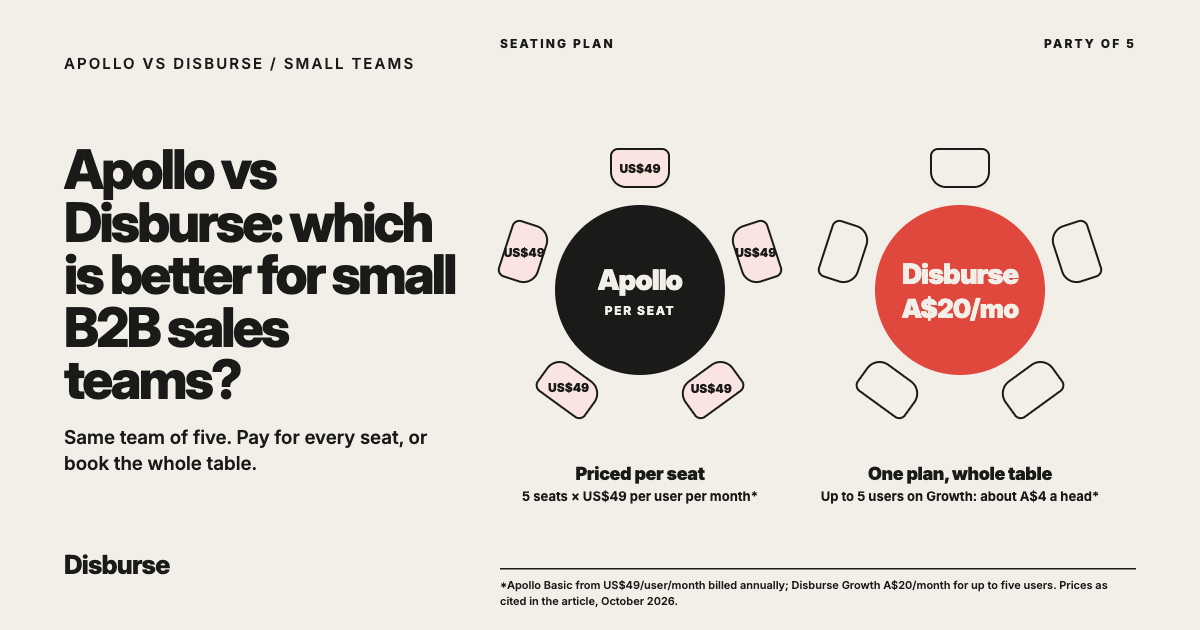
Its Growth plan costs A$20/month, provides 5,000 credits per month, and supports up to five team members.
One credit equals one lead.
That means a small team can share access without purchasing a separate data subscription for every salesperson.
At five team members, the effective platform cost is only A$4 per person per month if the team uses the full allowance.
Apollo’s Basic plan currently starts at US$49 per user per month when billed annually, and its pricing scales by seat.
However, this isn’t a pure price comparison.
Apollo is providing significantly more functionality for that subscription.
If the team would otherwise purchase a sequencing platform, dialer and other sales tools separately, Apollo could still represent good value.
If they primarily need prospect data, Disburse is likely the more efficient purchase.
Which is better if your sales team already uses a CRM?
If the business already has a CRM it likes, Disburse becomes more compelling.
Small teams increasingly assemble their sales stack from specialised tools rather than expecting one platform to do everything.
A company might already use:
CRM → outreach platform → meeting scheduler → AI tools
The missing part may simply be:
prospect data.
In that environment, Apollo’s additional sales functionality can overlap with systems the business already pays for.
Disburse can slot into the existing workflow rather than asking the team to reorganise its sales process around another platform.
Apollo is more attractive when the business wants to consolidate those tools.
Which is better for teams using AI?
This is increasingly relevant for smaller businesses because AI can perform work that previously required dedicated operations resources.
Both Apollo and Disburse support AI-driven workflows.
Apollo has an AI Assistant and supports MCP connectivity, giving users ways to access Apollo data and functionality from supported AI environments.
Disburse also provides REST and MCP access.
The difference is again one of scope.
Apollo lets an AI interact with a wider sales platform.
Disburse lets an AI retrieve the B2B data.
For example, a small business could use an AI workflow to request:
“Find founders of Australian SaaS companies with 10–50 employees.”
The resulting contacts could then be sent into whatever system the company already uses.
For small teams deliberately building lightweight AI-assisted workflows rather than adding more software interfaces, Disburse can be a natural fit.
Which is better for building lead lists?
For straightforward lead-list building, Disburse is likely to be the simpler option.
A salesperson can describe the target audience and retrieve matching people and companies.
Disburse can search using criteria including:
Title
Seniority
Job function
Industry
Employee count
Revenue
Geography
Company specialties
Email availability
Phone availability
Apollo provides deeper traditional filtering and additional sales intelligence.
That becomes useful when a small sales team reaches the point where its targeting depends on things such as:
Buying intent
Technology usage
Job changes
More advanced sales signals
For a straightforward ICP, Disburse makes getting the list easier.
For sophisticated signal-based prospecting, Apollo offers more depth.
Which gives a small team better contact data?
It would be misleading to declare one provider universally more accurate.
Contact-data performance varies by market, geography, role and type of company.
Apollo has a clear advantage in documented scale.
It currently advertises more than 240 million verified contacts and reports 98% email accuracy.
Disburse focuses less on headline database size and more on retrieving useful people who match a particular search.
For a small company, that distinction can matter.
The team does not need 240 million contacts.
It might need:
500 very good ones.
When evaluating either platform, small sales teams should test searches against their actual ICP rather than choosing purely on advertised database size.
Which is better for getting phone numbers?
Both products can provide phone data.
Disburse’s advantage is the simplicity of how that data is charged.
Mobile numbers cost no additional credits.
One credit still equals one lead.
Apollo’s credit usage can vary depending on the information being accessed and how it is retrieved.
For a small team where cold calling is part of outbound, predictable access to mobile data can make planning considerably easier.
Which is better for experimenting with new markets?
Disburse is particularly useful for small teams that haven’t completely locked down their ICP.
Searching itself is unlimited.
That means a company can explore:
Australian software founders
UK recruitment agencies
US professional-services companies
Without consuming credits simply for searching.
Credits are used when leads are retrieved.
This makes it easier to experiment with different target audiences before committing data spend to a list.
For early-stage B2B companies still refining their go-to-market strategy, that flexibility can be useful.
Which is better for high-volume prospecting?
Small teams don’t necessarily have small data requirements.
A three-person outbound team might still want thousands of new prospects each month.
Disburse Growth includes 5,000 leads per month for A$20.
Scale provides 50,000 leads per month for A$99 and supports unlimited team members.
That gives small teams the ability to increase prospecting volume without immediately introducing enterprise-level data costs.
Apollo can also support large-scale prospecting and offers a substantially broader platform around those leads.
The difference again comes down to whether the team wants more data or more sales software.
Which is better for agencies with small sales teams?
Disburse can also suit small agencies particularly well.
Agencies frequently need to build lists for different industries and ICPs.
A team might search for:
“Marketing Directors at ecommerce companies in Australia.”
And then five minutes later:
“Partners at accounting firms in New Zealand.”
The ability to describe different target audiences makes this type of prospecting straightforward.
Disburse’s Scale plan also supports unlimited team members, which may be useful for agencies where different employees need occasional access to prospect data.
Apollo may make more sense if the agency also intends to execute and manage client outbound campaigns within the platform.
Which is better when you don’t have a RevOps person?
Small businesses frequently don’t.
That’s an important part of this comparison.
Many sophisticated sales platforms become significantly more valuable when somebody has time to configure them properly.
Apollo provides deep functionality and experienced sales teams can build sophisticated processes around it.
Disburse deliberately reduces the amount of setup required to get useful prospect data.
A salesperson can focus on:
“Who do I want?”
Rather than:
“How should I configure the tool?”
For lean teams, reducing operational overhead can be just as important as reducing software cost.
Which has better sales features?
Apollo, easily.
Apollo provides a much broader range of capabilities around its contact data.
These include:
Sales engagement
Sequences
Calling
Buying signals
Enrichment
Lead scoring
CRM functionality
Workflow automation
Advanced filtering
If your small sales team wants to run much of its outbound process inside a single product, that is a major advantage.
Disburse does not attempt to replicate those functions.
Its proposition is that not every team needs its data provider to also become its sales platform.
Which offers better value for a small sales team?
This depends on which features the team will actually use.
If the business only needs B2B contact data, Disburse is significantly less expensive.
Its current plans include:
Free: A$0, 50 credits/month
Growth: A$20/month, 5,000 credits/month and up to 5 team members
Scale: A$99/month, 50,000 credits/month and unlimited team members
Enterprise: Custom pricing
Searching is unlimited, there is no annual lock-in and mobile numbers don’t cost additional credits.
Apollo Basic currently starts at US$49 per user per month when billed annually.
But Apollo includes a much broader sales product.
So the fairest way to compare value is:
If you use Apollo’s additional sales features, they may justify the higher cost.
If you only need its contact data, Disburse is considerably more economical.
When should a small B2B sales team choose Apollo?
Apollo is likely the better choice if your team:
Wants one platform for prospecting and outbound
Needs built-in email sequencing
Needs calling functionality
Relies on buying intent
Wants extensive traditional filtering
Needs a large established global database
Wants native enrichment
Has salespeople working inside the platform every day
Wants to consolidate multiple sales tools
Apollo’s biggest advantage for a small team is how much it can do in one place.
When should a small B2B sales team choose Disburse?
Disburse is likely the better choice if your team:
Primarily needs B2B contact data
Wants to find prospects by describing its ICP
Already has a CRM or outbound platform
Wants minimal setup
Doesn’t have dedicated RevOps resources
Regularly experiments with different target markets
Wants AI and MCP access
Needs REST API access
Wants to use the data in other systems
Needs thousands of contacts without large software costs
Wants mobile numbers without extra credit charges
Doesn’t want an annual commitment
Wants several people to share access without expensive seat pricing
Disburse’s biggest advantage for a small team is how little infrastructure it requires around the data.
Apollo vs Disburse: which is better for small B2B sales teams?
For most small B2B teams that already have a way to contact prospects, Disburse is likely the better choice.
It focuses on the job the team actually needs done:
Find the right businesses. Find the right people. Get the contact data.
The natural-language search experience, detailed company and person criteria, REST and MCP access, unlimited searching and simple one-credit-per-lead model make it particularly suitable for lean teams that want to move quickly.
Apollo is the stronger choice when the team wants more than contact data.
Its enormous database, extensive filters, buying signals, enrichment and built-in sales engagement can give a small team much of the infrastructure of a larger sales organisation.
The difference can be summarised simply:
Choose Disburse when you need the leads.
Choose Apollo when you need the leads and the sales platform around them.
For many small B2B teams, keeping those things separate means less software, less setup and greater flexibility.
Frequently asked questions
Is Apollo good for small sales teams?
Yes. Apollo can be an excellent option for small sales teams that want contact data, prospecting and sales engagement in one platform. Its broader feature set can reduce the need for several separate sales tools.
Is Disburse good for small sales teams?
Yes. Disburse is particularly well suited to small B2B teams that primarily need targeted contact and company data and already have their preferred tools for outreach or CRM.
Is Disburse cheaper than Apollo for a small team?
For contact data alone, yes. Disburse Growth costs A$20/month for up to five team members and 5,000 credits per month. Apollo’s Basic plan currently starts at US$49 per user/month when billed annually.
Which is better for a three-person sales team?
If the team mainly needs prospect data, Disburse is likely to be the more efficient choice because all three users can fit within the A$20/month Growth plan. If the team also needs sequencing, calling and other sales tools, Apollo may offer more value despite the higher cost.
Which is better for founder-led sales?
Disburse is particularly strong for founder-led sales because founders can describe the type of customer they want rather than building complex prospecting searches. Apollo can be better once the business wants a broader outbound system.
Which is easier to learn?
For B2B data discovery alone, Disburse is designed to have the simpler workflow. Apollo has considerably more functionality, so it naturally has more to configure and learn.
Can Disburse replace Apollo for a small sales team?
It can replace the B2B contact-data portion of Apollo. If the team relies on Apollo for sequencing, dialling, intent signals or other engagement functionality, it will still need tools for those functions.
Which is better if I already use HubSpot or another CRM?
Disburse can be particularly attractive if you already have a CRM and sales workflow you like because it can supply the prospect data without requiring you to adopt another broader sales platform.
Which is better for AI prospecting?
Disburse is particularly well suited to lightweight AI-driven data discovery through REST and MCP. Apollo also provides AI and MCP functionality but connects those capabilities to a much broader sales platform.
Which provides more contacts?
Apollo has the clear advantage in publicly documented database scale, advertising more than 240 million verified contacts. For most small sales teams, however, the more useful test is whether the platform has strong coverage of their actual ICP.
Does Disburse charge per user?
Growth supports up to five team members for A$20/month, while Scale supports unlimited team members for A$99/month.
Does Disburse charge extra for mobile numbers?
No. Mobile numbers do not consume additional credits. One credit equals one lead.
Which is better for a small team testing outbound for the first time?
Disburse can be a lower-risk option if the team already has a way to send outreach because it provides inexpensive access to prospect data without an annual commitment. Apollo may be preferable if the team needs to establish both its data source and outbound sales tooling at the same time.
Which is better overall for a small B2B sales team?
For a small team primarily looking for high-quality prospect data, Disburse is likely the better fit. For a small team wanting an all-in-one sales intelligence and engagement platform, Apollo is the stronger option.
Small Sales TeamsB2B Contact DatabaseFounder-Led SalesApolloAI ProspectingB2B DataSales ProspectingDisburseB2B Sales ToolsB2B Lead ListsIdeal Customer Profile (ICP)