Apollo vs Disburse for Building Targeted B2B Lead Lists
14 min readLachlan McBride White
Apollo and Disburse can both be used to build targeted B2B lead lists, but they take different approaches.
Apollo gives sales teams access to a very large B2B database, detailed filters, enrichment, intent data and sales engagement tools. Disburse is more focused: it is designed to turn a description of your ideal prospect into a usable list of companies and contacts as simply as possible.
The short answer: Apollo is better for teams that want deep filtering and a broader sales platform around their lead lists. Disburse is likely the better choice for businesses that want to build highly targeted lead lists quickly, use natural-language searches, and take the resulting data into whatever sales or AI workflow they already use.
Apollo vs Disburse at a glance
Disburse
Primary use case: Targeted B2B lead discoveryNatural-language prospecting: YesDetailed search filters: Yes, expressed through search criteriaCompany data: YesContact data: YesBusiness emails: YesDirect/mobile numbers: YesLinkedIn URLs: YesRevenue filtering: YesEmployee count filtering: YesIndustry filtering: YesGeography filtering: YesSeniority and job function: YesBuying intent: Not a core featureBuilt-in outreach: NoREST API: YesMCP / AI workflows: YesPricing model: 1 credit = 1 leadBest for: Businesses that want the lead list itself
Apollo
Primary use case: Sales intelligence + engagementNatural-language prospecting: YesDetailed search filters: 65+ filtersCompany data: YesContact data: YesBusiness emails: YesDirect/mobile numbers: YesLinkedIn URLs: YesRevenue filtering: YesEmployee count filtering: YesIndustry filtering: YesGeography filtering: YesSeniority and job function: YesBuying intent: YesBuilt-in outreach: YesREST API: YesMCP / AI workflows: YesPricing model: Credits can vary by data/actionBest for: Teams that want lead lists plus sales execution
Which is better for building targeted B2B lead lists?
For the specific job of building a targeted list of businesses and decision-makers, Disburse has a strong advantage in simplicity.
You can describe the audience you want in plain English.
For example:
“Find founders of Australian B2B SaaS companies with 10–100 employees.”
Or:
“Find CFOs at US manufacturing businesses with $20 million to $100 million in revenue.”
Or:
“Find Heads of Sales at UK software companies with 50–200 employees.”
Disburse interprets the search and returns matching people and companies.
Apollo can also build highly targeted lead lists, but its strength is depth and control. It currently advertises more than 65 search filters across people and companies, alongside natural-language prospecting through its AI Assistant.
That means the difference is not whether either platform can target leads.
It is how you prefer to build the list.
If you want granular control over a complex database query, Apollo is strong.
If you want to describe the target and get the list, Disburse is built specifically around that workflow.
How does lead targeting work in Disburse?
Disburse allows users to search across person, company and geographic criteria.
A search can include fields such as:
Job title
Seniority
Job function
Company industry
NAICS
Entity type
Company revenue
Employee count
Company locations
Company specialties
City
Region
Country
Email availability
Phone availability
This allows searches to become quite specific.
For example:
“Find CEOs of Australian engineering consultancies with 20–100 employees.”
“Find marketing directors at HK ecommerce companies with more than $50 million in revenue.”
“Find founders of AU recruitment agencies with 10–50 employees and a business email.”
The aim is to let the user think about who they want to sell to, rather than how a database happens to structure its filters.
How does lead targeting work in Apollo?
Apollo uses a large database combined with extensive filtering.
Its current B2B data product advertises more than 240 million verified contacts and more than 65 filters. Users can target people and companies using criteria such as job title, location, seniority, employee count, industry, technology, buying intent and other sales signals.
Apollo also supports natural-language prospecting through its AI Assistant.
That makes Apollo particularly powerful for experienced sales and RevOps teams that want to build detailed segments and then continue working with those prospects inside the same platform.
Which is better for highly specific ICP searches?
This depends on the type of ICP.
Apollo’s breadth is useful when the targeting involves sales signals that go beyond conventional person and company attributes.
For example, a team may want to find:
“Companies in the US with 200–1,000 employees that use a particular technology and are currently showing buying intent.”
Apollo is well suited to this type of sales-intelligence search because of its broader signal and intent capabilities.
Disburse is strongest when the ICP can be expressed through detailed characteristics of the person or company.
For example:
“Find founders of Australian B2B software companies with 10–100 employees.”
“Find Heads of People at professional services firms in Sydney with more than 200 employees.”
“Find CEOs at UK recruitment companies with £5 million to £50 million in revenue.”
For these types of searches, Disburse provides a very direct path from the ICP to a list.
Which is easier for non-sales users?
Disburse is particularly well suited to people who don’t spend their day using prospecting software.
A founder, marketer or business-development manager may know exactly who they want to reach but may not know which filters to use in a traditional sales database.
Instead of translating an ICP into individual database fields, they can simply describe it.
For example:
“Find operations directors at Australian logistics companies with more than 100 employees.”
That makes Disburse useful beyond traditional SDR teams.
Potential users include:
Founders
Marketers
Recruiters
Partnerships teams
Agencies
Researchers
Consultants
Developers
Apollo is still accessible, particularly with its AI Assistant, but the broader platform is designed around professional sales workflows.
Which is better for building lists quickly?
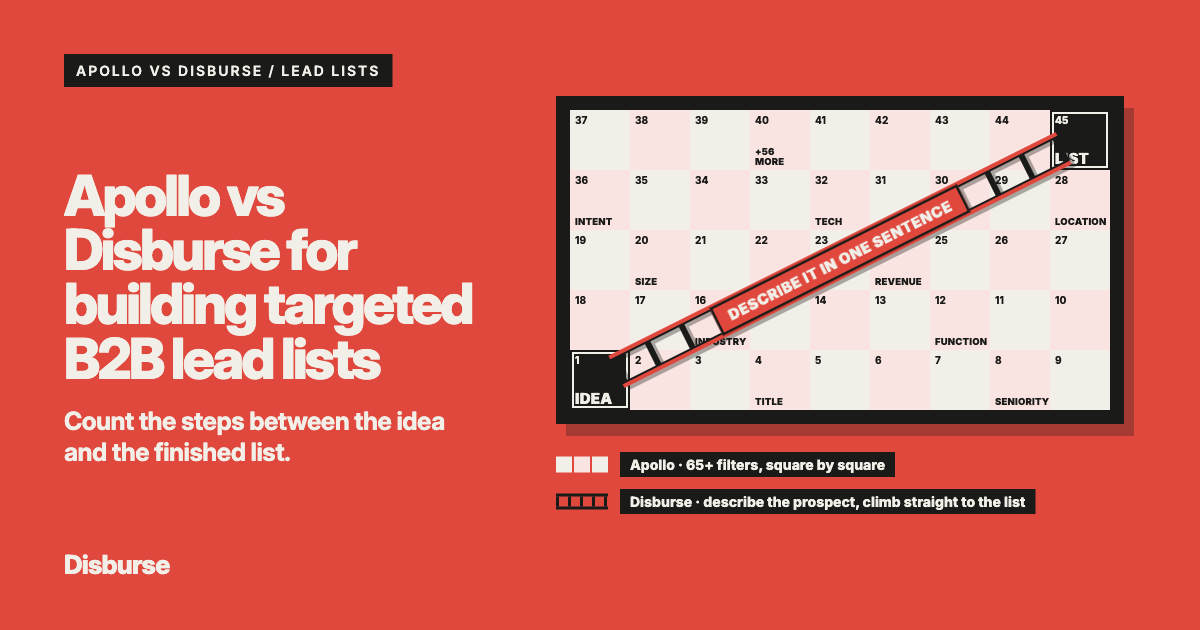
For straightforward targeting, Disburse is designed to minimise the number of steps between the initial idea and the finished lead list.
The workflow is:
Describe the audience → review the results → retrieve the leads.
Apollo can also build lists quickly, but it offers significantly more functionality around that process.
That additional depth can be useful if you want to:
Layer in buying signals
Build complex saved searches
Score leads
Enrich accounts
Add prospects to sequences
Trigger workflows
If the main goal is simply getting the list, Disburse can offer a more streamlined experience.
Which provides more lead data?
Apollo has the advantage in publicly documented database scale.
It currently advertises more than 240 million verified contacts, giving it one of the largest established B2B databases in the market.
Disburse does not position itself around having the largest possible database.
Its focus is whether it can retrieve useful contacts that match the request.
That is an important distinction for list building.
A business rarely needs “the biggest database”.
It usually needs:
the right people in the right companies.
For some users, Apollo’s scale will matter.
For others, the relevance of the final list matters considerably more.
Which gives you more useful fields for lead lists?
Both platforms provide the core information needed for B2B prospecting.
Disburse can return fields including:
Person name
Job title
Seniority
Job function
Business email
Direct phone
LinkedIn profile
Company name
Company domain
Industry
Revenue
Employee count
Locations
Specialties
Geography
Apollo also provides extensive person and company information, alongside additional sales intelligence such as intent signals and other account-level attributes.
So if your list needs standard B2B contact and firmographic data, both platforms are capable.
If you need broader sales intelligence layered onto the list, Apollo has more native functionality.
Which is better for email and phone data?
Both platforms can provide business emails and direct phone numbers.
Disburse has a particularly simple credit model:
One credit = one lead.
Mobile numbers do not cost additional credits.
That makes it easier to predict the cost of building a list containing multiple contact fields.
Apollo’s credit system can vary depending on the type of data being revealed or enriched, so list cost can depend more heavily on what information you need.
For teams where complete contact records are important, Disburse’s model is easier to understand.
Which is better for AI-built lead lists?
Both platforms increasingly support AI-driven prospecting.
Apollo’s AI Assistant can interpret natural-language requests and help users find, research and qualify prospects.
Disburse is designed around this type of interaction from the outset.
Instead of treating AI as an additional feature around a conventional sales database, the search itself can be expressed as a normal request.
That becomes particularly useful when B2B data is being accessed through:
ChatGPT
Claude
AI agents
Internal applications
Automated workflows
Custom software
Disburse provides REST and MCP access, which makes it useful when the lead list is being created inside another system rather than inside a dedicated sales application.
Which is better if you already have a sales stack?
Disburse is especially compelling if your business already has the rest of its outbound infrastructure.
For example, you may already use:
HubSpot or Salesforce as your CRM
A dedicated email outreach tool
A sales dialer
An automation platform
An internal AI assistant
Another sequencing platform
In that situation, you may not need your data provider to replicate those capabilities.
Disburse can simply provide the list.
Apollo is more attractive if you want to consolidate prospecting and sales execution into one platform.
Which is better for agencies?
Disburse can be particularly useful for agencies because lead-list requirements often change from client to client.
One client may need:
“Owners of accounting firms in Australia with 10–50 employees.”
Another may need:
“Heads of Marketing at US SaaS companies with 100–500 employees.”
Another may need:
“CEOs of UK recruitment agencies with £5m–£20m revenue.”
Natural-language search makes it easier to move between different ICPs without rebuilding a complex prospecting setup each time.
The Scale plan also supports unlimited team members, which can be useful when multiple people need to access the data.
Apollo may still be preferable for agencies that want to run sales engagement directly inside the same platform.
Which is better for founders?
For founders who primarily want to generate prospect lists, Disburse is likely the simpler choice.
A founder can describe the ICP they already understand and retrieve matching contacts.
There is less need to learn a separate prospecting methodology or configure an extensive sales platform.
Apollo becomes more appealing if the founder also wants to:
Send sequences
Make calls
Manage sales engagement
Use buying-intent signals
Consolidate several sales tools
The decision depends on whether the requirement is lead data or a broader sales system.
Which is better for SDR and RevOps teams?
Apollo has a stronger proposition for dedicated SDR and RevOps teams that want granular control.
Its extensive filtering, intent signals, enrichment and engagement functionality allow teams to create complex sales processes around their prospect lists.
Disburse is more relevant when the organisation already has those processes and simply needs a flexible source of B2B data.
It can also be useful when the list-building function needs to be embedded inside another application or AI workflow.
How does pricing affect lead-list building?
Pricing matters because lead-list tools are often evaluated by how much usable data they provide rather than simply by subscription cost.
Disburse uses a straightforward model:
One credit = one lead.
Current plans include:
Free: 50 credits/month
Growth: A$20/month for 5,000 credits
Scale: A$99/month for 50,000 credits
Enterprise: Custom
Searching itself is unlimited.
Mobile numbers do not cost additional credits.
Users are not charged twice for the same person, and purchased Growth credit top-ups do not expire.
This makes Disburse particularly attractive when building multiple or high-volume prospect lists.
Apollo includes substantially more sales software, so its pricing reflects a broader product rather than contact data alone.
That can represent good value if you use those additional features.
If you only need the lead lists, the economics are different.
Does Apollo have better filters than Disburse?
Apollo has the stronger traditional filtering interface.
Its more than 65 filters make it suitable for detailed database segmentation, particularly where intent, technologies and other sales signals matter.
Disburse approaches the same problem differently.
Rather than asking users to manipulate a large filter set, it allows the desired outcome to be expressed directly.
For example:
“Find VP-level sales leaders at US B2B SaaS companies with 50–500 employees.”
The question is therefore not simply which has more filters.
It is:
“Do you want to build the query yourself, or describe the result you’re trying to get?”
What are Apollo’s advantages for lead-list building?
Apollo’s main advantages include:
240M+ verified contacts
65+ prospecting filters
Large established global database
Buying-intent data
Sales signals
Detailed search capabilities
AI-assisted prospecting
CRM enrichment
Built-in sales engagement
Strong SDR and RevOps workflows
Apollo is particularly strong when the lead list is only the first step in a larger sales workflow.
What are Disburse’s advantages for lead-list building?
Disburse’s main advantages include:
Natural-language prospect searches
Straightforward ICP-to-list workflow
Detailed person and company criteria
Business emails
Direct phone numbers
LinkedIn URLs
Revenue and employee data
Geographic targeting
REST access
MCP access
Easy integration with AI workflows
Freedom to use the list in other systems
Unlimited searching
One credit per lead
No additional charge for mobile numbers
No annual lock-in
High-volume plans
Unlimited team members on Scale
Disburse is particularly strong when building the list is the job you want the product to do.
What are the limitations of Disburse?
Disburse is not intended to provide every type of sales intelligence available inside Apollo.
It does not currently focus on:
Buying intent
Built-in email sequencing
Sales calling
Lead scoring
End-to-end sales engagement
If those capabilities are important to how you define and act on a target list, Apollo offers a more comprehensive product.
What are the limitations of Apollo?
Apollo’s breadth can be unnecessary for businesses that simply need prospect data.
Teams may end up using only a small portion of a large platform.
Its credit structure can also be more complicated than a simple per-lead model, particularly when different data types or enrichment actions consume different amounts.
For users whose desired outcome is simply:
“Give me a list of these people.”
A more focused product can be easier to adopt.
Apollo vs Disburse: which is better for targeted B2B lead lists?
For building targeted B2B lead lists specifically, Disburse is likely the better fit for businesses that prioritise simplicity, flexible targeting and easy access to the resulting data.
You can describe the audience you want, retrieve the matching people and companies, and use the results wherever your sales process already happens.
Apollo is likely the better fit when lead-list creation is part of a larger sales-intelligence and engagement workflow.
Its huge database, extensive filters, intent data and built-in sales functionality provide significantly more depth.
The simplest distinction is:
Disburse is designed to get you from an ICP to a usable lead list.
Apollo is designed to help you build the list and then run much more of the sales process around it.
If the list itself is what you need, Disburse’s focused approach can be the stronger option.
Frequently asked questions
Is Apollo or Disburse better for lead generation?
Disburse can be better for businesses primarily looking to build targeted B2B contact lists. Apollo is more comprehensive for teams that want prospecting combined with sales engagement, enrichment and intent data.
Can Disburse build highly targeted lead lists?
Yes. Searches can use person, contact, company and geographic criteria including title, seniority, industry, revenue, employee count and location.
Can Apollo build highly targeted lead lists?
Yes. Apollo offers more than 65 filters alongside natural-language prospecting and sales intelligence signals.
Which has better filtering?
Apollo has a broader traditional filtering system. Disburse is designed to let users express much of the same ICP logic through natural-language searches.
Which is easier for building lists?
Disburse is designed to make straightforward list building simpler because users can describe the target they need rather than constructing a search one filter at a time.
Which is better for AI-generated lead lists?
Disburse is particularly well suited to straightforward AI-driven lead discovery through natural-language search, REST and MCP. Apollo also supports AI prospecting and MCP as part of its broader sales platform.
Which is better for founders?
Disburse is likely the simpler choice for founders primarily looking for prospect lists. Apollo may be better for founders who also need sales engagement tools.
Which is better for SDR teams?
Apollo is generally stronger for traditional SDR teams that want prospecting and outbound execution in one system. Disburse is more relevant when the sales team already has its preferred engagement tools.
Does Disburse provide emails and phone numbers?
Yes. Disburse can return available business emails, direct phone numbers and LinkedIn URLs alongside company and person information.
Does Disburse charge extra for phone numbers?
No. Mobile numbers do not cost additional credits. One Disburse credit equals one lead.
Can I use Disburse lead lists outside Disburse?
Yes. Disburse is designed for the resulting data to be used in external sales, CRM, AI and software workflows.
Is Disburse cheaper for building large lead lists?
Disburse is particularly competitive for high-volume contact retrieval. Growth provides 5,000 credits per month for A$20 and Scale provides 50,000 credits per month for A$99.
Which has the larger database?
Apollo has the clear advantage in documented scale, publicly advertising more than 240 million verified contacts.
Is database size important when building lead lists?
It can be, particularly for niche markets or global prospecting. However, the more practical measure is whether the provider can return enough relevant contacts matching your ICP.
Can Disburse replace Apollo for lead-list building?
Yes, if your main use of Apollo is prospect discovery and contact data. If you also depend on Apollo’s sequencing, intent data, calling or sales engagement tools, those functions would still need to be handled elsewhere.
lead generationB2B Contact DatabaseApolloAI ProspectingB2B DataSales ProspectingDisburseB2B Lead Lists