Apollo vs Disburse: Database Filters vs Natural-Language B2B Search
17 min readLachlan McBride White
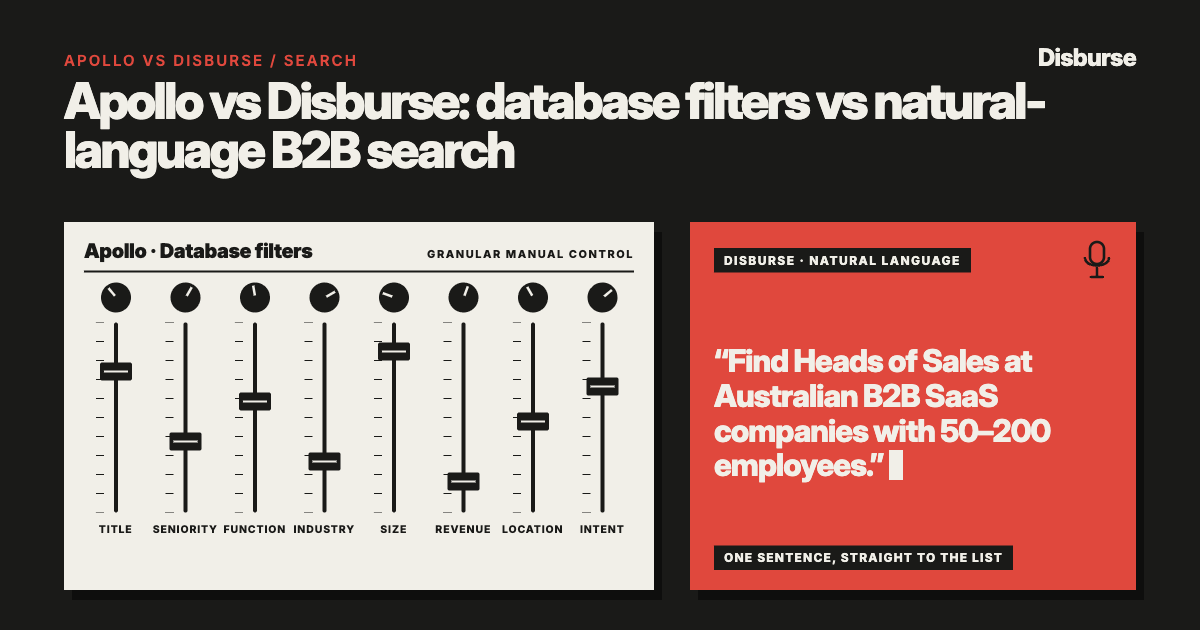
Finding B2B prospects has traditionally meant opening a database and applying filters for things like job title, industry, company size, revenue and location.
Apollo is very good at this. It offers an extensive set of search filters that gives sales teams granular control over who appears in their prospect lists.
Disburse approaches the same problem differently.
Instead of requiring users to construct the search one filter at a time, Disburse lets them describe the companies and people they want to find in natural language.
For example:
“Find Heads of Sales at Australian B2B SaaS companies with 50–200 employees.”
The difference is therefore less about what you’re searching for and more about how you search for it.
The short answer: Apollo is stronger for sales teams that want extensive manual control over database filters, particularly when targeting based on sales signals, technologies or intent. Disburse is likely the better option for businesses that want to describe their ideal prospect naturally and get straight to a targeted B2B contact list.
Apollo vs Disburse search at a glance
Disburse
Core search experience: Natural-language B2B searchNatural-language search: YesTraditional filter interface: Not the core experienceJob title targeting: YesSeniority targeting: YesJob function targeting: YesIndustry targeting: YesEmployee count: YesRevenue: YesGeography: YesCompany specialties: YesNAICS: YesEmail availability: YesPhone availability: YesTechnology filters: Not a core search fieldBuying intent: NoJob-posting filters: Not a core search fieldSales signals: NoBest for: Turning an ICP description into a contact list
Apollo
Core search experience: Database filters + AI searchNatural-language search: YesTraditional filter interface: ExtensiveJob title targeting: YesSeniority targeting: YesJob function targeting: YesIndustry targeting: YesEmployee count: YesRevenue: YesGeography: YesCompany specialties: Keywords and industry filtersNAICS: YesEmail availability: YesPhone availability: YesTechnology filters: YesBuying intent: YesJob-posting filters: YesSales signals: YesBest for: Detailed sales-database segmentation
How does Disburse search work?
Disburse is designed around a straightforward idea:
Tell it who you want to find.
A user can describe their target market in normal language rather than translating it into a sequence of database filters.
For example:
“Find founders of Australian B2B SaaS companies with 10–100 employees.”
Or:
“Find CFOs at New Zealand manufacturing companies with more than 100 employees.”
Or:
“Find Heads of Marketing at Singaporean software companies with 50–500 employees.”
Or:
“Find senior HR decision-makers at Australian professional services firms with more than 200 employees.”
Disburse interprets the request and returns matching people and companies.
The user can search using criteria across person, contact, company and geography data.
These include:
Name
Job title
Seniority
Job function
Email availability
Phone availability
Company name
Company domain
Industry
NAICS
Entity type
Revenue
Employee count
Company location
Company specialties
City
Region
Country
The user thinks about the business outcome rather than the structure of the database.
How does Apollo search work?
Apollo is built around an extensive B2B search and filtering system.
Users can search for people or companies and combine criteria to narrow the results.
Apollo currently supports filters across areas including:
Job titles
Seniority and job function
Company size
Industry and keywords
Location
Revenue
SIC and NAICS
Technologies
Funding
Headcount growth
Job postings
Buying intent
Job changes
Website visitors
Market segments
Company and people lookalikes
Sales signals
Apollo uses AND logic across different filters and OR logic within individual filters, allowing experienced users to build quite sophisticated prospect queries.
This level of control is one of Apollo’s strongest advantages.
Does Apollo also have natural-language search?
Yes.
This is an important distinction when comparing the two platforms in 2026.
Apollo is no longer limited to manually clicking database filters.
Its AI Assistant can interpret plain-language requests and search for people or companies without requiring users to configure every filter themselves.
That means you could give Apollo a request such as:
“Find sales leaders at SaaS companies in Australia with 50–200 employees.”
And use AI to help construct the search.
So it would be inaccurate to describe the comparison as:
Apollo = filters
versus
Disburse = natural language.
A more accurate distinction is:
Apollo is a sophisticated filtered sales database that also supports natural-language search.
Disburse is a B2B data product designed around natural-language discovery as the primary experience.
That difference becomes more meaningful when deciding which product better matches the way your team wants to prospect.
What is wrong with traditional B2B database filters?
Nothing, necessarily.
Filters are extremely useful.
If you know exactly which attributes matter and understand how the database structures its information, filters provide precise control over a search.
The challenge is that your ideal customer profile doesn’t always naturally exist as a set of dropdown boxes.
A founder might describe their ICP as:
“Growing Australian software companies selling to enterprises where the founder still leads sales.”
A recruiter might say:
“Mid-sized engineering consultancies across Australia and New Zealand where I need the person responsible for hiring engineers.”
A salesperson might say:
“Singapore-based fintech companies where I want the most senior sales decision-maker.”
Humans naturally describe prospects in terms of who they are looking for.
Traditional prospecting databases require users to translate that idea into the particular fields and filters supported by the platform.
Natural-language search attempts to remove that translation step.
What is the advantage of natural-language B2B search?
The biggest advantage is accessibility.
You don’t need to be an experienced SDR or RevOps specialist to describe your ideal customer.
A founder can know:
“We sell to Australian recruitment agencies with 10–50 employees.”
A salesperson can know:
“Our buyer is usually the Head of Operations at logistics companies.”
A marketer can know:
“We want CFOs at mid-market businesses in Singapore.”
Those are already useful search instructions.
Disburse is designed to turn those instructions directly into prospect discovery.
This can make B2B data more accessible to:
Founders
Small sales teams
Marketers
Recruiters
Agencies
Consultants
Partnerships teams
Developers
AI agents
The user doesn’t have to learn how the database thinks before they can ask for what they want.
What is the advantage of Apollo’s database filters?
Control.
Apollo’s filtering system is considerably broader than the core searchable fields available in Disburse.
For example, Apollo can filter based on criteria such as:
Buying intent
Technologies
Funding
Job postings
Headcount growth
Job changes
Website visitors
This can enable searches such as:
“Find Australian software companies with 100–500 employees that use Salesforce and are currently hiring salespeople.”
That type of search goes beyond standard firmographic and contact data.
Apollo also supports Boolean logic for certain searches, exclusions, saved personas, lookalikes and combinations of person and company criteria.
For experienced SDR and RevOps teams building sophisticated prospecting strategies, that depth is valuable.
Which is better for defining an ICP?
For many businesses, Disburse provides the more intuitive starting point.
An ICP usually begins as a sentence, not a collection of database filters.
For example:
“Australian accounting firms with 20–100 employees. We sell to the managing partner.”
In Disburse, that description is already close to the search itself.
With a conventional database workflow, the same idea might need to be translated into:
Country: Australia
Industry: Accounting
Employees: 20–100
Seniority: Owner / Partner
Title: Managing Partner / Partner / Founder
Neither approach necessarily produces a better result simply because of how the query is entered.
But natural language reduces the distance between thinking about your ICP and searching for it.
Which is better for complicated searches?
It depends on what makes the search complicated.
If the complexity comes from combining standard B2B characteristics, Disburse can make the request easier to express.
For example:
“Find founders and CEOs at B2B software companies headquartered in Australia or Singapore, with 20–200 employees and more than A$5 million in revenue.”
That is a relatively complicated filter combination, but it is easy to describe.
If the complexity depends on specialist sales-intelligence signals, Apollo is stronger.
For example, searches involving:
Technology usage
Buying intent
Website visitors
Job changes
Funding
Job postings
Headcount growth
Are areas where Apollo’s deeper filter set becomes valuable.
Which is faster for building a prospect list?
For a straightforward ICP search, Disburse is designed to minimise the steps between the idea and the list.
The workflow is essentially:
Describe the ICP → search → retrieve the contacts.
That can be particularly useful when you’re regularly switching between audiences.
An Australian agency, for example, might search:
“Founders of Australian SaaS companies with 20–100 employees.”
Then:
“Marketing Directors at Singaporean ecommerce businesses with 100–500 employees.”
Then:
“Managing Directors at New Zealand engineering consultancies with 20–200 employees.”
The user doesn’t have to rebuild their mental model around a different combination of filters each time.
Apollo can also make this faster through its AI Assistant and saved personas, so the difference becomes smaller for users who have already configured their Apollo environment.
Which is better for APAC prospecting?
For APAC businesses, the search experience can be particularly important because targeting often spans several very different markets.
A team may simultaneously prospect across:
Australia
New Zealand
Singapore
Hong Kong
Japan
Malaysia
Indonesia
The Philippines
Other Asia-Pacific markets
Natural language makes it easy to express those differences.
For example:
“Find founders of B2B SaaS companies in Australia, New Zealand and Singapore with 10–100 employees.”
Or:
“Find senior sales leaders at fintech companies headquartered in Singapore and Hong Kong.”
Or:
“Find CEOs of Australian and New Zealand recruitment agencies with 20–100 employees.”
Disburse’s search experience is particularly useful when the goal is quickly building different prospect segments across APAC without having to configure each market manually.
Apollo also supports international location filtering and can combine a person’s location with their employer’s location, making it a strong option for teams that need detailed geographic control.
Which is better for founders?
Natural-language search is particularly useful for founder-led sales.
Founders often understand their market extremely well but aren’t necessarily professional sales-operations users.
A founder might know:
“Our best customers are Australian professional-services firms with 20–100 employees, and the founder or managing director normally buys.”
That is enough information to begin a Disburse search.
The founder doesn’t need to know which database filters, Boolean operators or persona configuration will best represent the ICP.
Apollo’s AI Assistant has significantly reduced this problem within Apollo too.
But Apollo still offers a much broader sales environment around the search.
If the founder primarily needs the contacts, Disburse provides a more focused experience.
If they want to build an outbound sales system around those contacts, Apollo provides considerably more functionality.
Which is better for SDR and RevOps teams?
Apollo has a stronger case for sophisticated SDR and RevOps teams.
These users may actually want the filters.
A RevOps manager might want precise control over:
Inclusions and exclusions
Territories
Technologies
Buying signals
CRM status
Existing sequences
Account engagement
Website visitors
Job changes
Apollo’s filter system can incorporate many of these variables into prospecting.
Disburse is better suited when the objective is primarily to retrieve the companies and contacts matching a defined ICP rather than manage the wider sales context around those records.
Which is better for agencies?
Disburse can be particularly useful for agencies because agencies often switch ICPs constantly.
One client may sell to:
“Australian construction companies with 50–200 employees.”
Another may target:
“Singaporean fintech companies with 20–100 employees.”
Another may need:
“New Zealand professional-services firms with more than A$10 million in revenue.”
Natural-language search makes moving between those audiences straightforward.
Instead of building and maintaining a complex prospecting setup for every client, the target can simply be described.
Apollo may be more attractive to agencies that also want to manage outbound sequences and other sales execution inside the same platform.
Which is better for recruiters?
The same principle applies to recruiting.
A recruiter may want:
“Engineering managers at Australian mining companies with more than 500 employees.”
Or:
“Senior software engineers at SaaS companies in Sydney and Melbourne.”
Or:
“CFOs at New Zealand manufacturing companies with 100–500 employees.”
A natural-language interface allows the recruiter to describe the target audience without needing to think like a database administrator.
Apollo’s deeper filters can be useful when more specialised criteria are required.
Which is better for AI agents and automated workflows?
Natural-language B2B search becomes especially interesting when the user isn’t a person.
An AI agent doesn’t necessarily need a graphical database interface.
It needs a way to express what data it requires and receive structured information back.
Disburse provides REST and MCP access, making its B2B data usable inside:
AI assistants
Agents
Internal applications
Automated workflows
Custom sales software
This allows an AI workflow to request a target audience and use the returned data elsewhere.
Apollo also offers API and MCP access, giving developers and AI agents access to its broader sales ecosystem.
The distinction is therefore similar to the human experience:
Disburse provides a focused interface to B2B data.
Apollo provides access to a much broader sales platform.
Can natural-language search replace filters entirely?
Not always.
Filters remain valuable when precision and repeatability are more important than simplicity.
A RevOps team running the same carefully defined segment every week may prefer a saved, structured filter set.
Natural language is particularly useful when:
Searches change frequently
The user isn’t a sales-data specialist
The ICP is easier to describe than configure
Prospecting happens through an AI assistant
Teams experiment with new markets
Different users need to access the same data without training
The strongest prospecting products increasingly support both approaches.
Apollo has moved in this direction by adding natural-language AI search alongside its extensive filters.
Disburse approaches the problem from the opposite direction: natural-language discovery is the starting point rather than an additional interface on top of a traditional sales platform.
Does natural-language search produce better leads?
Not automatically.
The quality of a lead depends on the underlying data and how well the search represents the actual ICP.
Natural language does not magically make poor targeting good.
Its advantage is that it can make good targeting easier to express.
If a business has a well-defined ICP, reducing the friction involved in translating that ICP into database parameters can make prospecting faster and more accessible.
The quality of the final results should still be evaluated against the business’s actual target market.
Which approach is more flexible?
Apollo provides more flexibility within the search itself because its filter library extends into intent, technologies, sales activity and other signals.
Disburse provides flexibility in how the search is expressed and where the resulting data is used.
The data can be retrieved and taken into the business’s existing:
CRM
Outbound platform
AI workflow
Internal system
Application
Automation
So there are two different types of flexibility.
Apollo: greater control over a large number of search and sales-intelligence variables.
Disburse: greater simplicity in asking for standard B2B person and company data and using it elsewhere.
Is natural-language B2B search easier to learn?
Generally, yes.
There is very little new syntax to learn when the interface is normal language.
If you can describe your ideal customer to another person, you can describe it to the search.
For example:
“Find founders of Australian cybersecurity companies with 10–100 employees.”
The user doesn’t need to know where the industry filter is, how the employee ranges work or which seniority level maps most closely to founder.
This can reduce the learning curve for people who only use prospecting tools occasionally.
Apollo’s AI Assistant also addresses much of this learning curve, but users who want to take full advantage of Apollo’s deeper targeting capabilities still benefit from understanding its filtering system.
Does Disburse still use structured data?
Yes.
Natural-language search does not mean the results are unstructured.
The request can be natural language while the resulting data remains structured and usable.
Disburse can return fields such as:
Person
Name
Title
Seniority
Job function
Contact
Business email
LinkedIn URL
Direct phone
Company
Company name
Domain
Industry
NAICS
Entity type
Revenue
Employees
Locations
Specialties
Geography
City
Region
Country
This distinction is important.
Natural language is the way you ask for the data. Structured records are what you get back.
That makes the results suitable for sales tools, spreadsheets, CRMs, APIs and automated workflows.
Does pricing change the comparison?
It can, particularly for businesses that want to experiment with many searches.
Disburse allows unlimited searching.
Credits are used when leads are retrieved rather than every time a user experiments with a search.
Its model is:
One credit = one lead.
Current plans include:
Free: 50 credits/month
Growth: A$20/month for 5,000 credits
Scale: A$99/month for 50,000 credits
Enterprise: Custom
Mobile numbers don’t cost additional credits, there is no annual lock-in, and Growth credit top-ups never expire.
That makes it relatively low-risk to experiment with different ICPs and APAC markets.
Apollo’s pricing reflects a much broader sales product, so businesses should consider whether they want only the prospecting data or the additional sales functionality as well.
When are Apollo’s filters better?
Apollo’s approach is likely better when:
You have experienced SDR or RevOps users
You want precise manual control
Targeting relies on buying intent
Technology usage matters
You want job-posting signals
Website visitor data matters
Job changes are part of your targeting
You need sophisticated exclusions
You want sales activity included in prospecting logic
Prospecting feeds directly into Apollo engagement workflows
Apollo’s filter depth is a genuine strength.
When is Disburse’s natural-language search better?
Disburse is likely better when:
You can clearly describe your ICP
You want to get from idea to list quickly
Users aren’t prospecting-software experts
Your target audience changes regularly
You’re testing different APAC markets
You want B2B data inside AI workflows
You need REST or MCP access
You already have a preferred sales stack
You want the data without a broader sales platform
Simplicity matters more than having the largest number of filters
Disburse’s advantage is not that filters are bad.
It is that many users shouldn’t need to think in filters in the first place.
Apollo vs Disburse: which search approach is better?
Neither approach is universally better.
Apollo is stronger when prospecting requires deep, granular control across a large number of database and sales-intelligence variables.
Its extensive filters make it particularly powerful for experienced SDR and RevOps teams building sophisticated prospect segments.
Disburse is stronger when the user already knows who they want and wants the shortest path from that idea to usable B2B data.
Instead of learning how a database represents your ICP, you describe the ICP directly.
The simplest way to understand the difference is:
Apollo asks: Which filters should we apply?
Disburse asks: Who are you looking for?
Apollo can now answer that second question through AI as well, which makes the comparison closer than it once was.
But for Disburse, that isn’t an additional way to use the product.
It’s the product’s starting point.
For founders, small sales teams, agencies and AI-driven businesses, particularly those prospecting across APAC, that can make B2B data discovery considerably simpler.
Frequently asked questions
Does Apollo use database filters?
Yes. Apollo has an extensive filtering system covering person, company, sales and intent criteria including title, seniority, industry, company size, revenue, technology, buying intent, job postings and other attributes.
Does Apollo support natural-language search?
Yes. Apollo’s AI Assistant allows users to search for people and companies using plain natural language without manually selecting every filter.
Does Disburse support natural-language B2B search?
Yes. Natural-language prospect discovery is a core part of Disburse. Users describe the companies and people they want and Disburse turns the request into a structured B2B search.
Is natural-language prospecting better than filters?
It depends on the use case. Natural language is generally simpler and more accessible. Filters can provide greater manual control for sophisticated prospecting strategies.
Which is easier to use, Apollo or Disburse?
For straightforward B2B contact discovery, Disburse is designed to be simpler. Apollo provides substantially deeper search and sales functionality, which can be valuable for experienced sales teams.
Which is better for highly targeted searches?
Both can create highly targeted searches. Disburse is strong when targeting can be described through person, company and geographic attributes. Apollo is stronger when targeting requires additional sales intelligence such as buying intent, technologies, job changes or website activity.
Which is better for APAC prospecting?
Both platforms can be used for APAC prospecting. Disburse is particularly useful for teams that want to quickly express different ICPs across Australia, New Zealand, Singapore and other APAC markets in natural language. The actual data coverage should be tested against the specific countries and industries being targeted.
Which is better for founders?
Disburse is particularly well suited to founders who understand their ICP but don’t want to learn a sophisticated prospecting platform. Apollo may be better for founders who also want a broader set of sales engagement tools.
Which is better for RevOps teams?
Apollo is generally stronger for RevOps teams that need granular control over filters, sales signals, intent and existing sales activity. Disburse is more focused on retrieving the underlying B2B contact and company data.
Can I search Disburse by revenue and employee count?
Yes. Company revenue and employee count are among the searchable company fields available in Disburse.
Can Disburse find emails and phone numbers?
Yes. Disburse can return available business emails, direct phone numbers and LinkedIn URLs alongside person and company data.
Can Disburse work with AI agents?
Yes. Disburse provides REST and MCP access, allowing B2B data retrieval to be incorporated into AI agents and automated workflows.
Is Disburse an Apollo alternative?
Yes. Disburse is particularly relevant as an Apollo alternative for businesses that primarily want B2B contact and company data rather than Apollo’s broader sales intelligence and engagement platform.
What is the biggest difference between Apollo and Disburse search?
Apollo provides a highly configurable sales database with extensive filters and an AI interface for natural-language search. Disburse makes natural-language B2B data discovery the core experience, with the goal of reducing the steps between describing an ICP and retrieving the relevant contacts.
APAC ProspectingB2B Contact DatabaseApolloAI ProspectingNatural-Language SearchB2B DataDisburseB2B Lead ListsIdeal Customer Profile (ICP)